What Makes the Sweet Tooth Comic So Unforgettable?
What Makes the Sweet Tooth Comic So Unforgettable?
You heard about the Netflix show. Maybe you watched it. But something felt different — deeper, darker, more unsettling — and someone told you it came from a comic. Now you want to know what the original sweet tooth comic actually looks like, how it ends, and whether it is worth reading. It is. And once you understand the full scope of Jeff Lemire’s original story, the Netflix version will feel like a gentle echo of something far more powerful.
What Is the Sweet Tooth Comic and Where Did It Come From?
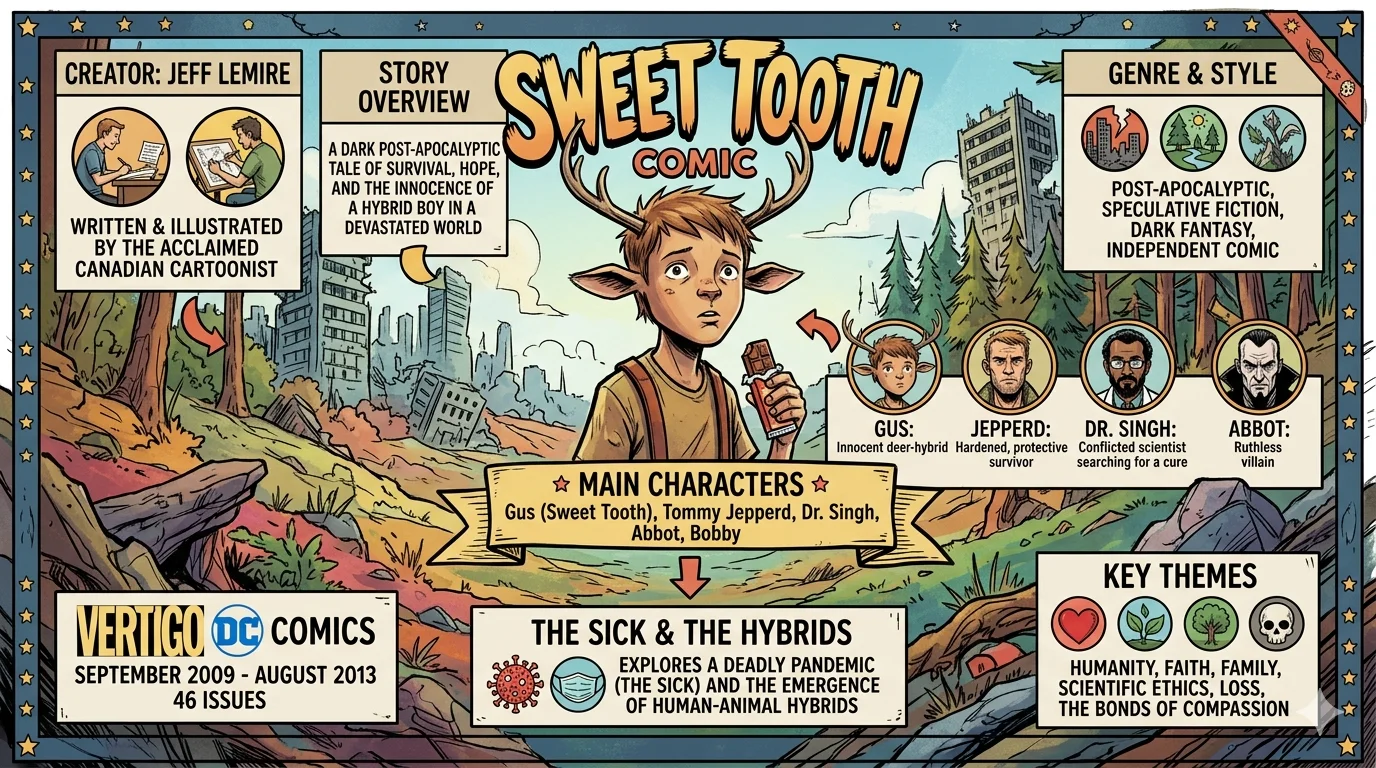
The sweet tooth comic is a post-apocalyptic graphic novel series written and illustrated by Jeff Lemire, published under DC Comics’ Vertigo imprint. It ran from 2009 to 2013, spanning 40 issues collected into six volumes. The story takes place in a world devastated by a mysterious plague called the Affliction, where all new children are born as human-animal hybrids. Normal human births have stopped entirely.
Vertigo was DC’s mature-readers label — the same home that gave readers Preacher, Sandman, and Y: The Last Man. Publishing the sweet tooth comic under that banner gave Lemire the freedom to tell a story that does not soften its edges for anyone. The result is one of the most emotionally raw, visually distinct, and thematically rich comics of the past two decades.
Who Created the Sweet Tooth Comic Book?
Jeff Lemire is both the writer and artist of the sweet tooth comic book — a combination that gives the series a rare sense of unified vision. Before creating Gus, Canadian cartoonist Lemire, who was born in 1976, had already established a reputation for telling intensely intimate, rural tales in novels like Essex County. His scratchy, loose illustration style feels deliberately imperfect — like memories drawn from a grief-soaked mind rather than a polished studio.
Lemire has spoken openly in interviews with outlets like The Comics Journal about drawing from his rural Ontario upbringing when designing the decayed, overgrown landscapes of the sweet tooth comic. That personal authenticity bleeds into every page. This is not a world designed to look apocalyptic — it feels like one that genuinely stopped caring about its own beauty.
His editor at Vertigo, Shelly Bond, consistently championed the series and helped Lemire maintain creative control throughout its entire run. That editorial trust made a measurable difference in the story’s consistency and emotional honesty.
Sweet Tooth Comic Characters: Who Are the Key Players?
The sweet tooth comic characters are the real engine of the story. Lemire constructs his story on individuals, their harm, and their urgent need to connect rather than action. Lemire constructs his story on individuals, their harm, and their urgent need to connect rather than action.
Gus — The central figure of the sweet tooth comic. He is a nine-year-old boy born with deer antlers and deer ears, raised in the woods of Nebraska by his deeply religious father after the world collapsed. Gus is innocent, trusting, and dangerously optimistic. His father kept him completely isolated from the outside world and taught him that his hybrid nature made him special — chosen. That belief shapes every decision Gus makes throughout the story, often with heartbreaking consequences.
Jepperd — Tommy Jepperd is the muscle. A large, scarred former hockey player who finds Gus after his father dies and agrees to take him to a place called The Preserve, supposedly a sanctuary for hybrids. Jepperd is closed off, violent when necessary, and carrying a grief so large it has nearly swallowed him whole. His relationship with Gus forms the emotional backbone of the entire sweet tooth comic. As the story unfolds, the layers of his past peel back slowly — and what is underneath is devastating.
Dr. Singh — A scientist obsessed with finding the origin of the Affliction and the hybrids. Singh starts the story as a morally ambiguous figure and moves progressively toward something darker as his obsession deepens. He is one of the most complex sweet tooth comic characters in the series — neither villain nor hero.
Lucy — A woman Jepperd encounters early in the story. Her connection to both Jepperd and the broader mystery of the Affliction becomes clearer as the volumes progress.
The Hybrid Children — Beyond Gus, the sweet tooth comic populates its world with a range of hybrid children — bear-human, pig-human, bird-human — each one carrying their own trauma, personality, and survival instinct. Bobby, a bear hybrid who cannot speak but communicates through expressive behavior, becomes a quietly heartbreaking presence throughout the later volumes.
Abbott — The primary antagonist for much of the series. Abbott leads a paramilitary group called The Militia, which hunts hybrid children. He is not a nuanced villain — he is the story’s clearest representation of how fear and tribalism turn human beings into monsters.
The World of the Sweet Tooth Comic Book: Setting and Atmosphere
The setting of the sweet tooth comic is the American Midwest and Alaska, presented as a decayed, overgrown wilderness where civilization has largely collapsed. Roads are cracked and reclaimed by weeds. Cities are half-abandoned. Small communities survive through violence and scarcity.
Lemire draws this world in earth tones — browns, grays, washed-out greens. There is almost no brightness in the palette. That visual choice is intentional. The sweet tooth comic book is not a story about the world ending spectacularly. It is about what happens to the people left behind after the spectacle is over — how they rot, how they hold on, and occasionally how they manage to love something even in the rubble.
The contrast between Gus’s innocent perspective and the brutal reality surrounding him creates a constant, aching tension. He sees beauty where the reader sees danger. That gap between his eyes and the reader’s eyes is where the emotional power of the sweet tooth comic lives.
Sweet Tooth Comic Ending Explained
The sweet tooth comic ending is one of the most debated and emotionally loaded finales in modern graphic novel history. It is not a happy ending by conventional definition — but it is a deeply meaningful one.
In the final arc, Gus discovers the full truth about his origin. He was not born randomly. His father — a man he believed was his biological parent — was actually a scientist named Richard Thacker who played a direct role in creating the hybrid children as part of a spiritual and scientific experiment tied to the Affliction itself. Gus is the first hybrid, which means the virus and the hybrids are not separate phenomena — they are two sides of the same event.
The sweet tooth comic ending reveals that the hybrid children represent the next stage of human evolution. Normal humans, tied to the old world, are dying out. The hybrids are what comes next. Gus essentially becomes the father of a new species — not through violence or conquest, but simply by surviving and allowing the natural order of this changed world to take hold.
Jepperd dies protecting Gus in the final chapters. His death is the emotional culmination of everything the sweet tooth comic has built — a broken man who found one more reason to be good, and paid the highest price for it. It is earned, not manipulative. Readers who have followed Jepperd across all six volumes will feel it deeply.
The final pages show an elderly Gus — many years later — living peacefully in a world populated entirely by hybrid descendants. He tells the story of how the world changed to the next generation. It circles back to the beginning structurally, completing the fairy-tale frame Lemire established from the very first issue.
The sweet tooth comic ending rewards patience. It does not offer a rescue — it offers a transformation. The old world does not come back. Something different and, the story argues, ultimately better takes its place.
Sweet Tooth Comic vs Show: What Actually Changed?
The sweet tooth comic vs show comparison reveals significant creative differences — some understandable for a mainstream streaming adaptation, others more jarring for readers of the original.
Tone: The sweet tooth comic is darker, more morally complex, and far less optimistic than the Netflix series. The show softens Gus into a more conventionally endearing child protagonist. The comic’s Gus is more naive in a way that feels genuinely unsettling rather than cute.
Jepperd’s arc: In the comic, Jepperd’s betrayal of Gus early in the story — leading him to The Preserve for personal reasons — is devastating and handled with brutal honesty. The show handles this differently, adjusting the timeline and softening the consequences.
Violence and darkness: The sweet tooth comic book does not protect its readers from the ugliness of its world. Children suffer. Good people die for nothing. The Netflix show pulls several of these punches, which is understandable for a wider audience but changes the emotional stakes considerably.
Characters added for the show: The Netflix adaptation introduced new characters — including characters played by Nonso Anozie and Dania Ramirez — who do not exist in the sweet tooth comic in the same form. These additions were created to expand the ensemble and add diversity to the cast, which works well on screen.
The ending: The Netflix show diverges significantly from the sweet tooth comic ending in its later seasons, building toward a different resolution that reflects the demands of a serialized streaming narrative rather than a closed, pre-planned comic arc.
For readers asking sweet tooth comic vs show — which is better — the honest answer depends on what you want. The show is warmer, more immediately accessible, and better at building a world people can comfortably inhabit for multiple seasons. The comic is sharper, sadder, and more honest about what survival actually costs.
Why the Sweet Tooth Comic Book Still Hits Hard
The sweet tooth comic book was published between 2009 and 2013 — and its themes feel more relevant now than they did then. A world reshaped by a mysterious illness, communities fracturing along tribal lines, children paying for the failures of their parents’ generation — none of that has aged into irrelevance.
Lemire built something that functions simultaneously as a post-apocalyptic survival story, a road narrative, a coming-of-age tale, and a meditation on parenthood. Most stories can carry one or two of those frames convincingly. The sweet tooth comic carries all four without any of them feeling forced.
The comic also benefits from its status as a completed work with a planned ending. Lemire knew from early in the run where the story would go and how it would end. That clarity of intention is visible in the structure — each volume builds on the last with a confidence that only comes from knowing your destination.
Themes That Make the Sweet Tooth Comic Unforgettable
The sweet tooth comic builds its emotional weight around a small number of themes, but explores each one with genuine depth.
Parenthood and sacrifice: Nearly every adult in the story is defined by what they do or fail to do for the children in their care. Gus’s father sacrifices everything to protect him — but also imprisons him. Jepperd ultimately becomes the father Gus needs by choosing to die for him.
Evolution and fear of the other: The hybrid children represent something new and unknown. The human response — hunting them, experimenting on them, weaponizing them — mirrors real-world patterns of how majorities treat those who are different. The sweet tooth comic does not moralize about this. It simply shows it clearly.
Faith and meaning: Gus’s father gives him a deeply religious worldview. That faith keeps Gus hopeful in situations that would destroy a more cynical person. The comic neither endorses nor condemns that faith — it treats it as a genuinely complex force that can protect and distort simultaneously.
Sweet Tooth Comic Book Reading Order
New readers approaching the sweet tooth comic book for the first time should follow this volume order:
- Volume 1: Out of the Deep Woods — Issues 1–5
- Volume 2: In Captivity — Issues 6–11
- Volume 3: Animal Armies — Issues 12–19
- Volume 4: Endangered Species — Issues 20–26
- Volume 5: Unnatural Habitats — Issues 27–33
- Volume 6: Wild Game — Issues 34–40
All six volumes are available as individual trade paperbacks and as part of the Sweet Tooth: The Deluxe Edition hardcover omnibus series published by DC Comics, which many readers consider the definitive format for experiencing the full story.
Awards and Critical Recognition of the Sweet Tooth Comic
The sweet tooth comic earned significant critical recognition during its original run and in the years since.
Jeff Lemire received an Eisner Award nomination for Best Writer during the series’ run — one of comics’ highest honors, often described as the industry’s equivalent of the Oscars. The Eisner Award program, administered annually at San Diego Comic-Con, recognized Lemire’s work across multiple categories throughout his career.
Publishers Weekly praised the sweet tooth comic book as one of the standout Vertigo titles of its era, noting its unusual combination of literary ambition and accessible visual storytelling. Comic Book Resources placed it among the best post-apocalyptic comics ever published, specifically citing the emotional authenticity of Lemire’s character work.
The Netflix adaptation, premiering in 2021, brought an entirely new audience to the source material and drove a significant surge in trade paperback sales — evidence that the sweet tooth comic had lasting commercial as well as critical value.
Complete Sweet Tooth Comic Reference Table
| Element | Details |
|---|---|
| Creator | Jeff Lemire (writer and artist) |
| Publisher | DC Vertigo |
| Run | 2009–2013 |
| Total Issues | 40 |
| Volumes | 6 trade paperbacks |
| Main Character | Gus — deer-hybrid boy |
| Key Supporting Character | Tommy Jepperd — former hockey player |
| Antagonist | Abbott — leader of The Militia |
| Setting | Post-apocalyptic American Midwest and Alaska |
| Central Threat | The Affliction — a deadly global plague |
| Central Mystery | Origin of the hybrid children |
| Tone | Dark, emotional, literary |
| Art Style | Loose, expressive, earth-toned |
| Netflix Adaptation | 2021 — 3 seasons |
| Ending Type | Bittersweet — evolutionary transformation |
| Reading Format | Individual issues, trade paperbacks, deluxe hardcovers |
| Best For | Readers of Y: The Last Man, Saga, Daytripper |
6 Frequently Asked Questions About the Sweet Tooth Comic
Q1: Is the sweet tooth comic appropriate for younger readers?
The sweet tooth comic is published under DC’s Vertigo imprint, which means it is rated for mature readers. It contains violence, themes of child endangerment, grief, and moral complexity. It is not appropriate for children, despite its child protagonist. Readers 16 and older who enjoy serious, literary graphic novels will find it very rewarding.
Q2: How does the sweet tooth comic ending differ from the Netflix show?
The sweet tooth comic ending reveals Gus as the first hybrid and the origin point of a new human species, with Jepperd dying to protect him. The Netflix show builds toward a different conclusion shaped by the needs of its ongoing narrative. The comic’s ending is more final, more mythological, and more emotionally devastating in its quiet way.
Q3: Who are the most important sweet tooth comic characters?
The most essential sweet tooth comic characters are Gus, Jepperd, and Dr. Singh. Gus provides the emotional center. Jepperd provides the moral weight. Singh represents the danger of intellect without conscience. Abbott functions as the primary external threat. Together, they cover every dimension of the story’s thematic concerns.
Q4: Is the sweet tooth comic book worth reading if I already watched the show?
Yes — without hesitation. The sweet tooth comic book and the Netflix show are genuinely different experiences. The comic is darker, more self-contained, and emotionally sharper. Reading it after the show gives you a second, deeper pass through the same story world with a very different emotional result.
Q5: How long does it take to read the full sweet tooth comic?
The sweet tooth comic spans 40 issues across six volumes. A dedicated reader can complete the full series in three to five reading sessions. The Deluxe Edition hardcovers, which collect the issues in larger, higher-quality formats, are particularly well-suited to longer, immersive reading sessions.
Q6: What other comics should I read if I love the sweet tooth comic?
Readers who connect deeply with the sweet tooth comic typically respond well to: Y: The Last Man by Brian K. Vaughan (post-apocalyptic, character-driven), Saga by Brian K. Vaughan and Fiona Staples (family survival in a hostile world), Daytripper by Fábio Moon and Gabriel Bá (emotional, literary, beautifully drawn), and Lemire’s own Essex County for a closer look at his most personal, pre-Gus storytelling.
The Sweet Tooth Comic Is Still Waiting for You
The sweet tooth comic is the kind of story that stays with you. Not because it is comfortable — it is not — but because it is honest. Jeff Lemire built something that trusts its readers completely. It does not protect you from grief or ugliness or moral complexity. It walks you through all of it with a deer-antlered boy who believes the world is still worth loving.
If you have only seen the Netflix show, you have seen a warm and well-made adaptation. But the sweet tooth comic book is the real thing — rawer, sadder, and ultimately more powerful. Pick up Volume 1 this week. You will not put it down easily
| Read More Informative Blogs Like This: Amazing Guide to the space force orbital warship carrier |