What Does ‘Head Over Heels’ Actually Mean?
Using an idiom the wrong way can make your writing sound stiff or confusing. People search the head over heels meaning constantly, yet few actually know where the phrase comes from or how to use it correctly. That small gap shows up in essays, messages, and even cover letters. This guide closes it for good, with a clear definition, surprising history, and real examples you can use with confidence.
Author’s note: This guide draws on verified etymology from Merriam-Webster, Etymonline, and Dictionary.com, cross-checked for accuracy, so you’re getting a properly researched explanation rather than a recycled guess.
Head Over Heels Meaning: The Quick Definition
The head over heels meaning, in plain terms, is being completely and overwhelmingly affected by strong emotion, most often love or excitement. When someone says they’re “head over heels,” they mean they’ve lost themselves entirely in that feeling, to the point where logic takes a back seat.
You’ll almost always see this phrase paired with “in love,” as in “head over heels in love,” though it can describe intense excitement about anything: a new job, a hobby, or even a favorite show.
Grammatically, the phrase functions as an adverbial or adjectival expression describing the depth of someone’s emotional state, not a literal physical position.
Literal vs Figurative: Two Sides of the Head Over Heels Meaning
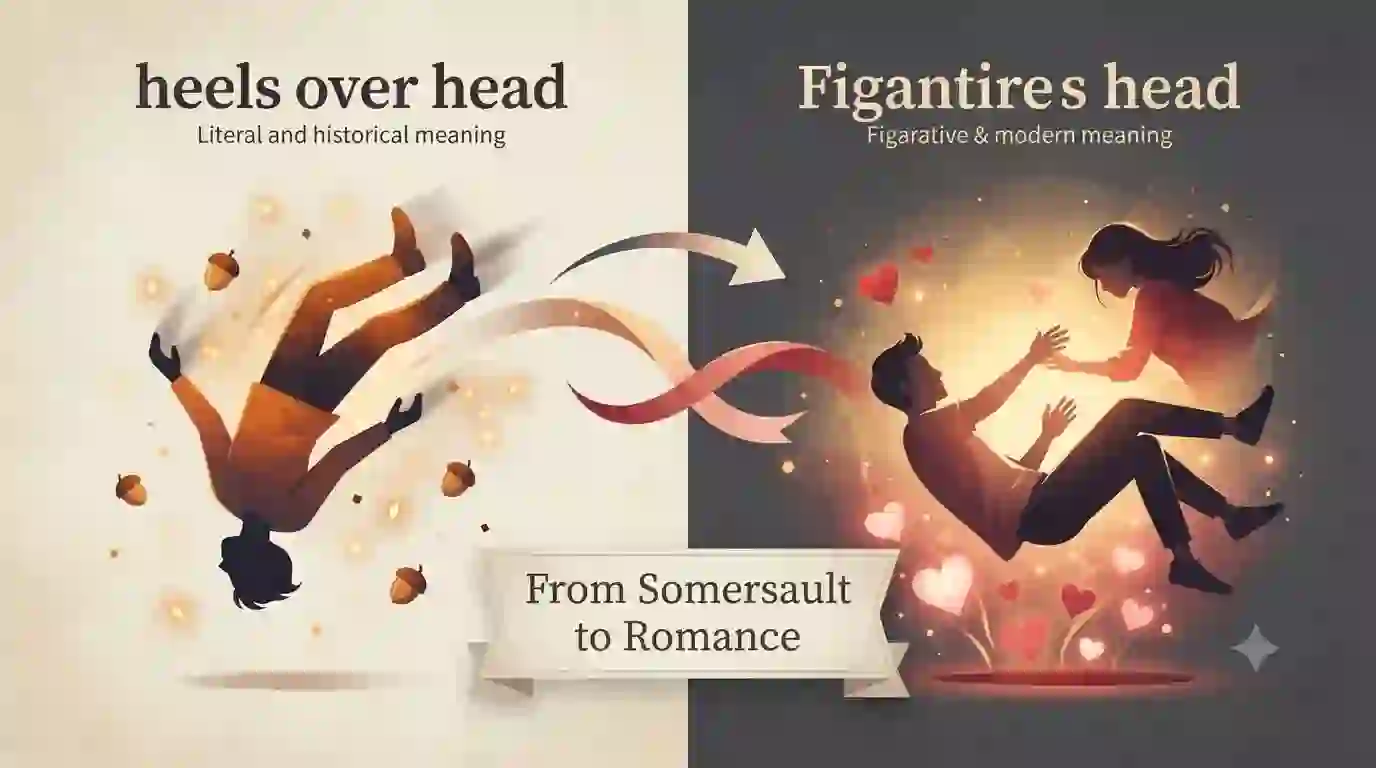
Every idiom starts somewhere concrete, and the head over heels meaning is no exception. The literal sense describes tumbling forward in a somersault, with your head leading the motion and your heels flipping over above it.
The figurative sense, which dominates modern usage, borrows that image of losing balance and control to describe emotional overwhelm. Falling in love, in this framing, feels like losing your footing entirely.
- Literal use: describing an actual physical tumble or fall, such as in gymnastics or an accidental stumble.
- Figurative use: describing deep emotional infatuation, excitement, or being completely consumed by a feeling.
Almost every modern sentence you’ll encounter uses the figurative version, since the literal use has become rare outside of sports or comic writing.
Where Did This Phrase Come From? Origin & History
Understanding the head over heels meaning gets a lot more interesting once you look at its backwards history. According to Etymonline, the original Middle English version from the late 1300s was actually “heels over head,” describing a somersault or reckless tumble.
That word order flipped sometime around the 1720s, producing the “head over heels” arrangement we use today, even though the new phrasing describes a body position that’s actually normal, not upside down. Linguists still aren’t entirely sure why the swap happened.
Merriam-Webster traces one of the earliest romantic uses to a 1711 translation of the Greek writer Lucian, where a lovesick character is described tumbling in emotional distraction. Dictionary.com notes the phrase’s modern romantic association solidified further during the 1800s, as the expression shifted from describing physical falls to describing falling in love.
Why Do We Say “Head Over Heels” When We are in Love?
The connection between tumbling and falling in love makes more sense once you consider how both experiences feel. Losing your balance is sudden, disorienting, and often involuntary, which mirrors exactly how infatuation tends to hit people.
This is also why the phrase pairs so naturally with the verb “fall.” You don’t choose to fall head over heels the same way you don’t choose to trip. It happens to you, often before you’ve had time to think it through.
That shared sense of losing control is central to the head over heels meaning as most native English speakers understand it today. It’s also why the head over heels meaning rarely applies to slow, cautious feelings — the phrase is built for sudden, overwhelming ones.
How to Use Head Over Heels in a Sentence
Applying the head over heels meaning correctly in a sentence comes down to placement, since the phrase usually functions as an adverbial expression describing how deeply someone feels something.
- “After their first date, she fell madly in love with him.”
- “He’s head over heels about his new job.”
- “They went head over heels in love within a few weeks of meeting.”
- “The trip to the amusement park had the kids giddy with anticipation.”
Notice that the phrase typically follows a verb like “fall,” “be,” or “go,” and it almost always connects to a strong positive emotion rather than a neutral or negative one.
Head Over Heels vs Heels Over Head: Which Came First?
This is one of the most searched questions tied to the phrase, and the answer surprises most people. “Heels over head” actually came first, dating back to the 1300s, and it made more literal sense since it described the heels flipping above the head during a fall.
“Head over heels” is technically the “wrong” word order if you’re being literal, since your head sits above your heels normally anyway. Despite that, the reversed version won out in popular use by the 1700s, and the head over heels meaning we use now completely replaced the original phrasing in everyday speech.
Head Over Heels or Head Over Heals? Fixing the Common Misspelling
This mix-up trips up more writers than you’d expect. The correct spelling is “heels,” referring to the back part of your foot, not “heals,” which relates to recovering from an injury or illness.
A simple trick: think of your actual heel touching the ground when you stand. If you picture “healing,” you’ve picked the wrong word. Getting the spelling right matters just as much as knowing the head over heels meaning, since a misspelled idiom undercuts your credibility just as fast.
Synonyms and Similar Idioms Worth Knowing
Building topical range around one idiom helps you express the same idea with variety. Here are close alternatives that carry a similar emotional weight.
| Phrase | Closest Meaning | Typical Usage |
|---|---|---|
| Smitten | Instantly infatuated | “He was smitten the moment she walked in.” |
| Swept off your feet | Overwhelmed by charm or romance | “She was swept off her feet on their first date.” |
| Love at first sight | Instant, powerful attraction | “It was love at first sight for both of them.” |
| Falling hard | Deeply, quickly attached | “He’s falling hard for her already.” |
| Besotted | Foolishly infatuated | “He seemed completely besotted with his new puppy too.” |
| Enamored | Filled with admiration or love | “She became enamored with the city after one visit.” |
While these phrases overlap, none carry the exact same tumbling, off-balance imagery baked into the head over heels meaning, which is part of why the original phrase has stuck around so long.
Head Over Heels in Songs, Movies & Pop Culture
The phrase has inspired plenty of creative work over the decades, which helps explain why it stays so recognizable. Tears for Fears released a well-known 1985 track titled “Head Over Heels,” capturing that same feeling of falling into something before you’ve fully processed it.
The phrase also lent its name to a cult 1980s teen film and later a jukebox musical built around the Go-Go’s catalog, both borrowing the same tumbling, lovestruck energy the idiom carries. This constant reuse across music and film keeps the head over heels meaning fresh for every new generation of listeners and viewers.
Example Sentences for Every Context
Seeing the phrase across different situations makes the head over heels meaning easier to apply naturally in your own writing.
- Romantic context: “Within a month, she was head over heels for her new neighbor.”
- Excitement context: “The whole team was head over heels about the product launch.”
- Childhood context: “My daughter is head over heels for her new puppy.”
- Career context: “He went head over heels for the startup’s mission on day one.”
- Literal context: “The gymnast flipped head over heels across the mat with perfect form.”
Notice how the figurative examples always attach to something the speaker feels strongly and positively about.
How Other Languages Capture the Same Feeling
Plenty of languages have their own version of this same tumbling, lovestruck image, which shows how universal the feeling really is.
- French uses “tomber amoureux fou,” roughly “to fall madly in love.”
- Spanish often says “estar loco por alguien,” meaning “to be crazy about someone.”
- German uses “bis über beide Ohren verliebt,” literally “in love up to both ears.”
- Italian favors “perdere la testa,” meaning “to lose your head” over someone.
Each version leans on a different physical image, but all of them describe that same sense of losing control to a powerful feeling, which shows the head over heels meaning taps into something close to a universal human experience.
Mistakes to Avoid When Using This Phrase
- Confusing “heels” with “heals” is the single most common written error tied to this idiom.
- Using it for negative emotions, since the phrase almost always implies something positive, not distress or fear.
- Overusing it in formal writing, where a more neutral phrase like “deeply attached” may fit better.
- Forgetting the hyphenation in adjective form, such as “a head-over-heels romance,” which some style guides prefer hyphenated before a noun.
Avoiding these small slip-ups keeps your writing polished, and it shows you’ve genuinely grasped the head over heels meaning rather than just repeating a phrase you’ve heard before.
Quick Reference Table: Head Over Heels at a Glance
| Detail | Information |
|---|---|
| Modern meaning | Completely overwhelmed by love or excitement |
| Original phrase | “Heels over head” (1300s) |
| Word order flipped | Around the 1720s |
| Common pairing | “Fall head over heels in love” |
| Common misspelling | “Head over heals” (incorrect) |
| Part of speech | Adverbial/adjectival phrase |
| Closest synonym | Smitten, swept off your feet |
Frequently Asked Questions
What does head over heels mean in a relationship? It describes being completely and intensely in love with someone, often to the point of losing normal judgment or restraint around them.
Is head over heels an idiom or a literal phrase? It’s primarily an idiom today, though it started as a literal description of a somersault before shifting toward its current emotional meaning.
Can head over heels describe things other than love? Yes, it can describe any strong, positive excitement, such as being head over heels about a new job, hobby, or upcoming trip.
Is it “head over heels” or “head over heals”? The correct spelling is “heels,” referring to the back of the foot. “Heals” is incorrect and relates to recovering from injury, not this idiom.
What’s a good synonym for head over heels? “Smitten,” “swept off your feet,” and “besotted” all carry a similar meaning, though none capture the exact tumbling imagery of the original phrase.
Where did the phrase head over heels originate? It began as “heels over head” in the 1300s, describing a somersault, before the word order flipped to today’s version around the 1720s.
Final Thoughts
Knowing the full head over heels meaning turns a phrase you’ve probably used a hundred times into one you actually understand, from its backwards word order to its centuries-old connection to falling in love. Use it confidently in your next sentence, spell it correctly, and pick the right synonym when you want variety.
Ready to put it into practice? Try writing one sentence right now using the phrase correctly, and see how naturally it fits your own story.