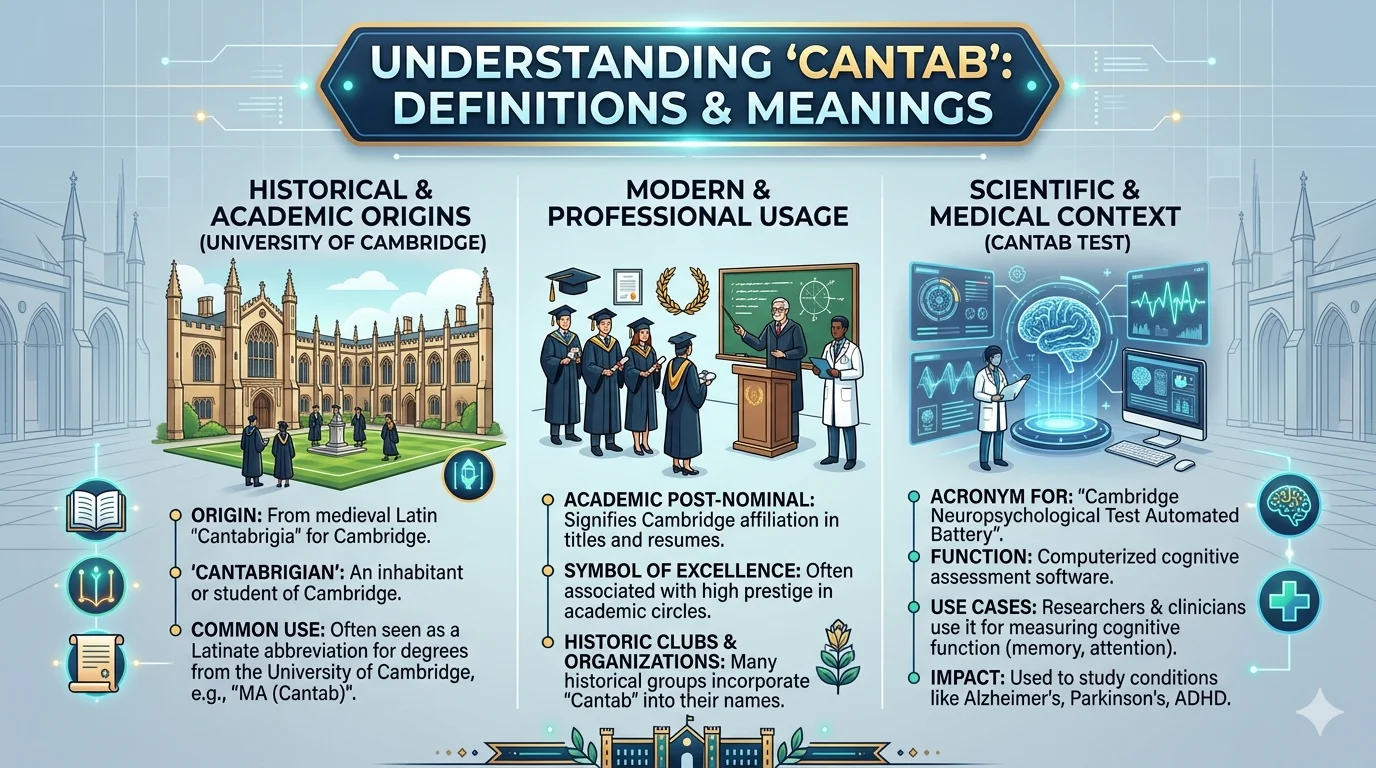
Cantab Definition & Meaning Explained
Introduction:
You see the letters Cantab printed after a professor’s name or on a professional certificate — and you have no idea what it means. That confusion is more common than you think, even among educated professionals. The cantab meaning is actually straightforward once you know its Latin roots and Cambridge University connection. You will not ever have to guess again because this tutorial explains everything in detail.
Quick Reference: Cantab at a Glance
| Feature | Detail |
|---|---|
| Full Term | Cantabrigiensis |
| Language Origin | Latin |
| English Translation | “Of Cambridge” |
| Used By | Graduates of the University of Cambridge |
| Common Usage | Written after a degree, e.g., MA (Cantab) |
| Equivalent for Oxford | Oxon (Oxoniensis) |
| Pronounced | KAN-tab |
| Type | Post-nominal abbreviation |
| Applies To | All Cambridge degree holders |
| First Documented Use | Medieval Latin academic tradition |
What Is the Cantab Meaning?
The cantab meaning traces back to the Latin word Cantabrigiensis, which means “of Cambridge” or “belonging to Cambridge.” It is a post-nominal abbreviation — a short set of letters placed after a person’s name — to indicate that their academic degree was awarded by the University of Cambridge in England.
When you see something like Dr. Sarah Ahmed, PhD (Cantab), it tells you immediately that Dr. Ahmed earned her doctorate at Cambridge. The tag is not decorative. It is a precise academic identifier recognized across universities, hospitals, law firms, and research institutions worldwide.
The abbreviation Cantab comes from Cantabrigia, the Latin name for Cambridge that dates back to medieval scholarship. Universities across Europe used Latin to record academic achievements for centuries, and many of those naming conventions — including cantab — survived into modern professional practice.
What Is the Full Cantab Definition?
Cantab definition: A Latin abbreviation of Cantabrigiensis, meaning “of or from Cambridge.” It appears in brackets after a degree title to identify the University of Cambridge as the awarding institution.
The word carries academic, geographic, and institutional meaning all at once. It is not a degree itself — it is the identifier that tells people where a degree came from. Think of it as a university stamp written in Latin.
Where and How Is Cantab Used?
Understanding the cantab meaning also requires knowing exactly where it appears. People use cantab in several clear, consistent contexts:
- After a degree title: BSc (Cantab), MA (Cantab), MB BChir (Cantab), PhD (Cantab)
- On CVs and resumes: Professionals list it to specify their degree source
- On published research papers: Academics include it in author credentials
- In medical practice: Cambridge-trained doctors often include MB BChir (Cantab)
- On legal documents and official biographies: Barristers and judges trained at Cambridge use it formally
- In academic publications and journals: Authors signal Cambridge affiliation
The placement is always after the degree abbreviation and inside parentheses or brackets. You would write MA (Cantab), not Cantab MA or MA Cantab without brackets.
Cantab vs. Oxon: What Is the Difference?
One of the most searched questions connected to the cantab meaning is how it differs from Oxon. The answer is simple but worth knowing precisely.
| Feature | Cantab | Oxon |
|---|---|---|
| Full Latin Term | Cantabrigiensis | Oxoniensis |
| Means | Of Cambridge | Of Oxford |
| University | University of Cambridge | University of Oxford |
| Example Usage | DPhil (Oxon) | PhD (Cantab) |
| Origin | Medieval Latin | Medieval Latin |
| Both Used In | CVs, degrees, formal publications | CVs, degrees, formal publications |
Both terms serve the same purpose — they identify a prestigious British university as the source of the degree. Neither is superior to the other in terms of formatting. They are simply geographic and institutional labels preserved from Latin academic tradition.
If someone holds degrees from both universities, they may write both post-nominals: MA (Cantab), DPhil (Oxon).
The History Behind the Cantab Abbreviation
The cantab abbreviation did not appear by accident. The University of Cambridge was founded in 1209, and from its earliest years, scholars recorded academic work in Latin. The city of Cambridge itself was known as Cantabrigia in medieval Latin — a name that historians believe derived from the River Cam and a local place name combining Romano-British and Norman French roots.
Latin was the universal language of European scholarship from the medieval period through the 17th century. Degrees, dissertations, university charters, and graduation ceremonies were all conducted in Latin. The phrase Cantabrigiensis appeared in official documents to mean “a person or thing belonging to Cambridge.”
As English gradually replaced Latin in academic writing, the full Latin term became unwieldy. The shortened form — Cantab — emerged as a clean, recognizable abbreviation that retained the prestige and precision of the original. Today, even though Latin is no longer the working language of scholarship, cantab remains the accepted and preferred post-nominal for Cambridge graduates in formal and professional writing.
Who Can Use the Cantab Post-Nominal?
Not everyone can append Cantab to their name. The term applies specifically to graduates of the University of Cambridge. This includes:
- Holders of undergraduate degrees: BA (Cantab), BSc (Cantab)
- Holders of postgraduate degrees: MPhil (Cantab), PhD (Cantab), LLM (Cantab)
- Medical graduates: MB BChir (Cantab) — the Cambridge undergraduate medical degree
- Honorary degree recipients from Cambridge
- Holders of Cambridge’s unique MA degree, which Cambridge awards to BA graduates automatically after a set number of years
It is worth noting that the Cambridge MA (Cantab) works differently from an MA at most other universities. Cambridge awards it to BA graduates based on seniority rather than additional study, which is a long-standing tradition specific to Cambridge and Oxford. This does not diminish its validity — it simply reflects the ancient structure of those institutions.
Why the Cantab Meaning Matters Professionally
Knowing the cantab meaning is genuinely useful, especially in professional environments. When you review a CV, a medical referral, or a legal brief, you may encounter cantab frequently. It signals specific things:
- The person trained at one of the world’s most competitive universities
- Their degree meets the rigorous academic standards of the University of Cambridge
- In medicine, MB BChir (Cantab) tells you the physician trained under Cambridge’s integrated clinical curriculum
- In law, an LLM (Cantab) signals advanced legal training from a globally recognized institution
Recruiters, hiring managers, and academic peers all recognize Cantab as a meaningful credential marker. It is not mere decoration — it carries real information about a person’s academic background.
Cantab Meaning in Medicine: A Closer Look
Medical professionals use the cantab abbreviation more than almost any other field. The Cambridge medical degree — MB BChir — stands for Medicinae Baccalaureus, Baccalaureus Chirurgiae, meaning Bachelor of Medicine, Bachelor of Surgery. When written in full, it appears as MB BChir (Cantab).
This degree is equivalent to the MBChB or MBBS awarded at other UK medical schools. The cantab post-nominal simply confirms that the physician graduated from Cambridge’s School of Clinical Medicine, which is based at Addenbrooke’s Hospital in Cambridge.
Cambridge’s medical program is known for its strong scientific and research foundation, often attracting students who go on to clinical research, academic medicine, and specialist practice. The MB BChir (Cantab) is therefore recognized not just as a clinical qualification but as a marker of research-oriented medical training.
Is Cantab Only for Cambridge, England?
Yes — cantab exclusively refers to the University of Cambridge in Cambridge, England. It does not apply to:
- Harvard University (despite “Cambridge, Massachusetts” being its home city)
- MIT (also in Cambridge, Massachusetts)
- Any other university that happens to be located in a place named Cambridge
This is a question that genuinely trips people up. Harvard’s home city is named after Cambridge, England — the connection is historical, not academic. Harvard graduates do not use Cantab. The term belongs entirely to the University of Cambridge, UK.
If you see Cantab on a credential, it always and only means the University of Cambridge in England, founded in 1209.
How to Pronounce and Write Cantab Correctly
Pronunciation: KAN-tab (two syllables, stress on the first)
Writing rules:
- Always capitalize: Cantab, not cantab
- Always use parentheses after the degree: PhD (Cantab)
- Never write it as a standalone title without the degree preceding it
- Do not place a period after it in British English: MA (Cantab) not MA (Cantab.)
- In American English, some style guides add a period, but the British standard — used by Cambridge itself — does not
Cantabrigian: The Related Term You Should Know
Cantabrigian is the full adjective and noun form of the same Latin root. It means “a person from or associated with Cambridge” — specifically the University of Cambridge.
While Cantab is the formal post-nominal used after degree titles, Cantabrigian appears in prose writing. For example: “She is a proud Cantabrigian who now teaches at University College London.”
Both words share the same Latin origin — Cantabrigia — and both are specific to Cambridge, England. The distinction is purely one of context: Cantab belongs on credentials and formal documents, while Cantabrigian flows naturally in written descriptions and biographical writing.
Frequently Asked Questions
1. What does cantab mean in simple terms?
Cantab means “of Cambridge.” It is a Latin abbreviation placed after a degree title to show that the degree was awarded by the University of Cambridge in England. For example, MA (Cantab) means a Master of Arts degree from Cambridge.
2. What is the full form of cantab?
The full form is Cantabrigiensis, a Latin word meaning “of or belonging to Cambridge.” It derives from Cantabrigia, the medieval Latin name for the city of Cambridge, England.
3. Is cantab only for Cambridge University in England?
Yes. Cantab applies exclusively to the University of Cambridge, England. It does not apply to universities in Cambridge, Massachusetts — including Harvard or MIT — even though those cities share the name.
4. What is the difference between cantab and Oxon?
Both are Latin post-nominals for British universities. Cantab (Cantabrigiensis) means “of Cambridge” and applies to University of Cambridge graduates. Oxon (Oxoniensis) means “of Oxford” and applies to University of Oxford graduates. They serve the same function — identifying the awarding university — for two different institutions.
5. Can anyone use the cantab abbreviation?
No. Only graduates of the University of Cambridge can use Cantab after their degree. This includes undergraduate and postgraduate degree holders, medical graduates (MB BChir Cantab), and honorary degree recipients from Cambridge.
6. How should cantab be written on a CV?
Write it in parentheses, directly after the degree abbreviation, with a capital C. The correct format is: PhD (Cantab), MA (Cantab), or MB BChir (Cantab). Do not use a period after Cantab in British English.
The Lasting Significance of Cantab
The cantab meaning connects a two-syllable abbreviation to more than eight centuries of academic history. From the medieval Latin scholars who wrote Cantabrigiensis in their official records to the modern physician who prints MB BChir (Cantab) on their clinic door, the word carries the same clear message — this person trained at Cambridge.
It is not a title of superiority. It is a title of origin. And in professional and academic writing, knowing exactly where a qualification came from matters enormously.
Whether you are checking a doctor’s credentials, reviewing a professor’s publication history, or simply curious after seeing the word on a nameplate — you now know precisely what cantab means, where it comes from, and how it is used correctly.