Proscribed Meaning: Definition, Examples & Legal Usage
What Does Proscribed Mean? The Core Definition
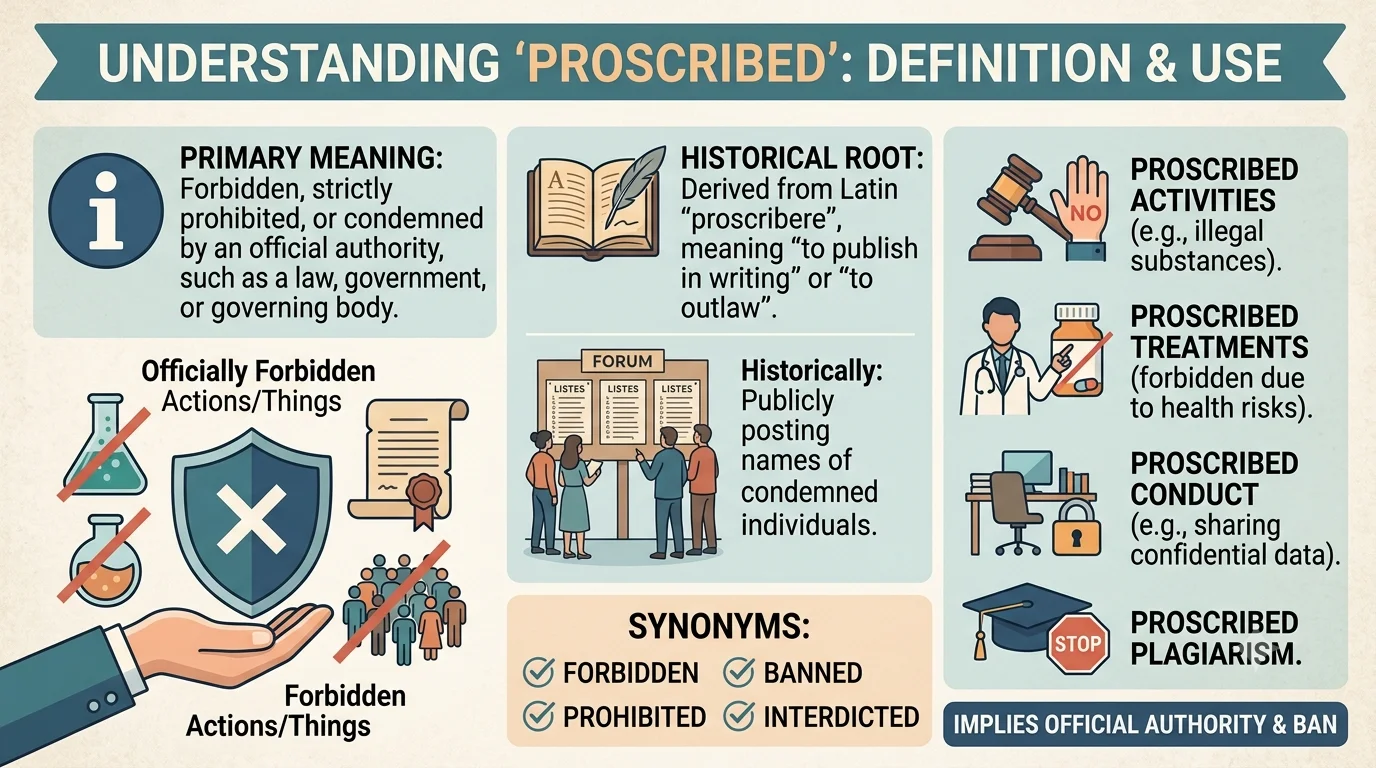
Proscribed means officially forbidden, banned, or condemned. The word carries legal, moral, or procedural weight. When a government proscribes an organization, it outlaws it. When a rulebook proscribes certain conduct, it declares that conduct unacceptable and punishable. Merriam-Webster defines “proscribe” as “to condemn or forbid as harmful or unlawful.”
The proscribed meaning always involves an authority drawing a hard line. It never suggests a gentle suggestion or a mild preference. A proscribed action is not just frowned upon—it is formally placed out of bounds. The term appears in statutes, court rulings, medical ethics guidelines, and even religious texts. Understanding it correctly protects you from misreading rules that carry serious consequences.
The Latin Roots: Where Proscribed Comes From
Proscribe entered English in the 15th century from the Latin proscribere, meaning “to publish in writing” or “to outlaw.” The Latin word breaks into pro- (“before, publicly”) and scribere (“to write”). In ancient Rome, a proscription was a public notice listing citizens declared enemies of the state. Their property was seized, and anyone could kill them without legal penalty.
This brutal origin anchors the proscribed meaning in official, written condemnation. The word never lost that sense of public, legal finality. When something is proscribed today, it is not hidden disapproval—it is an open, written, enforceable ban.
Proscribed vs. Prescribed: The Crucial Difference
The one-pen-stroke difference between “proscribed” and “prescribed” causes endless confusion. They sound similar but stand as near opposites.
- Proscribed = Forbidden, banned, condemned. A proscribed activity is one you must avoid.
- Prescribed = Recommended, ordered, set down as a rule to follow. A prescribed medicine is one a doctor tells you to take. A prescribed procedure is one you must follow.
Think of “proscribe” as “prohibit” and “prescribe” as “preset.” The prefix “pro-” in proscribe means “in front of” in the sense of exposing to public condemnation. In prescribe, “pre-” means “before” as in laying down a rule in advance. The proscribed meaning stands firmly on the side of forbidding.
Proscribed in Law: Banned Activities and Forbidden Conduct
Legal systems rely heavily on the word proscribed. A criminal code proscribes specific acts—theft, assault, fraud—and attaches penalties. When lawmakers draft a statute, they proscribe conduct they want to eliminate. Courts interpret what the law proscribes and what it permits.
In international law, certain weapons are proscribed under treaties. Land mines and chemical weapons face global proscription. Organizations like the United Nations proscribe actions that threaten peace. The proscribed meaning in these settings carries the force of multiple governments acting together. Breaking a proscription often triggers sanctions, prosecution, or military response.
Black’s Law Dictionary defines “proscribe” as “to declare something illegal or to outlaw.” A proscribed organization cannot legally operate within a jurisdiction. Its assets face seizure, and its members risk arrest. Governments update proscribed lists constantly as they identify new threats.
Proscribed Organizations: When Groups Are Outlawed
The term “proscribed organization” appears frequently in news about terrorism and extremism. The United Kingdom maintains an official list of proscribed groups under the Terrorism Act 2000. Membership in a proscribed organization carries criminal penalties, including imprisonment. Financial support for such groups is also proscribed.
Other nations keep similar lists. The United States designates Foreign Terrorist Organizations. India bans organizations under the Unlawful Activities (Prevention) Act. In every case, the proscribed meaning remains the same: the group has zero legal standing, and associating with it breaks the law. These proscriptions get reviewed periodically, and groups can be added or removed.
Medical Contexts: Proscribed Substances and Treatments
Medicine uses “proscribed” for substances and procedures that are officially banned due to danger or lack of efficacy. A drug that causes severe harm gets proscribed by the FDA or equivalent regulatory bodies. Doctors who prescribe proscribed substances face license revocation and criminal charges.
The proscribed meaning also covers treatments declared unethical by medical boards. A discredited surgical technique that maims patients becomes proscribed within the profession. Medical ethics committees proscribe experiments that violate patient consent standards. These proscriptions protect public health and maintain trust in medical institutions.
Religious and Cultural Proscriptions
Religious texts often proscribe specific foods, behaviors, and practices. Kosher laws in Judaism proscribe eating pork and shellfish. Islamic dietary laws proscribe alcohol and pork. In some Hindu traditions, certain meats are proscribed. These proscriptions carry deep spiritual weight, not just social disapproval.
Cultural proscriptions vary widely. Some societies proscribe public displays of affection. Others proscribe specific words considered taboo. The proscribed meaning in these contexts signals a community’s boundary between acceptable and forbidden. Breaking a cultural proscription may bring shame, ostracism, or social consequences rather than legal ones.
Synonyms That Match the Proscribed Meaning
A set of words captures different angles of the proscribed meaning.
- Banned: Forbidden by law or rule; simple and direct.
- Prohibited: Formally prevented; often used in rules and regulations.
- Outlawed: Made illegal, usually applied to groups or actions.
- Forbidden: Not allowed, often carrying moral or religious weight.
- Interdicted: Prohibited by judicial or military order.
- Condemned: Judged as wrong and declared unacceptable.
- Vetoed: Rejected by a person in authority.
Each synonym fits the proscribed meaning in specific contexts. “Outlawed” fits organizations. “Banned” fits substances. “Condemned” carries moral flavor. None carries the exact mix of public, written condemnation and legal force that “proscribed” does.
Antonyms: What Stands Opposite to Proscribed
The opposite side of the proscribed meaning shines through these words.
- Permitted: Allowed by rule or authority.
- Authorized: Given official permission.
- Endorsed: Publicly approved and supported.
- Recommended: Advised as beneficial.
- Sanctioned: Given official approval (though confusingly, “sanction” can also mean “penalize,” making context essential).
- Allowed: Not forbidden; the simplest opposite.
When an activity is permitted, it sits outside the proscribed zone entirely. Understanding these opposites helps lock in the proscribed meaning by contrast.
How to Use Proscribed Correctly in Sentences
Concrete examples make the proscribed meaning clear and usable.
- The new school policy proscribes any form of bullying, and violations lead to immediate suspension.
- Federal regulations proscribe the sale of certain exotic animals as pets.
- The treaty proscribes the use of chemical weapons under any circumstances.
- The ethics committee proscribed the experimental therapy after three patients suffered severe complications.
- The military code proscribes fraternization between officers and enlisted personnel.
Notice the pattern: an authority declares something forbidden in writing, with consequences attached. That is the proscribed meaning in action.
Common Mistakes When Using Proscribed
Errors with this word usually involve confusion with its sound-alike cousin.
- Mistake: Using “proscribed” when you mean “prescribed.” “The doctor proscribed antibiotics” is wrong. Doctors prescribe, not proscribe.
- Mistake: Treating “proscribed” as a mild discouragement. “The teacher proscribed talking in class” understates the word. A proscribed action is banned, not just frowned upon.
- Mistake: Forgetting the past tense spelling. Both “proscribe” and “prescribe” shift to “proscribed” and “prescribed” in the past, making context the only clue to meaning.
- Mistake: Assuming proscribed means “written before.” That is “prescribed.” The proscribed meaning always involves condemnation, not recommendation.
Focus on the link between “proscribe” and “prohibit.” That mental hook prevents the most common slip.
Proscribed Meaning at a Glance: Quick Reference Table
| Category | Detail |
|---|---|
| Pronunciation | proh-SKRYBD |
| Part of Speech | Adjective (past participle), also verb “proscribe” |
| Origin | Latin proscribere (to publish in writing, outlaw) |
| First Known Use in English | 15th century |
| Core Meaning | Officially forbidden, banned, or condemned |
| Common Contexts | Law, medicine, religion, organizational policy |
| Contrast Word | Prescribed (recommended, ordered) |
| Common Synonyms | Banned, prohibited, outlawed, forbidden, interdicted |
| Common Antonyms | Permitted, authorized, endorsed, allowed |
| Key Preposition | Often used with “by” (proscribed by law) |
This table crystallizes the proscribed meaning in a format you can check whenever doubts arise.
Frequently Asked Questions About Proscribed Meaning
What is the simple proscribed meaning?
The simple proscribed meaning is “officially forbidden or banned.” When an authority proscribes something, it declares that thing illegal or unacceptable and backs that declaration with penalties.
What is the difference between proscribed and prescribed?
Proscribed means forbidden. Prescribed means recommended or ordered. They are near opposites. The proscribed meaning always signals condemnation, while prescribed signals direction to follow.
Can a person be proscribed?
Yes, historically and in some legal contexts. In ancient Rome, proscribed individuals were publicly listed for execution. Today, a person cannot be “proscribed” in the sense of outlawed in most democracies, but their actions or memberships can be proscribed, leading to legal consequences.
How is proscribed used in law?
In law, proscribed describes acts, substances, or organizations that statutes have declared illegal. The proscribed meaning in a legal text indicates a formal, enforceable ban with penalties for violation.
What are examples of proscribed things?
Proscribed things include banned drugs, outlawed weapons, terrorist organizations on government lists, unethical medical procedures, and culturally forbidden foods. Anything a formal authority has officially condemned fits the proscribed meaning.
Is “proscribed” always negative?
Yes. The proscribed meaning is inherently negative because it describes something condemned or forbidden. There is no positive or neutral use of the word.
Own the Word, See the Warning Clearly
Every time you read that something is “proscribed,” you now see a red flag. The proscribed meaning signals an authority’s firm line—do not cross it. Whether the context is a government ban, a medical board ruling, or a religious law, the word carries the ancient weight of public condemnation and real consequences.
Print the quick reference table above and pin it near your desk. When you write rules, policies, or arguments, use “proscribed” to call out exactly what stands forbidden. And when you spot someone mixing it up with “prescribed,” you have the clarity to correct them. Share this guide with anyone who handles legal documents, medical writing, or policy drafts. The sharper your word choices, the safer your decisions become.