What Does Futz Mean? Definition & Usage Guide
Introduction
You heard someone say “stop futzing around” and froze — not because the sentence was rude, but because the word felt familiar and strange at the same time. That is the futz meaning puzzle. The word sits between slang and everyday speech, between mild and sharp, between Yiddish immigrant culture and twenty-first-century American English. This guide unpacks exactly what futz means, where it came from, how to use it correctly, and why it still works better than any clean synonym that tries to replace it.
What Is the Futz Meaning?
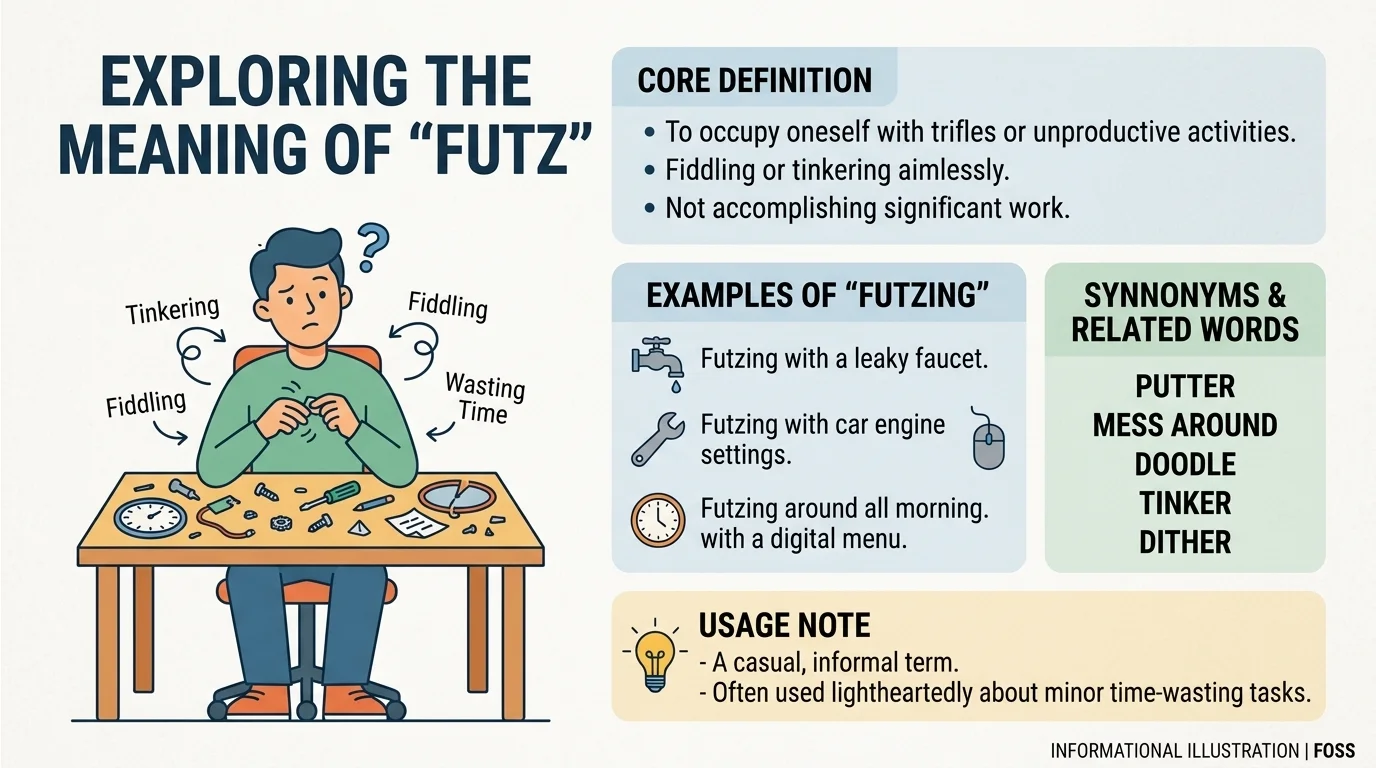
The futz meaning is straightforward once you hear it in context. Futz means to waste time doing things that accomplish nothing, to tinker with something aimlessly, or to fiddle with an object or situation without any clear purpose or goal.
It carries a tone of mild frustration — the speaker is usually pointing out that time, effort, or focus is being spent on something that does not deserve it. The word packs a clear message into one syllable.
Simple definition:
Futz (verb) — to idle, mess around, tinker without purpose, or waste time on trivial matters.
Merriam-Webster defines futz as “to fool around” — often paired with “around” to form the widely used phrase “futz around.” The Oxford English Dictionary traces it back to at least 1907, with broader American usage recorded from the 1930s onward.
How Do You Pronounce Futz?
Futz rhymes with “cuts” and “nuts.” The pronunciation is:
/ fʌts /
- One syllable
- Rhymes with: guts, mutts, butts, cuts
- The “u” is a short vowel sound, like in “fun” or “run”
The past tense is futzed (one syllable). The present participle is futzing (two syllables: FUTZ-ing). The third-person singular is futzes.
Most people who are unfamiliar with the futz meaning still get the pronunciation right on first attempt because the spelling is phonetically direct.
What Does “Futz Around” Mean?
“Futz around” is the most common form of the word in everyday American speech, and it carries the same core futz meaning with slightly more emphasis on the aimlessness of the activity.
When someone tells you to “stop futzing around,” they are telling you to stop wasting time, get focused, and do something productive. The phrase implies that the person being addressed is moving through actions without intention — not resting deliberately, not working deliberately, just drifting.
Futz around in a sentence:
- “We don’t go down there to futz around — we go to get results.”
- “She spent the whole afternoon futzing around on her phone instead of finishing the report.”
- “He’s been futzing around with that old engine for three weeks and it still won’t start.”
The phrase is informal. You would say it to a friend, a family member, or a colleague in a casual setting. You would not use it in a formal email or a written report.
The Origin and Etymology of Futz
The etymology of futz is one of the most interesting word-origin stories in American slang — it is genuinely debated by linguists and lexicographers.
The leading theory: Futz is most likely a partial translation and adaptation of the Yiddish phrase arumfartsn zikh, which literally means “to fart around.” The Yiddish word fartsn comes from Middle High German varzen, meaning “to fart.” The prefix arum- means “around.” When Yiddish-speaking immigrants brought the phrase into American English in the early twentieth century, it softened into the phonetically cleaned-up “futz.”
The secondary theory: Several linguists have argued that futz is simply a euphemistic softening of a more explicit English profanity. The construction of the phrase “futz around” mirrors the cruder phrase it replaces, both in rhythm and intent.
The earliest recorded use: According to the Online Etymology Dictionary, the word appears in American English in print as early as 1907, with consistent documented usage from 1932 onward in works like James T. Farrell’s novel Young Lonigan, set in Chicago.
The Dictionary of American Regional English confirms that by the 1940s the phrase was already in use among adolescents in New York City, and by the 1980s it had crossed into mainstream advertising — including a 1984 Apple Macintosh advertisement that used the word “futzes” to describe what everyday computer users do with information.
The Oxford English Dictionary updated its entry for futz as recently as March 2026, adding new senses and refining its understanding of the word’s geographic spread and historical depth.
The word belongs to a cluster of Yiddish-origin English words that softened explicit concepts for general audiences — a group that includes putz, klutz, schlep, and schmooze.
Futz as a Verb: All Its Forms
Understanding the futz meaning requires knowing how it functions grammatically. Futz operates primarily as an intransitive verb, though it can also appear in transitive constructions when the speaker is describing interference with a specific object.
Conjugation Table
| Form | Word | Example |
|---|---|---|
| Base form | futz | “Don’t futz with the settings.” |
| Third-person singular | futzes | “She always futzes with her hair before meetings.” |
| Present participle | futzing | “He is futzing around instead of working.” |
| Simple past | futzed | “They futzed with the recipe and ruined dinner.” |
| Past participle | futzed | “The code had been futzed with by someone.” |
Two main uses:
- Intransitive (futz / futz around) — describing aimless, unproductive activity with no specific object.
- “Stop futzing and get moving.”
- “I futzed around all morning and got nothing done.”
- Transitive (futz with) — describing careless or unnecessary interference with a specific thing.
- “Don’t futz with the thermostat.”
- “She futzed with the audio settings and made them worse.”
Both uses carry the same tone: mild irritation at wasted time or pointless interference.
Real-World Examples of Futz in Sentences
The futz meaning clicks immediately when you see it in natural sentences. Here are examples across different everyday contexts:
At home:
- “I spent Saturday futzing around in the garage without actually fixing anything.”
- “Stop futzing with the Wi-Fi router — just call the provider.”
- “He futzed with the thermostat all evening and the house still felt cold.”
At work:
- “We can’t keep futzing with the launch date — pick one and commit.”
- “She noticed her teammate futzing around on his phone during the client call.”
- “Don’t futz with the formatting; it looks fine.”
With technology:
- “I futzed with the settings for an hour before finding the issue.”
- “AI gives you easier access to features so you don’t have to futz with menus.” (Wall Street Journal, January 2026)
- “If you didn’t want to futz with the word blockchain, you could just buy the stock instead.” (Slate, February 2026)
In food and cooking:
- “You can futz with the recipe all you want, but if the base is bland, nothing helps.” (Salon, December 2025)
With the body:
- “That can futz with gut motility, speeding up or slowing down digestion.” (SELF, August 2025)
These examples show that futz works in casual conversation, journalism, advertising, and even health writing. It travels well across registers without losing its core futz meaning.
Futz vs. Putz: What Is the Difference?
Futz and putz are both Yiddish-origin American slang words, and people often confuse or interchange them. They share roots and similar tones, but they mean slightly different things.
Comparison Table: Futz vs. Putz
| Feature | Futz | Putz |
|---|---|---|
| Primary meaning | To waste time, tinker aimlessly | A foolish or inept person; also, to mess around |
| Part of speech | Primarily a verb | Primarily a noun; also used as a verb |
| Tone | Mild frustration | Mild contempt or affectionate teasing |
| Common form | “Futz around,” “futz with” | “What a putz,” “putzing around” |
| Yiddish root | arumfartsn (to fart around) | putz (a fool, also a vulgar term) |
| Example sentence | “Stop futzing with the remote.” | “He forgot his keys again — what a putz.” |
The key distinction: You futz with objects or time. You call someone a putz. When putz is used as a verb (“putzing around”), it means roughly the same as “futzing around” — both describe aimless, unproductive movement.
The futz meaning focuses on the action of wasting time. The putz meaning focuses more on the person doing it.
Futz Synonyms: Other Ways to Say the Same Thing
Knowing the futz meaning also means knowing when a synonym works better for your specific context. Here are the closest alternatives, with notes on when each fits best.
Synonym Table
| Synonym | Meaning | Best Used When |
|---|---|---|
| Fiddle with | Tinker with something repeatedly | The focus is on an object, not time |
| Tinker | Adjust or experiment informally | Technical or mechanical context |
| Putter around | Move aimlessly with small tasks | Gentle, domestic, unhurried activity |
| Dawdle | Move or act slowly, wasting time | Emphasizing slowness more than aimlessness |
| Mess around | Behave playfully or without focus | Casual, slightly more energetic tone |
| Loaf | Do nothing; rest unproductively | Total inactivity rather than aimless tinkering |
| Doodle | Sketch or play without purpose | Specifically creative or visual contexts |
| Monkey with | Interfere carelessly with something | Slightly stronger warning tone |
| Faff (British) | Waste time on trivialities | British English equivalent of futz around |
None of these carries the exact texture of futz. The word sits at the crossing point between “wasting time” and “pointless interference” — and no single synonym captures both sides of that meaning with the same economy.
What Makes Futz Different From Similar Slang?
The futz meaning is sharper than “mess around” but softer than more explicit alternatives. That tonal middle ground is precisely what makes it useful.
When you say someone is “messing around,” the phrase could mean they are playing, joking, or being careless — the meaning depends entirely on context. When you say someone is “futzing around,” the meaning is specific: they are occupied with something trivial, purposeless, or counterproductive.
Futz also carries an emotional temperature. It expresses mild exasperation — not anger, not indifference — and that specificity makes it the right word in situations where you want to signal disapproval without escalating into conflict.
That balance explains why the word has lasted more than a century in American speech. Slang terms survive when they fill a gap that polite alternatives cannot cover cleanly. Futz fills that gap.
Is Futz a Rude or Offensive Word?
The word is not profane or offensive in contemporary American English. It is informal and mildly colorful, but entirely appropriate in casual conversation, everyday writing, and mainstream journalism.
Major publications — the Wall Street Journal, the Los Angeles Times, WIRED, SELF, and Slate — have all used “futz” in print within the last three years. Merriam-Webster lists it as a standard dictionary entry. The Oxford English Dictionary tracks its usage with scholarly precision.
The word’s Yiddish-origin roots once gave it a slightly edgier reputation because the source phrase carried a crude literal meaning. That edge has softened almost completely in modern usage. Today, saying “stop futzing around” reads as playfully impatient — not vulgar.
When to use futz confidently:
- Casual conversation with friends or family
- Informal workplace exchanges
- Personal essays, blogs, and feature writing
- Parenting situations (“stop futzing with your food and eat”)
When to avoid futz:
- Formal business documents
- Academic writing
- Professional presentations
- Any setting where informal slang feels out of place
Futz in American Regional Speech
The futz meaning is most firmly rooted in the Northern United States — particularly in cities like Chicago, New York, and the broader Midwest — where Yiddish-speaking immigrant communities were concentrated in the late nineteenth and early twentieth centuries.
The Dictionary of American Regional English (DARE) documents “futzing around” appearing in central Wisconsin as early as the 1920s, and in New York City by the 1940s. By the 1980s, its use had spread nationally, helped partly by advertising, print media, and later by television and internet writing.
Today, the word has no strong regional restriction. An American speaker in Texas or California uses “futz” with the same ease as a speaker in Chicago or Philadelphia. The regional flavor has faded. What remains is the word’s tone — that specific blend of impatience, affection, and mild scolding that makes it irreplaceable.
A Brief History of Yiddish Words in American English
Futz belongs to a large family of Yiddish-origin words that entered American English through immigrant communities and became permanent parts of the language. Understanding this context deepens the futz meaning by showing the cultural channel it traveled through.
Other Yiddish words that became standard American English:
| Word | Meaning | Entered Common Use |
|---|---|---|
| Klutz | A clumsy person | Early-to-mid 20th century |
| Schlep | To drag or carry something with effort | Early-to-mid 20th century |
| Schmooze | To chat in a friendly, often strategic way | Mid 20th century |
| Chutzpah | Audacious nerve or boldness | Mid 20th century |
| Glitch | A small technical malfunction | Mid 20th century |
| Kvetch | To complain persistently | Mid-to-late 20th century |
| Putz | A foolish person; to mess around | Early-to-mid 20th century |
| Futz | To idle or tinker aimlessly | Early 20th century |
These words entered English because they expressed concepts that existing English vocabulary could not capture quite as efficiently. Each one filled a specific emotional or behavioral niche. Futz fills the space between laziness and interference — and it has held that space for over a hundred years.
6 Frequently Asked Questions About Futz Meaning
Q1: What does futz mean in simple terms? Futz means to waste time doing unimportant things, or to interfere with something in a careless, aimless way. If someone tells you to “stop futzing around,” they want you to focus and do something productive.
Q2: Is futz a Yiddish word? The word is rooted in Yiddish. It most likely derives from the Yiddish phrase arumfartsn zikh, meaning “to fart around,” which itself comes from Middle High German. Yiddish-speaking immigrants brought the phrase into American English in the early 1900s, where it softened into its current form.
Q3: What is the difference between futz and putz? Futz is primarily a verb describing the act of wasting time or tinkering pointlessly. Putz is primarily a noun referring to a foolish or incompetent person, though it can also be used as a verb (“putzing around”) in the same sense as futz. Both come from Yiddish and carry a mildly teasing tone.
Q4: Is it rude to say futz? No. Futz is informal but not offensive or profane. Major newspapers, magazines, and dictionaries use it without concern. It is best reserved for casual rather than formal settings, but the word itself is entirely appropriate for most everyday conversations.
Q5: How do you use futz in a sentence? You can use it as a simple verb or pair it with “around” or “with.” Examples: “Stop futzing with the settings.” / “I futzed around all morning and got nothing done.” / “She’s always futzing with her hair before the meeting starts.”
Q6: When did futz first appear in the English language? The Oxford English Dictionary places the earliest known use in 1907. The word appears clearly in American fiction by 1932, most notably in James T. Farrell’s Young Lonigan. By the 1940s it was documented in New York and Midwestern American speech, and by the 1980s it had gone fully national.
The Right Word at the Right Moment
The futz meaning has survived a hundred years of language change for one simple reason: no other word does exactly what it does. It calls out aimless tinkering without cruelty. It expresses impatience without anger. It describes both wasted time and needless interference in a single syllable that anyone who has heard it even once immediately understands.
The next time you catch someone adjusting something that did not need adjusting, or drifting through an afternoon without landing on anything, or fiddling with a device that was working perfectly before they touched it — you now have the exact word for it.