What Does Parens Mean? Math, Script & English Guide
You see “parens” in a coding tutorial, then again on a math worksheet, then in a grammar lesson. Each source explains it a little differently, and the mismatch is confusing. Guess wrong and you might break a line of code, misread a formula, or write an awkward sentence. This guide clears up parens meaning across math, scripting, and English, with simple rules, real examples, and a quick reference table you can bookmark.
About This Guide
This guide was researched and written by a content team focused on English usage and coding fundamentals, cross-checked against Merriam-Webster’s dictionary entry for “parenthesis,” MDN Web Docs’ JavaScript reference, Khan Academy’s math curriculum on order of operations, and the official Python documentation on data structures. Sources are listed below for further reading.
Parens Meaning: The Quick Definition
Parens is short for parentheses. It refers to the curved marks ( ) that always appear in pairs: one opening mark and one closing mark. Writers, coders, teachers, and editors all use the word “parens” as a fast, casual way to talk about these symbols.
The core idea stays the same everywhere: parens hold something extra. A side note. A grouped value. A piece of code that belongs together. What changes is the job that “something extra” does, depending on the field.
Here is where this idea shows up most often:
- English writing and grammar
- Mathematics and order of operations
- Computer programming and scripting
- Citations and reference lists
- Legal and technical documents
Each context adds its own twist, so let’s break it down field by field.
Parens Meaning in English: Grammar and Sentence Rules
In English, parens meaning centers on one job: adding extra information without disrupting the main sentence. Writers place a word, phrase, or short clause inside the curved marks to add a side comment, an example, or a clarification the reader can skip without losing the main point.
Example: “The workshop starts at 9 a.m. (please arrive ten minutes early).”
The sentence still makes sense if you remove the parenthetical part. That is the test for correct use: if the sentence collapses without it, the information belongs in the main sentence, not inside parens.
A few grammar rules to keep in mind:
- Place regular punctuation (commas, periods) outside the closing parenthesis when the enclosed text is part of a larger sentence.
- Give a full standalone sentence inside parens its own punctuation, including a capital letter and a period, only when it stands completely alone.
- Avoid stacking parentheses inside parentheses in formal writing; use a comma or a dash instead.
- Keep parenthetical remarks short. Long asides inside parens slow the reader down and often work better as a separate sentence.
Grasping this rule also helps with reading comprehension. Once you know the enclosed text is optional detail, you can skim past it quickly or slow down to catch the extra context, depending on what you need.
Parens Meaning in Math: Order of Operations Explained
In mathematics, the idea shifts from “optional detail” to “do this first.” Parentheses are grouping symbols that tell you exactly which part of an expression to solve before anything else.
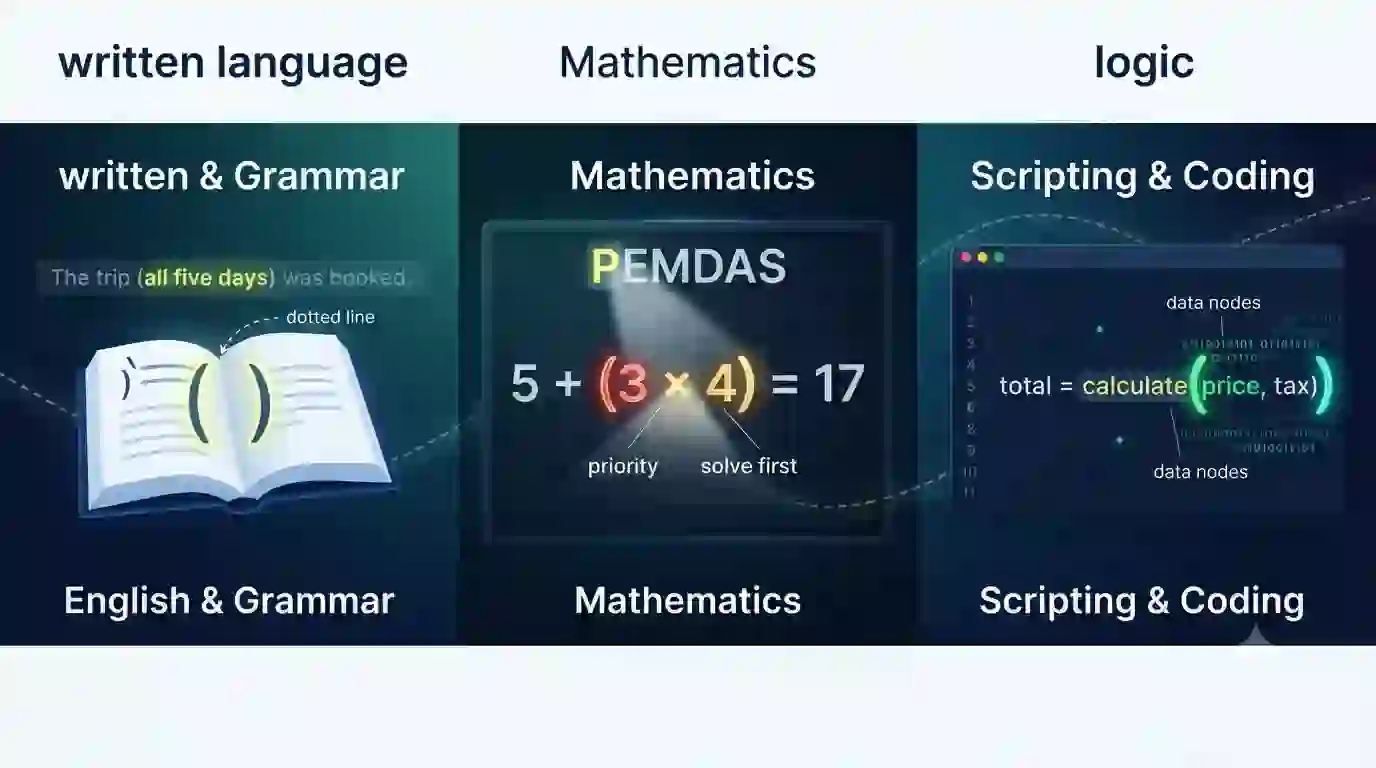
This rule sits at the top of the order of operations, often remembered through the acronym PEMDAS: Parentheses, Exponents, Multiplication and Division, Addition and Subtraction. Math teachers rely on this fixed sequence for a simple reason: without an agreed-upon order, the same expression could produce several different answers depending on who solves it. Parentheses remove that risk by marking the one part of an equation that must be handled before anything else touches it.
Example: 5 + (3 × 4)
Without parens, a student might add 5 and 3 first. With them, the rule is clear: multiply 3 by 4 first, then add 5. The answer becomes 17, not 32.
Quick math rules worth memorizing:
- Always solve the innermost parentheses first when expressions are nested.
- Treat everything inside a single set of parens as one unit before moving to the next operation.
- Use brackets [ ] around parentheses when an expression needs a second layer of grouping, so the structure stays easy to read.
- Remember that a number placed right before parens, like 4(3 + 2), means multiplication.
Once a student understands this rule, order-of-operations problems stop feeling like guesswork and start following a clear, repeatable pattern.
Parens Meaning in Script: Parentheses in Coding Languages
For developers, this idea covers three main jobs: calling a function, grouping an expression, and building certain data structures. The exact use depends on the programming language, but the underlying logic stays consistent.
In JavaScript, parens act as what’s known as a grouping operator. Wrapping part of an expression in parens tells the program to evaluate that piece first, ahead of the language’s usual operator order. That means writing (2 + 3) * 4 forces addition to happen before multiplication, the same logic taught in math class.
Parens also call functions. Typing myFunction() tells the program to run that function right now. Leaving off the parens, as in myFunction, only refers to the function without executing it.
In Python, the idea stretches even further, since these marks also build a tuple, an ordered set of values that can’t be changed later. An empty pair of parentheses creates an empty tuple on its own, but a single value needs a trailing comma placed right after it; wrapping just one item in parentheses without that comma still leaves it as the original data type, not a tuple.
Common coding uses of parens:
- Calling a function or method:
print("Hello") - Grouping math or logical expressions:
(a + b) * c - Defining parameters in a function:
def greet(name): - Building tuples in Python:
(1, 2, 3) - Wrapping conditions in an if-statement:
if (age > 18)
Missing or mismatched parens is one of the most common bugs in programming. A single unclosed parenthesis can throw an error across an entire file, so pairing them correctly matters just as much as understanding the concept.
Parentheses vs. Brackets vs. Braces: What’s the Difference?
People often use “parens,” “brackets,” and “braces” as if they mean the same thing. They don’t. Each symbol has its own shape and its own job.
| Symbol | Common Name | Typical Use | Example |
|---|---|---|---|
| ( ) | Parentheses / Parens | Extra info in writing; grouping in math; function calls in code | (see page 12), (2+3)*4, print(“hi”) |
| [ ] | Square brackets | Editorial notes in writing; nested grouping in math; lists/indexing in code | [sic], 2 + [3 × (4−1)], list[0] |
| { } | Curly braces | Set notation in math; code blocks and objects in programming | {1, 2, 3}, function() { return x; } |
| < > | Angle brackets | HTML/XML tags; generic types in some languages | <div>, List<String> |
Knowing this table helps you avoid mixing symbols in the wrong context, which is a quick way to create confusing sentences or broken code.
Types of Parentheses You Should Know
Not every set of parens does the same job, even within one field. Here are the main types you will run into:
- Round parentheses ( ) – the standard form, used for asides in writing, grouping in math, and function calls in code.
- Nested parentheses – parens placed inside other parens, common in complex math expressions and layered code logic.
- Citation parentheses – used in academic writing to hold a source, date, or page number, such as (Smith, 2023).
- Interruption parentheses – hold a full aside that breaks the flow of a sentence on purpose, often for humor or emphasis.
- Function-call parentheses – found directly after a function name in programming, telling the program to execute it.
Recognizing these types makes it easier to apply the right rule the moment you see a set of curved marks.
Common Mistakes People Make With Parens

Even confident writers and coders slip up with parens. Watching for these mistakes keeps your writing clean and your code error-free.
- Placing a period inside the closing parens when the enclosed text is part of a larger sentence.
- Overusing parenthetical asides until the main sentence gets lost.
- Forgetting to close a parenthesis in code, which triggers a syntax error.
- Mixing up parentheses, brackets, and braces in math expressions.
- Nesting too many nested parens in writing, making sentences hard to follow.
A quick proofread or a code linter catches most of these issues before they cause bigger problems.
Parens Meaning at a Glance: Complete Reference Table
This table sums up the idea across every major context, side by side, for a fast comparison.
| Context | What Parens Mean Here | Example | Key Rule |
|---|---|---|---|
| English grammar | Extra, optional information | The trip (all five days) was fully booked. | Sentence must work without the parenthetical part |
| Mathematics | Grouping symbol; solve first | 5 + (3 × 4) = 17 | Always solve inside parens before other operations |
| Programming (general) | Function calls and grouping | total(price, tax) | Every opening parenthesis needs a matching close |
| Python (tuples) | Ordered, unchangeable collection | (1, 2, 3) | A single-item tuple needs a trailing comma |
| JavaScript | Grouping operator for precedence | (2 + 3) * 4 | Overrides normal operator order |
| Citations (APA/MLA) | Holds author, date, or page | (Johnson, 2024) | Placed right after the referenced idea |
| Legal or technical text | Defines a term or abbreviation | the buyer (“Client”) agrees | First use defines the term for later reference |
Keep this table handy any time you need a fast answer instead of scrolling back through the full explanation.
How to Use Parens Correctly: Step-by-Step Rules
Follow these steps any time you’re unsure whether parens belong in your sentence, formula, or code.
- Check if the information is optional. If removing it doesn’t break the sentence, parens are a good fit.
- Match every opening mark with a closing one. In writing, math, and code, an unmatched parenthesis is always a mistake.
- Solve or read the inside first. In math and code, whatever sits inside parens gets handled before the rest of the expression.
- Keep punctuation outside, unless the entire enclosed sentence stands alone.
- Avoid overcrowding one sentence with multiple parenthetical remarks; split them into separate sentences instead.
- Test your code after adding or removing parens, since even one missing mark can break an entire script.
These six steps cover almost every situation where this question comes up, from a quick email to a multi-line function.
Parens in Popular Programming Languages: A Side-by-Side Look
The way parens work shifts slightly across programming languages, even though the core purpose, grouping and calling, stays consistent.
| Language | Main Use of Parens | Example |
|---|---|---|
| Python | Function calls, tuples, grouping | (a, b), print(x) |
| JavaScript | Function calls, grouping operator, arrow functions | (x) => x * 2 |
| Java | Method calls, casting, conditionals | if (x > 0) |
| C | Function declarations, casting, conditionals | int add(int a, int b) |
| SQL | Grouping conditions, function arguments | WHERE (age > 18 AND active = 1) |
New coders benefit from studying this table early, since misreading how parens work in one language often causes confusion when switching to another.
Why Parens Meaning Matters for Clear Communication
Parens meaning isn’t just a grammar footnote or a coding technicality. It shapes how clearly an idea comes across, whether you’re writing a report, solving an equation, or building an app.
A misplaced parenthesis in writing buries the main point under unnecessary detail. A missing parenthesis in math changes the entire answer. A single unclosed parenthesis in code stops a program from running at all. Getting parens right, in every field, protects clarity and prevents small errors from turning into big problems.
Once you internalize how these curved marks work across all three areas, math, scripting, and English, you start reading formulas, code, and sentences with real confidence instead of guesswork.
Frequently Asked Questions About Parens Meaning
1. What is the simplest parens meaning? Parens is a short, casual word for parentheses, the curved marks ( ) used to add extra information. Writers, teachers, and coders use “parens” as a quick nickname instead of saying the full word “parentheses” every time.
2. What is parens meaning in math? In math, this term refers to a grouping symbol that tells you which part of an expression to solve first. This rule sits at the top of the order of operations, so anything inside parens gets calculated before exponents, multiplication, division, addition, or subtraction.
3. What is parens meaning in script or coding? In coding, parens meaning covers function calls, grouped expressions, and certain data structures like Python tuples. Typing a function name followed by parens, such as print(), tells the program to run that function immediately.
4. What is parens meaning in English grammar? In English grammar, this term refers to punctuation marks that hold extra, non-essential information inside a sentence. The main sentence should still make complete sense even if you remove everything inside the parens.
5. Are parentheses and brackets the same thing? No. Parentheses are curved ( ), while brackets are square [ ], and each one plays a different role across writing, math, and programming. Brackets often show editorial notes in writing or handle nested grouping and list indexing in code.
6. Can a sentence start with parens? Yes, a sentence can open with a parenthesis, though the punctuation shifts slightly based on context. If the entire sentence sits inside the parens, it gets its own capital letter and closing punctuation before the final mark.
Master Parens Meaning: Your Next Step
Parens meaning changes shape across English, math, and code, but the core idea never does: these curved marks group extra information so the main point stays clear. Use the reference table above the next time you’re unsure whether a parenthesis belongs in your sentence, formula, or function. Bookmark this guide, share it with a student or teammate who mixes up parens and brackets, and start applying these rules in your next piece of writing or code today.