What Is the Capital of France? A Complete Guide to Paris
Millions of people search this exact question every month, yet many pages online repeat outdated numbers or skip the real story behind the answer. Guessing wrong on a school test, a pub quiz, or a travel plan wastes time and creates confusion later. This guide answers what is the capital of France in plain terms, then backs it up with verified facts, dates, and figures you can actually use.
What Is the Capital of France? The Quick Answer
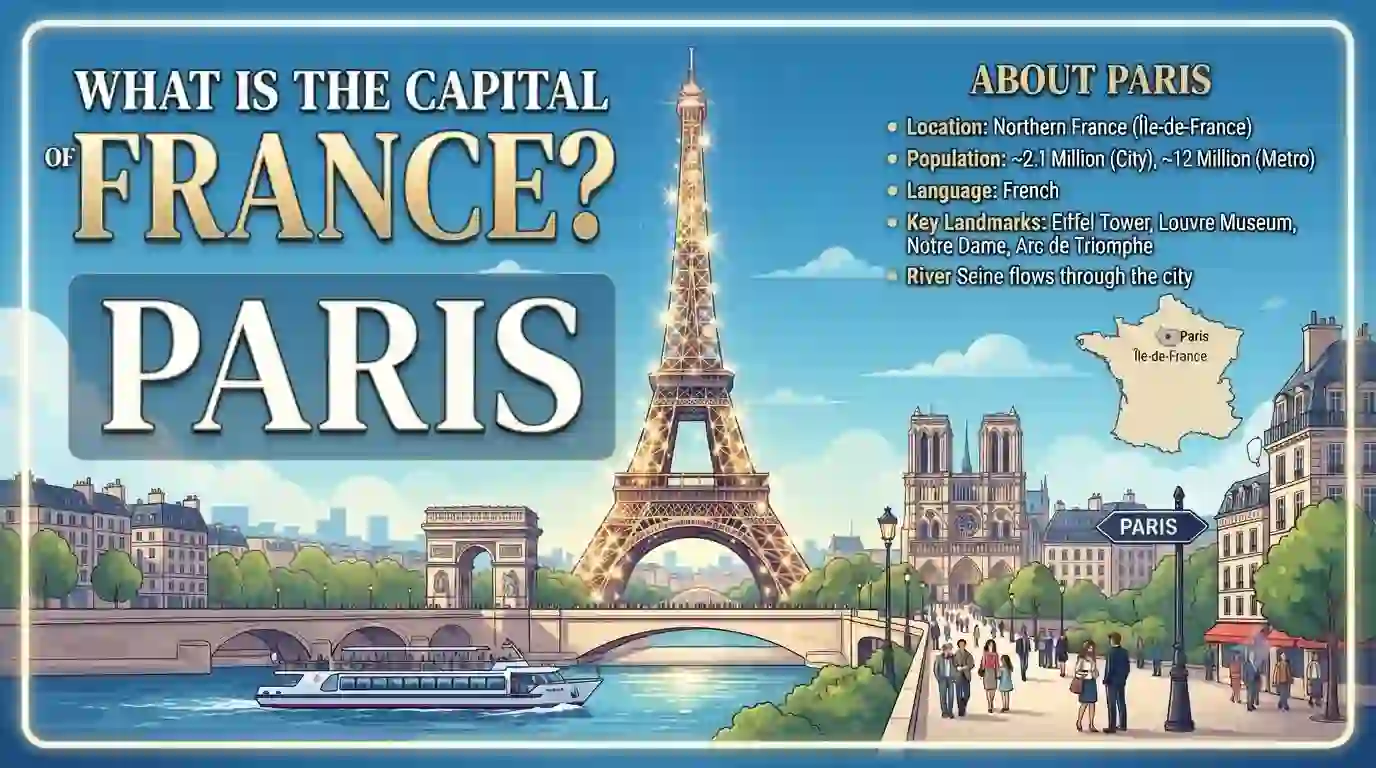
Paris is the capital of France. It sits on the Seine River in the north-central part of the country and has held this role, with one short interruption, since the year 987.
Paris is also the largest city in France by population. It functions as the seat of the national government, the home of the President, and the country’s main center for business, culture, and tourism. When someone asks what is the capital of France, the single-word answer is Paris, but the full picture involves centuries of history and a city that shapes daily life across the entire nation.
Quick Facts Table: Capital of France at a Glance
The table below answers what is the capital of France through hard numbers and core details. Save it for quick reference.
| Category | Detail |
|---|---|
| Official capital | Paris |
| Country | France |
| Region | Île-de-France |
| Coordinates | 48.8566° N, 2.3522° E |
| River | Seine |
| Population (city proper) | Around 2.1 million residents |
| Metro area population | Roughly 10–12 million residents |
| Area (city proper) | About 105 square kilometers |
| Arrondissements | 20 administrative districts |
| First settled | Around the 3rd century BC |
| Became national capital | 987 CE, under Hugh Capet |
| Official language | French |
| Currency | Euro (€) |
| Time zone | Central European Time (CET/CEST) |
| Government type | Republic (President and Prime Minister) |
| UNESCO World Heritage status | Banks of the Seine, inscribed in 1991 |
| Main airports | Charles de Gaulle, Orly |
| Nickname | The City of Light |
Where Is the Capital of France Located?
Paris sits in the north-central region of France, roughly 280 kilometers south of London and about 450 kilometers north of Lyon. The Seine River runs directly through the city and splits it into the Left Bank and the Right Bank.
The city belongs to the Île-de-France region, which many people simply call the Paris region. This region holds close to a fifth of the entire French population, even though it covers a small share of the country’s total land area.
Flat terrain and a mild river valley climate made the site easy to build on and easy to defend. Anyone who wonders what is the capital of France in terms of geography should picture a compact, walkable city built around a river, surrounded by a much larger metropolitan area that stretches into the suburbs.
Why Is Paris the Capital of France?
Paris earned its status through a mix of geography, trade, and political power. The city sits at a natural crossroads where river and land routes meet, which made it valuable for commerce since ancient times.
Roman administrators recognized this advantage first, followed by Frankish kings who used the city as a base of power. Later, the Capetian dynasty made the choice permanent, and Paris grew into the administrative heart of the kingdom.
Modern France kept this arrangement in place. Every major branch of government, the courts, the parliament, and the presidency, still operates from Paris today, which reinforces why the capital of France remains centered here rather than shifting to another city.
Centralization also plays a role. French policy has favored a single dominant administrative hub for centuries, unlike countries that split government functions across several cities. This tradition keeps Paris firmly in place as the answer whenever people ask what is the capital of France.
A Brief History of How Paris Became France’s Capital
Understanding what is the capital of France today means looking back at how the title moved and settled over roughly two thousand years.
Ancient Origins
A Celtic tribe called the Parisii settled along the Seine around the 3rd century BC. They built their community on the Île de la Cité, an island that offered natural protection from raids and easy access to river trade routes.
Julius Caesar’s forces captured the settlement in 52 BC and built a Roman town called Lutetia on the site. Roman engineers expanded the settlement onto the Left Bank, adding baths, an amphitheater, and a road network that connected the town to the rest of Gaul.
The First Capital Status
Frankish king Clovis I took control of the region and made it his capital in the early 6th century. For several centuries afterward, French rulers moved the seat of power between different cities, including Lyon and Aachen, depending on which dynasty held the throne.
This period left Paris without a fixed status for a while. Viking raids in the 9th century further threatened the city’s stability, though the population held on and rebuilt after each attack.
Permanent Capital Under the Capetians
Paris became the fixed capital of France in 987, when Hugh Capet took the throne and started the Capetian dynasty. From this point forward, Paris kept its position as the political center almost continuously.
Under later Capetian kings, the city expanded rapidly. The University of Paris opened in the 12th century, the Louvre began as a fortress around 1200, and construction on Notre-Dame Cathedral started in the same era.
Modern Transformation
The 19th century brought the biggest physical change in the city’s history. Emperor Napoleon III commissioned Baron Haussmann to redesign the streets, replacing narrow medieval alleys with wide boulevards, uniform building facades, and new public parks.
The One Interruption
During the Second World War, the Vichy government briefly operated from the town of Vichy while Germany occupied Paris. Once Allied forces liberated the city in August 1944, the French government returned, and Paris has held the title without interruption since then.
Paris Population and Demographics
Population figures shift slightly depending on the source and the year of the count, but the city proper holds around 2.1 million residents based on recent French national statistics. The wider metropolitan area, which includes the suburbs, holds closer to 10 to 12 million people, making it one of the most populous urban areas in the European Union.
Paris has a younger median age than the rest of France, driven largely by students, young professionals, and international workers who move there for opportunities. The city also has one of the highest population densities in Europe, since most residents live within a compact 105-square-kilometer footprint.
International residents make up a notable share of the population as well. Communities with roots across Europe, North Africa, and beyond have shaped the city’s neighborhoods, food scene, and cultural calendar for generations.
People who ask what is the capital of France sometimes assume the answer relates only to size. Paris is indeed the largest French city, but its capital status comes from its political role, not just its population count.
Government and Political Role of the Capital of France
Paris houses every major French government institution. The President works and resides at the Élysée Palace in the 8th arrondissement, while the Prime Minister operates from the Hôtel Matignon nearby.
The two chambers of the French Parliament also sit in Paris. The National Assembly meets at the Palais Bourbon, and the Senate meets at the Palais du Luxembourg. Foreign embassies, international organizations, and diplomatic missions concentrate their French operations in the city for direct access to these institutions.
This concentration of government offices explains why officials and organizations base their operations in Paris rather than any other city. The answer to what is the capital of France carries real political weight, since national policy, foreign relations, and legal authority all flow from this single location.
Economy of the Capital of France
Paris generates a large share of French economic output relative to its size. The Île-de-France region alone accounts for roughly a third of the country’s gross domestic product, despite holding a much smaller share of its land area.
The La Défense business district, just outside the city center, hosts the headquarters or major offices of numerous multinational companies, banks, and financial institutions. Euronext Paris, one of the largest stock exchanges in Europe, also operates from the city, giving it a central role in continental finance.
Tourism adds another major layer to the local economy. Millions of international visitors arrive each year specifically to see the landmarks, museums, and neighborhoods that made the capital of France famous worldwide, supporting jobs in hospitality, retail, and transportation.
Transportation In and Out of the Capital of France
Getting around Paris rarely requires a car. The Paris Métro operates 16 lines and moves millions of passengers daily, connecting nearly every neighborhood within a short walk of a station.
The RER regional rail network extends service further into the suburbs, linking the city to nearby towns and both major airports. Extensive bus routes and a growing bike-share system fill in the remaining gaps for shorter trips.
Two major airports, Charles de Gaulle and Orly, connect the capital of France to destinations across the globe. High-speed TGV trains fan out from central Paris stations toward Lyon, Marseille, Bordeaux, and beyond, while the Eurostar service links the city directly to London through the Channel Tunnel.
How Paris Is Organized: The 20 Arrondissements
The city divides into 20 administrative districts called arrondissements, arranged in a clockwise spiral starting from the center near the Louvre. Each district carries its own character, local mayor, and neighborhood identity.
The 1st arrondissement holds the Louvre and the historic core of the city. The 4th covers Le Marais, known for narrow streets and historic architecture. The 18th contains Montmartre, home to the Sacré-Cœur Basilica and a long history tied to artists and writers.
This system helps residents and visitors navigate a dense city efficiently, and it plays a practical role in everything from postal addresses to school zoning across the capital of France.
Top Landmarks That Define the Capital of France
Paris holds some of the most recognized landmarks on Earth. These sites draw millions of visitors every year and shape how people picture the city.
- The Eiffel Tower – An iron lattice tower completed in 1889, now one of the most visited paid monuments in the world.
- The Louvre Museum – The largest art museum on the planet, housing the Mona Lisa and thousands of other works.
- Notre-Dame Cathedral – A Gothic cathedral on the Île de la Cité, under restoration after a 2019 fire, with construction dating back to the 12th century.
- Sainte-Chapelle – A smaller Gothic chapel famous for its stained-glass windows.
- Arc de Triomphe – A monumental arch honoring soldiers who fought for France.
- Sacré-Cœur Basilica – A white domed basilica sitting at the highest point in the city, in Montmartre.
- Musée d’Orsay – A former railway station turned museum, holding one of the finest Impressionist art collections anywhere.
- Centre Pompidou – A modern art museum recognizable by its exposed pipes and external escalators.
The Banks of the Seine, which include many of these landmarks, earned UNESCO World Heritage status in 1991 for showing more than two thousand years of urban development along a single riverfront.
Culture, Food, and Lifestyle in the Capital of France
Long before there was such a thing as modern tourism, Paris was known throughout the world for its cuisine, fashion, and the arts. The city holds thousands of restaurants, bakeries, and cafés, ranging from casual bistros to some of the most awarded fine-dining establishments in the world.
Fashion houses such as Chanel, Dior, and Louis Vuitton keep their headquarters in Paris, and the city still hosts major fashion weeks that influence global trends. Museums, galleries, and independent bookshops fill nearly every district, supporting a creative economy that predates most modern capitals.
Literature and cinema owe a large debt to the city as well. Generations of writers and filmmakers used Paris as both a home base and a backdrop, cementing its reputation as a center of artistic life well beyond France’s own borders.
Daily life in Paris moves at a walkable pace. Most residents rely on the extensive Métro system, and neighborhood markets remain a normal part of weekly routines rather than a tourist attraction.
Education and Universities in the Capital of France
Paris has served as an academic center since the Middle Ages, when the University of Paris, later known as the Sorbonne, opened in the 12th century. That institution helped establish the city as one of the intellectual hubs of medieval Europe.
Today, the capital of France hosts dozens of universities and research institutions, drawing students from across the globe. Strong programs in law, medicine, engineering, and the arts continue to attract both French and international scholars each year.
Paris Climate and the Best Time to Visit
Paris has a temperate climate with four distinct seasons. Summers stay mild, usually between 20°C and 25°C, while winters rarely drop far below freezing.
The best seasons for walking trips and outdoor sightseeing are spring and early fall. Many travelers choose April through June or September through October specifically to avoid summer crowds while still enjoying decent weather.
Winter brings shorter days and occasional rain, but hotel prices drop and popular sites carry smaller crowds during this period.
How the Capital of France Compares to Other French Cities
Paris stands far ahead of other French cities in population, economic output, and political influence. Marseille, the second-largest city, holds under a million residents, less than half of what Paris holds within city limits.
| City | Approximate Population | Known For |
|---|---|---|
| Paris | 2.1 million | Capital, government, global tourism |
| Marseille | 870,000 | Mediterranean port, seafood |
| Lyon | 520,000 | Gastronomy, former Roman capital |
| Toulouse | 490,000 | Aerospace industry |
| Nice | 340,000 | Riviera coastline, tourism |
The mix of population size, political presence, and cultural export is unique to this city in France. This gap is a major reason the question what is the capital of France rarely causes real confusion among people familiar with the country.
Fun and Surprising Facts About the Capital of France
- Paris covers only about 105 square kilometers within city limits, smaller than many mid-sized American cities.
- The city’s nickname, “The City of Light,” refers partly to its early adoption of street lighting and partly to its role during the Age of Enlightenment.
- Paris has 37 bridges crossing the Seine within the city itself.
- The Paris Métro carries more than 4 million riders on an average day.
- Notre-Dame Cathedral took nearly two centuries to complete, starting construction in the 12th century.
- Paris hosted the Summer Olympics in 1900, 1924, and again in 2024.
Common Mistakes People Make About the Capital of France
Some visitors confuse Paris with other well-known European capitals, or they assume the capital changed at some point in modern history. Neither is accurate.
A smaller number of people mix up Paris, France with Paris, Texas, or other towns sharing the same name worldwide. Search engines occasionally return mismatched results for casual queries, which adds to the confusion.
Sticking to verified sources, such as national statistics offices and established encyclopedias, avoids these mix-ups when researching what is the capital of France for school projects or travel planning.
Practical Tips for Visiting the Capital of France
A little planning goes a long way in Paris. Buy a multi-day transit pass at the start of your trip rather than single tickets, since it saves money on Métro and bus rides across a packed sightseeing schedule.
Book tickets for major museums and the Eiffel Tower online in advance. Long lines form at ticket counters during peak season, and skipping that wait frees up hours for actual sightseeing.
Pack comfortable shoes over anything else. Cobblestone streets and long museum halls cover more ground than most visitors expect, and public transit still involves plenty of walking between stations and entrances.
Basic French phrases help too. Locals respond warmly to a simple “bonjour” or “merci,” even in busy tourist zones, and it smooths over small interactions in shops, cafés, and taxis throughout the capital.
Frequently Asked Questions About the Capital of France
What is the capital of France? Paris is the capital of France. It has held this title since 987, with a brief interruption during World War II, and it remains the seat of the French government today.
Has France always had Paris as its capital? No. Before Paris, the Romans used Lyon as an administrative center, and Frankish kings occasionally ruled from other locations. Paris became the fixed and lasting capital in 987 under Hugh Capet.
What language do people speak in the capital of France? French is the official and dominant language spoken in Paris. English is widely understood in tourist areas, hotels, and major business districts.
What is the population of the capital of France? The city proper holds around 2.1 million residents, according to recent French national statistics. The greater metropolitan area holds closer to 10 to 12 million people.
Is Paris the largest city in France? Yes. Paris is both the capital and the largest city in France by population, followed by Marseille and Lyon.
What is the capital of France famous for? Paris is famous for landmarks like the Eiffel Tower and the Louvre, along with its influence on fashion, food, art, and architecture across the world.
Final Thoughts on the Capital of France
Paris answers the question of what is the capital of France through more than a thousand years of continuous political history, a population base of over two million residents, and a cultural footprint that reaches nearly every country on Earth. The city combines government authority with global influence in a way few capitals ever manage.
Anyone planning a trip, writing a report, or simply settling a trivia debate now has the full picture beyond the one-word answer. Explore the linked landmarks above, bookmark the facts table for later, and share this guide with anyone still asking the same question.