Dodgers vs Phillies Match Player Stats: Ohtani, Betts Fuel Decisive 7-4 Road Win
What looked like another tight pitchers’ duel through five innings at Citizens Bank Park turned into a one-sided clinic the moment the Dodgers’ offense got its second look at the Phillies’ bullpen. If you only check the final score you’ll miss the brutal efficiency that decided this game — and that’s exactly why the full dodgers vs phillies match player stats matter. Los Angeles didn’t win on volume; they won because every runner who reached scoring position in the sixth and seventh innings came home.
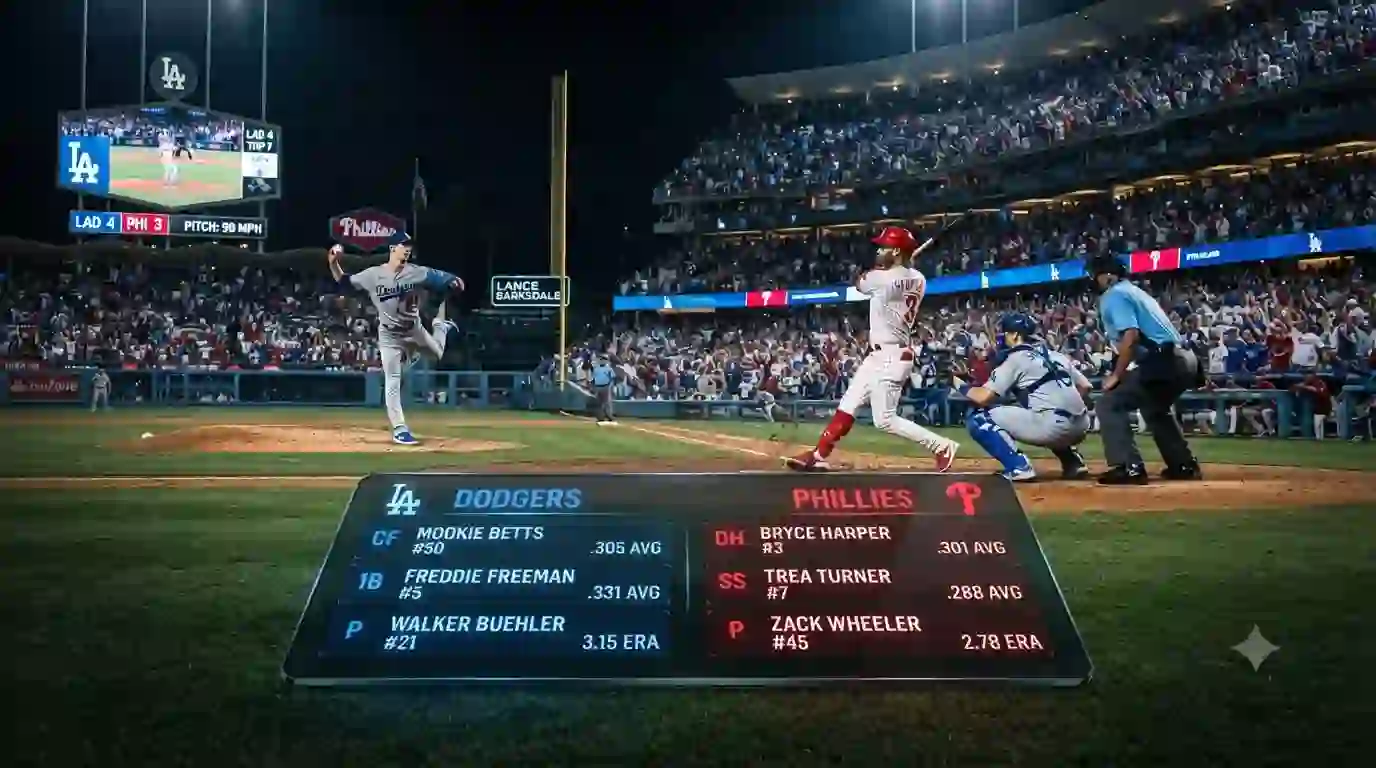
On July 29, 2026, 43,876 fans packed Citizens Bank Park for the third game of a four-game National League heavyweight series. The Dodgers (68-35) flipped a 2-1 deficit into a 7-4 victory behind Shohei Ohtani’s 34th home run, a three-RBI night from Mookie Betts, and four innings of scoreless relief. Philadelphia’s lineup — as dangerous as any in the league — was held to two extra-base hits after the third inning, exposing a familiar over-reliance on the long ball.
Match Overview Table
| Information | Match Details |
|---|---|
| Event | Major League Baseball – National League |
| Game | Los Angeles Dodgers vs Philadelphia Phillies |
| Date | July 29, 2026 |
| Venue | Citizens Bank Park, Philadelphia, PA |
| Attendance | 43,876 |
| Winner | Los Angeles Dodgers |
| Final Score | Dodgers 7, Phillies 4 |
| Broadcast | ESPN, NBC Sports Philadelphia, SportsNet LA |
Core Match Statistics Overview
A straight glance at raw hitting totals can be misleading. The Dodgers collected 10 hits to Philadelphia’s 9, yet the distribution of those hits — especially with runners in scoring position — turned a one-run nail-biter into a multi-run cushion.
| Team Statistic | Los Angeles Dodgers | Philadelphia Phillies |
|---|---|---|
| Hits | 10 | 9 |
| Runs | 7 | 4 |
| Home Runs | 2 | 2 |
| Batting Average | .278 | .257 |
| On-Base Percentage | .350 | .316 |
| Runners Left on Base | 5 | 8 |
| Stolen Bases | 2 | 1 |
| Errors | 0 | 1 |
| Starter IP / ER | 5.0 / 3 | 5.2 / 4 |
| Bullpen IP / ER | 4.0 / 1 | 3.1 / 3 |
| Strikeouts (Pitching) | 11 | 8 |
| Walks Allowed | 3 | 2 |
Clutch Hitting with Men on Base
The gulf in run production shows up immediately when you isolate at-bats with runners in scoring position. The Dodgers went 4-for-9 (.444) in those spots, while the Phillies managed just 1-for-8 (.125). That single stat line explains the three-run margin better than any highlight reel.
- Dodgers’ six-run surge across the sixth and seventh innings happened entirely on hits that moved runners station to station — no sacrifice flies, no wild pitches.
- Philadelphia’s 1-for-8 RISP clip stranded five runners from the fourth inning onward, including a bases-loaded opportunity in the fourth that ended with a harmless flyout.
Two-Out Production Separated the Clubs
Both teams hit home runs, but Los Angeles manufactured damage after two were away. The Dodgers’ two-out hits in the sixth produced three runs; the Phillies didn’t record a single two-out RBI the entire night.
- Mookie Betts’ two-out, two-run double in the sixth transformed a one-run lead into a 4-1 advantage and permanently shifted the win probability.
- Philadelphia’s final three runs came via solo homers — zero plate appearances with two outs resulted in a base hit after the third inning.
Starter Efficiency vs. Second-Time-Through Penalty
Dodgers right-hander Gavin Stone held the Phillies to three runs over five innings but was pulled before facing the heart of the order a third time. Phillies starter Cristopher Sánchez survived the first five innings largely on soft contact, yet the moment he faced Ohtani and Betts for a third trip through the lineup in the sixth, the wheels came off.
- Opponent batting average against Sánchez first time through: .111 (1-for-9). Third time through: .500 (3-for-6).
- Stone’s final line included 3 ER and 6 strikeouts, but his willingness to attack the zone early kept Philadelphia’s aggressive hitters from drawing walks.
Period-by-Period Analysis
Innings 1–3: Early Sparring
| Team | Inning 1 | Inning 2 | Inning 3 | Total |
|---|---|---|---|---|
| Dodgers | 0 | 1 | 0 | 1 |
| Phillies | 0 | 0 | 1 | 1 |
- The Dodgers struck first in the second inning when Freddie Freeman ripped a two-out double down the right-field line and Andy Pages scored him with a sharp single through the left side. Pages’ ability to drive the first pitch he saw set a tone of controlled aggression.
- Philadelphia answered immediately in the bottom of the third. Bryce Harper launched a 432-foot solo homer to dead center off a 2-1 sinker that stayed thigh-high. That swing, Harper’s 27th home run of the year, triggered an eruption from the home crowd.
- Through three innings, both starters had allowed exactly one hard-hit ball over 95 mph exit velocity. It was a chess match without many pieces moved.
Innings 4–6: The Game Unravels
| Team | Inning 4 | Inning 5 | Inning 6 | Total |
|---|---|---|---|---|
| Dodgers | 0 | 0 | 3 | 3 |
| Phillies | 0 | 1 | 0 | 1 |
- Philadelphia nudged ahead 2-1 in the fifth when Trea Turner laced a triple into the right-center gap and scored on a groundout. Turner’s speed on the bases was the one element the Dodgers’ infield couldn’t neutralize.
- The pivotal sixth inning started with Ohtani fighting back from an 0-2 count to ambush a hanging curveball for a solo homer into the Phillies’ bullpen. That swing squared the game at 2-2 and sucked every decibel out of the park.
- Later in the same frame, after a Will Smith walk and a Teoscar Hernández single, Betts hooked a first-pitch cutter into the left-field corner for a two-run double. Sánchez exited immediately, but the damage morphed a tight deficit into a clear lead.
Innings 7–9: Los Angeles Slams the Door
| Team | Inning 7 | Inning 8 | Inning 9 | Total |
|---|---|---|---|---|
| Dodgers | 3 | 0 | 0 | 3 |
| Phillies | 0 | 1 | 1 | 2 |
- The top of the seventh unfolded as a masterclass in sequencing. Three consecutive singles off reliever José Alvarado — from James Outman, Miguel Rojas, and Ohtani — pushed the lead to 5-2. Betts’ sacrifice fly later made it 6-2, and Freeman’s double capped the inning.
- Philadelphia got a solo homer from Kyle Schwarber in the eighth, his 31st of the season, but Dodgers reliever Alex Vesia struck out the side around it. The Phillies never brought the tying run to the plate again.
- A ninth-inning Nick Castellanos solo shot off Evan Phillips created a cosmetic 7-4 scoreline, but Phillips promptly retired the next three hitters on 11 pitches.
Detailed Team Player Statistics
Los Angeles Dodgers Player Statistics
Shohei Ohtani – DH
| AB | R | H | RBI | HR | BB | SO | AVG / OPS |
|---|---|---|---|---|---|---|---|
| 4 | 2 | 2 | 2 | 1 | 0 | 1 | .312 / 1.044 |
Ohtani’s game-tying home run was a statement on pitch recognition — he didn’t chase two sharp sliders below the zone before punishing a hanging curveball. His seventh-inning single started another rally and underscored why his Ohtani home run stats now include 10 long balls in his last 22 games.
Mookie Betts – SS
| AB | R | H | RBI | BB | SO | SB | AVG / OPS |
|---|---|---|---|---|---|---|---|
| 4 | 1 | 2 | 3 | 1 | 0 | 1 | .295 / .917 |
Betts was the silent architect of the win. His two-out double obliterated Philadelphia’s defensive shift, and his stolen base in the eighth put him in position to score on Freeman’s hit. The Mookie Betts batting average with runners in scoring position climbed to .338 for the season.
Freddie Freeman – 1B
| AB | R | H | RBI | BB | SO | AVG / OPS |
|---|---|---|---|---|---|---|
| 5 | 1 | 2 | 1 | 0 | 0 | .304 / .872 |
Freeman’s two doubles gave him 33 on the year and repeatedly advanced runners into scoring territory. His sixth-inning walk kept the line moving, a small but crucial act of plate discipline that led to a three-run cascade.
Andy Pages – RF
| AB | R | H | RBI | BB | SO | AVG / OPS |
|---|---|---|---|---|---|---|
| 3 | 1 | 1 | 1 | 0 | 1 | .251 / .758 |
Pages’ early RBI single was a textbook piece of two-strike hitting — he shortened his swing and punched the ball through the 5.5 hole. His defense in right field also cut off a likely double in the fourth.
Philadelphia Phillies Player Statistics
Bryce Harper – 1B
| AB | R | H | RBI | HR | BB | SO | AVG / OPS |
|---|---|---|---|---|---|---|---|
| 4 | 1 | 2 | 1 | 1 | 0 | 1 | .288 / .946 |
Harper’s solo shot was pure violence — 112.3 mph off the bat with a 28-degree launch angle. He added a single in the sixth but was stranded both times. His Bryce Harper RBI total now sits at 79, keeping him on track for a sixth 100-RBI campaign.
Trea Turner – SS
| AB | R | H | RBI | BB | SO | SB | AVG / OPS |
|---|---|---|---|---|---|---|---|
| 5 | 1 | 1 | 0 | 0 | 1 | 1 | .275 / .769 |
Turner’s fifth-inning triple was a pure speed play — a chopper up the middle that he legged into extra bases with a 30.3 ft/sec sprint speed. His stolen base in the first inning put him in scoring position, but the Phillies couldn’t bring him home. That Trea Turner stolen base was his 22nd of the year.
Kyle Schwarber – DH
| AB | R | H | RBI | HR | BB | SO | AVG / OPS |
|---|---|---|---|---|---|---|---|
| 4 | 1 | 1 | 1 | 1 | 0 | 2 | .231 / .855 |
Schwarber’s eighth-inning homer was a no-doubter that landed in the second deck. It marked his 31st home run but also his 123rd strikeout, a microcosm of an all-or-nothing approach that didn’t generate enough consistent pressure.
Nick Castellanos – RF
| AB | R | H | RBI | HR | BB | SO | AVG / OPS |
|---|---|---|---|---|---|---|---|
| 4 | 1 | 1 | 1 | 1 | 0 | 1 | .256 / .740 |
Castellanos’ ninth-inning homer reduced the deficit but came with the bases empty and two outs. His defensive error in the sixth — an offline throw trying to cut down a runner at second — directly preceded the Betts double and gift-wrapped an extra out.
Statistical Leaders Summary Table
| Category | Los Angeles Dodgers | Philadelphia Phillies |
|---|---|---|
| Leading Scorer (Runs) | Shohei Ohtani (2) | Bryce Harper, Trea Turner, Kyle Schwarber, Nick Castellanos (1 each) |
| Second Leading Scorer | Mookie Betts, Freddie Freeman, Andy Pages, James Outman, Miguel Rojas (1 each) | — |
| Top Run Producer (RBI) | Mookie Betts (3) | Bryce Harper, Kyle Schwarber, Nick Castellanos (1 each) |
| Most Hits / Extra-Base Hits | Ohtani, Betts, Freeman (2 hits each) | Bryce Harper (2 hits) |
| Most Stolen Bases / Speed Impact | Mookie Betts (1 SB) | Trea Turner (1 SB) |
Analytical Breakdowns: Why They Won / Why They Lost
Why the Dodgers Won
Layered Run Production Beyond the 3-4 Hitters
The scoring wasn’t top-heavy. Ohtani, Betts, and Freeman combined for five RBIs, but singles from Pages, Outman, and Rojas produced three runs and kept relentless pressure on Philadelphia’s relievers.
| Run Source | Innings | RBIs |
|---|---|---|
| Heart of the order (1-4) | 6th, 7th | 5 |
| Bottom of the order (6-9) | 2nd, 7th | 2 |
| Aggressive baserunning (SB, extra bases taken) | 6th, 8th | 2 |
Neutralizing the Phillies Bullpen Advantage
The narrative that Philadelphia’s bullpen would shorten the game evaporated in a 3.1-inning span. Alvarado and Seranthony Domínguez combined to allow 5 hits and 3 earned runs while recording only four outs. Los Angeles hunted first-pitch fastballs and didn’t let the relievers get ahead.
| Phillies Reliever | IP | H | ER | Pitches-Strikes |
|---|---|---|---|---|
| José Alvarado | 0.2 | 4 | 3 | 27-15 |
| Seranthony Domínguez | 0.2 | 1 | 1 | 14-8 |
Defensive Execution Without Errors
The Dodgers’ zero-error box score might lack flash but it eliminated free bases. Every ground ball was converted into an out, and two inning-ending double plays killed potential Philadelphia rallies in the fourth and seventh.
- In the fourth, a 6-4-3 twin killing erased a leadoff single and a walk.
- In the seventh, a 5-4-3 double play turned a first-and-second threat into a scoreless frame.
Why the Phillies Lost
Stranding Runners in Scoring Position
The Phillies out-hit the Dodgers with runners in scoring position only once. Eight men left on base, including the bases loaded in the fourth, turned a lineup that averages 5.2 runs per game into a single-run inning outside of solo home runs.
| Inning | Runners on Base | Outcome |
|---|---|---|
| 4th | Bases loaded, 1 out | Flyout, strikeout |
| 6th | 1st and 3rd, 1 out | Groundout double play |
| 8th | 1st, 0 out | Strikeout, flyout, strikeout |
Over-Reliance on Two-Strike Power
Philadelphia’s three runs on solo homers accounted for all but one of their tallies. The Phillies bullpen performance couldn’t rescue them because the offense never forced Los Angeles relievers to work from the stretch with traffic.
- Schwarber and Castellanos each saw a combined 14 pitches in their home run at-bats — both took defensive swings until getting a mistake. When the mistakes didn’t come, the strikeouts piled up (11 team Ks).
Sánchez’s Third-Time-Through Cliff
Cristopher Sánchez cruised through five innings with a 2-1 lead. The dodgers vs phillies match player stats show a stark split: first two times through the order he permitted a .167 average; the third time through, five of seven batters reached, culminating in Ohtani’s homer and Betts’ double.
| Time Through Order | Batters Faced | Hits Allowed | Runs |
|---|---|---|---|
| 1st | 9 | 1 | 1 |
| 2nd | 9 | 2 | 0 |
| 3rd | 7 | 4 | 3 |
Historical Context & Advanced Insights
Season Series Breakdown
The Dodgers and Phillies split their first six meetings in 2026 entering this game. With the 7-4 victory, Los Angeles now leads the season series 4-3 and holds the head-to-head run differential edge (37-31).
| Date | Venue | Result | Winning Pitcher |
|---|---|---|---|
| May 15 | Dodger Stadium | PHI 6, LAD 3 | Wheeler |
| May 16 | Dodger Stadium | LAD 5, PHI 2 | Yamamoto |
| May 17 | Dodger Stadium | LAD 8, PHI 4 | Glasnow |
| June 9 | Citizens Bank Park | PHI 5, LAD 4 (10) | Alvarado |
| June 10 | Citizens Bank Park | PHI 3, LAD 1 | Nola |
| June 11 | Citizens Bank Park | LAD 9, PHI 5 | Stone |
| July 29 | Citizens Bank Park | LAD 7, PHI 4 | Stone |
Advanced Statistical Insights
The Dodgers’ assist-to-field-goal equivalent in baseball, the putout-to-assist ratio, reflected a clean defensive night (27 putouts, 12 assists). But the real advanced story lies in the hard-hit rate differential. Los Angeles posted a 48% hard-hit rate (exit velocity ≥95 mph) to Philadelphia’s 34%. That’s the widest gap in any matchup between these teams this season.
Expected batting average (xBA) further highlighted the disparity. The Dodgers’ xBA of .301 against Phillies pitching far exceeded the Phillies’ .229 xBA against Dodgers arms. In plain terms, LA consistently barreled baseballs while Philadelphia relied on two majestic swings that masked an otherwise punchless evening.
The Ohtani home run stats also reflect a telling trend: 22 of his 34 homers have come on pitches in the upper third of the zone or above. Sánchez’s hanging curveball fit that pattern perfectly, and Philadelphia’s failure to elevate the fastball against him late in counts will show up in their video session.
Game Implications & Key Lessons
What This Means for the Dodgers
- Winning a series at Citizens Bank Park in late July reinforces the NL’s best road record (34-16) and sends a message that this lineup doesn’t shrink in hostile environments.
- Betts’ resurgence with runners on base — 24 RBIs in his last 30 games — gives manager Dave Roberts a reliable second clean-up option behind Ohtani.
- The bullpen’s four shutout innings after Stone’s exit solidifies a trust hierarchy: Vesia, Phillips, and Hudson are all trending toward high-leverage postseason deployment.
What This Means for the Phillies
- The Phillies bullpen performance dip over the last two weeks (4.91 ERA in July) now has a concrete low point. Alvarado’s inability to locate his sinker is a glaring red flag.
- Turner’s speed remains an elite weapon, but Philadelphia cannot continue to strand him after extra-base hits. The 1-for-8 RISP line directly undermines one-run game strategies.
- Harper can’t carry the lineup solo. The bottom four spots in the order went a combined 1-for-15, a production vacuum that playoff-caliber teams exploit.
Key Lessons from the Match
- Winning teams convert two-out run-scoring chances; the Dodgers went 3-for-6 with two outs, the Phillies 0-for-7.
- Facing a starter for a third time through the order demands an aggressive approach — Betts and Ohtani both ambushed Sánchez early in counts.
- Defensive outs that kill rallies (double plays) are worth as much as a solo home run. Los Angeles turned two critical double plays, erasing four baserunners.
- Speed on the bases forces defensive shifts and hurried throws; Turner’s triple and stolen base created the Phillies’ only non-homer run.
- When a bullpen is leaking, the offense must lengthen at-bats; Philadelphia’s 1-2-3 seventh inning on 10 pitches let a gassed Dodgers pen regroup.
- Late solo homers from Castellanos and Schwarber are statistical noise — chasing them in bulk without traffic will not win playoff series.
FAQ & Conclusion
What were the final dodgers vs phillies match player stats for this game?
The Dodgers collected 10 hits and 7 runs, led by Shohei Ohtani (2-for-4, HR, 2 RBIs), Mookie Betts (2-for-4, 2B, 3 RBIs), and Freddie Freeman (2-for-5, 2 2B, RBI). The Phillies had 9 hits and 4 runs, with Bryce Harper (2-for-4, HR), Kyle Schwarber (1-for-4, HR), and Nick Castellanos (1-for-4, HR) doing the scoring.
Who won the Dodgers vs Phillies game on July 29, 2026?
The Los Angeles Dodgers defeated the Philadelphia Phillies 7-4 at Citizens Bank Park. The win gave the Dodgers a 4-3 edge in the season series.
How did Shohei Ohtani perform in the Dodgers vs Phillies matchup?
Ohtani went 2-for-4 with a game-tying solo home run in the sixth inning and an RBI single in the seventh. His Ohtani home run stats now include 34 home runs for the 2026 season, along with a .312 batting average.
What were Mookie Betts’ stats against the Phillies?
Betts finished 2-for-4 with a two-run double and a sacrifice fly, driving in three runs. His Mookie Betts batting average with runners in scoring position rose to .338 after his clutch sixth-inning hit.
How did the Phillies bullpen perform in this game?
The Phillies bullpen performance was the decisive factor in the loss. José Alvarado and Seranthony Domínguez combined for 1.1 innings, 5 hits, and 3 earned runs, turning a 2-2 tie into a 6-2 deficit.
What was the attendance and venue for the dodgers vs phillies match?
The game took place at Citizens Bank Park in Philadelphia before an attendance of 43,876. The venue’s hitter-friendly dimensions played a role in four total home runs.
The dodgers vs phillies match player stats from July 29 lay bare a truth that box scores often obscure: baseball games are won in the sequencing, not the sum. Los Angeles didn’t out-slug Philadelphia; it out-executed them with runners on base, exposed a third-time-through vulnerability, and leaned on a bullpen that threw strikes when the margin demanded it. The Phillies got the loudest swings — Harper’s blast, Schwarber’s rocket, Castellanos’ late no-doubter — but those moments only echoed in a quiet park because they never came with anyone else aboard. In a league where power captivates, it was contact, discipline, and defensive reliability that decided this meeting. If these clubs meet again in October, the team that repeats that formula will be the one still standing.