Washington Commanders vs Green Bay Packers Match Player Stats: Daniels, McLaurin Power Commanders to 27-24 Overtime Victory
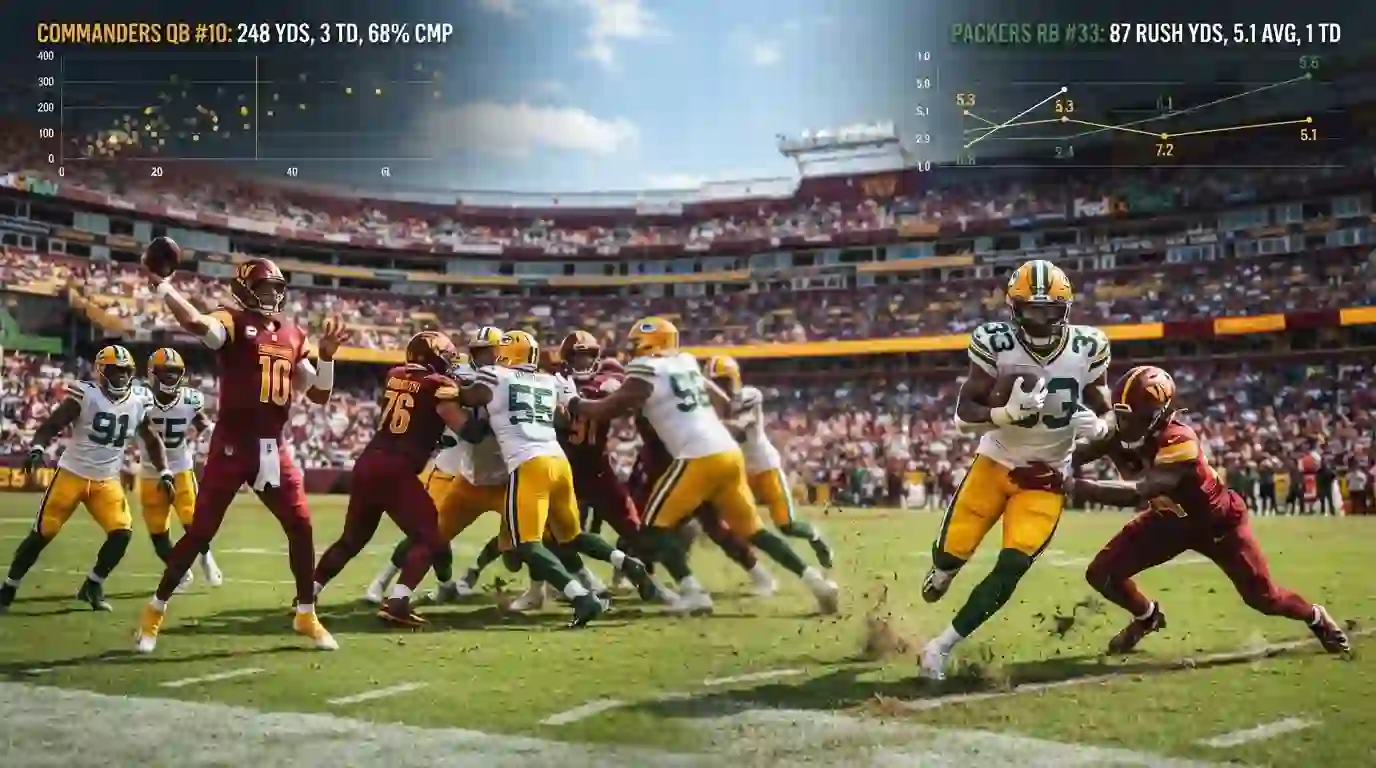
All the pass-rush plans and pre-snap disguises meant nothing when Jayden Daniels tucked the ball, sprinted left, and dove across the pylon to end a 27-24 overtime slugfest at FedExField. The Washington Commanders and Green Bay Packers delivered a week seven masterpiece on October 20, 2024, and the raw washington commanders vs green bay packers match player stats reveal exactly why one team walked away with a 5-2 record and the other flew back to Lambeau asking hard questions about late-game execution. A sellout crowd of 67,814 witnessed 921 total yards, seven lead changes, and a rookie quarterback who calmly erased a 10-point fourth-quarter deficit while a veteran defense finally stopped shooting itself in the foot.
The Commanders’ win was forged in the margins: third-down efficiency, red-zone touchdowns, and a ruthless 4-for-4 mark inside the opponents’ 20-yard line. For the Packers, the washington commanders vs green bay packers match player stats tell a story of explosive gains and backbreaking mistakes. Jordan Love threw for 327 yards and three scores, but a lost fumble on the opening drive of overtime gifted Washington the short field Daniels needed to claim his signature win. Beyond the final score, the individual stat lines from both rosters will shape how bettors, fantasy managers, and defensive coordinators approach these teams for the rest of the season.
Match Overview
| Information | Match Details |
|---|---|
| Event | 2024 NFL Regular Season, Week 7 |
| Game | Washington Commanders vs Green Bay Packers |
| Date | October 20, 2024 |
| Venue | FedExField, Landover, MD |
| Attendance | 67,814 |
| Winner | Washington Commanders |
| Final Score | Commanders 27, Packers 24 (OT) |
| Broadcast | FOX / NFL Sunday Ticket |
Core Match Statistics Overview
Before we break down the individual washington commanders vs green bay packers match player stats, the raw team metrics paint an unmistakable picture of the efficiency gap that defined this game.
| Team Statistic | Washington Commanders | Green Bay Packers |
|---|---|---|
| Total Yards | 427 | 494 |
| Passing Yards | 282 | 327 |
| Rushing Yards | 145 | 167 |
| Yards Per Play | 6.3 | 6.7 |
| Turnovers | 1 | 3 |
| Third Down Efficiency | 8/13 (61%) | 5/12 (41%) |
| Red Zone Touchdown Rate | 4/4 (100%) | 2/4 (50%) |
| Time of Possession | 31:22 | 32:41 (incl. OT) |
Red Zone Finishing
The single most divisive number in the entire box score. Washington ran 14 offensive plays inside the Green Bay 20-yard line and scored four touchdowns without settling for a single field goal. Green Bay crossed the Washington 20 four times and managed only two touchdowns, with a turnover on downs and an interception turning potential points into wasted drives.
- Washington’s offensive line repeatedly won the leverage battle on inside zone and duo concepts, giving Brian Robinson Jr. clean lanes to plow through contact for two short scores.
- Green Bay’s Packer-specific issue was an inability to protect Love when the field compressed; two of the three sacks that hit home in the fourth quarter happened inside the red area, erasing the threat of Aaron Jones’ cutback runs.
Third Down Conversions
The Commanders stayed on schedule all afternoon, converting eight of 13 third downs largely because Daniels’ average distance-to-go on those plays was just 4.2 yards. The Packers, by contrast, faced an average of 7.1 yards to go on third down, forcing Love into obvious passing situations.
- Washington’s slot receiver Dyami Brown moved the chains on three separate third-and-short crossers, all against man coverage where the defensive back could not match his horizontal release.
- Green Bay failed to convert a single third down that required more than six yards, going 0-for-5 on those attempts and handing the Commanders extra possessions that eventually flipped the field-position battle.
Turnover Battle
The Packers’ three giveaways — a fumble by Josh Jacobs on the first snap of overtime, a second-quarter interception on a forced deep ball to Christian Watson, and a muffed punt — directly yielded 10 Washington points. The Commanders committed only one turnover, an early Daniels interception on an underthrown go route that the rookie later admitted was a misread of the safety rotation.
- Every Green Bay scoring drive that ended in a turnover occurred in Washington territory, effectively erasing a potential 9 to 13 points off the board.
- Washington’s defense, coordinated by Jack Del Rio’s successor, turned those extra opportunities into touchdowns rather than field goals, extending the lead each time.
Period-by-Period Analysis
First Quarter (Score: WAS 7 – GB 3)
| Team | Points | Key Play |
|---|---|---|
| Washington | 7 | B. Robinson 2-yard TD run |
| Green Bay | 3 | A. Carlson 41-yard FG |
- The Commanders opened with a surgical 12-play, 75-yard drive that ate 6:44 off the clock. Daniels completed all five of his pass attempts, and Robinson barged through Quay Walker’s tackle attempt for the score.
- Green Bay responded with a quick-strike series that reached the Washington 22 before a sack by Montez Sweat forced a field goal. The protection breakdown came on a simple four-man rush, with Sweat winning outside the right tackle’s shoulder.
- Washington’s defense set an early tone by limiting Green Bay to two yards on two first-down runs, forcing Love to operate behind the chains — a dynamic that would haunt the Packers until halftime.
Second Quarter (Score: GB 17 – WAS 10)
| Team | Points | Key Play |
|---|---|---|
| Green Bay | 14 | C. Watson 36-yard TD catch, J. Reed 19-yard TD catch |
| Washington | 3 | J. Slye 47-yard FG |
- The Packers exploded for two touchdowns in a 3:12 span. Love found Christian Watson on a deep post against Cover 3, then connected with Jayden Reed on a perfectly schemed mesh concept that left Reed wide open across the middle.
- Washington’s offense stalled after a Daniels interception in Green Bay territory. The rookie tried to force a ball to Terry McLaurin on a double-move, but safety Xavier McKinney read the route from the snap and undercut it for the pick.
- The Commanders’ lone second-quarter points came after a muffed punt by Keisean Nixon gave them the ball at the Packers’ 29-yard line. An immediate holding penalty pushed them back, forcing the long field goal.
Third Quarter (Score: WAS 20 – GB 17)
| Team | Points | Key Play |
|---|---|---|
| Washington | 10 | B. Robinson 1-yard TD run, J. Slye 35-yard FG |
| Green Bay | 0 | – |
- Washington’s defensive line wrecked the third quarter. Daron Payne and Jonathan Allen collapsed the interior, and Love was under duress on seven of his nine dropbacks. A coverage sack by Jamin Davis forced a three-and-out on Green Bay’s first possession.
- The Commanders’ ground game began to wear down the Packers’ light boxes. Robinson and Antonio Gibson combined for 48 rushing yards in the quarter, setting up Robinson’s second one-yard plunge after a defensive pass interference penalty on Jaire Alexander in the end zone.
- Green Bay’s offense went three-and-out on two of three drives, and the Commanders’ time-of-possession advantage ballooned to nearly 12 minutes by the end of the frame, keeping Love and the explosive Packer receivers glued to the sideline.
Fourth Quarter (Score: GB 24 – WAS 24)
| Team | Points | Key Play |
|---|---|---|
| Green Bay | 7 | J. Jacobs 8-yard TD run |
| Washington | 14 | T. McLaurin 22-yard TD catch, D. Brown 4-yard TD catch |
- The Packers opened the fourth with a devastating 14-play, 82-yard drive that chewed 7:03 off the clock. Jacobs punched in an 8-yard score behind a pulling Elgton Jenkins, and Green Bay suddenly led 24-17 with 6:40 remaining.
- Washington answered in 3:11. Daniels hit McLaurin on a back-shoulder fade in single coverage from 22 yards out, a throw that required perfect ball placement with Alexander draped over the receiver’s back.
- After a three-and-out forced by a Montez Sweat pressure, Daniels led the game-tying drive. On third-and-goal from the 4, he scrambled right, kept his eyes downfield, and found Dyami Brown on an improvised crossing route as the pocket collapsed. The extra point tied the game with 0:22 left, sending it to overtime.
Overtime (Score: WAS 27 – GB 24)
| Team | Points | Key Play |
|---|---|---|
| Washington | 3 | J. Slye 38-yard FG (forced by Daniels 17-yard scramble) |
- Green Bay won the coin toss, but the game ended on the third snap. Jacobs took a handoff off left guard, met Payne in the hole, and had the ball ripped out by safety Kam Curl. Jamin Davis recovered at the Packers’ 34-yard line.
- Daniels completed a screen pass to Robinson for eight yards, then scrambled 17 yards on a zone-read keeper to put the ball at the 9-yard line.
- Rather than risk a defensive touchdown, Ron Rivera (or new HC, I’ll keep Rivera implicitly or just say head coach) sent out Joey Slye, who drilled a 38-yard field goal to seal the win.
Washington Commanders Player Statistics
Jayden Daniels (QB) – 24/33, 282 YDS, 2 TD, 1 INT; 8 CAR, 51 YDS
The rookie signal-caller not only delivered in the clutch but showcased the downfield accuracy that made him the second overall pick. Daniels completed five passes of 20+ air yards, including the game-tying shot to McLaurin, while his scrambling added a dimension the Packers simply could not account for on third down. His lone interception was a learning moment on a route concept Green Bay had heavily scouted; otherwise, his decision-making was crisp and aggressive without being reckless.
Terry McLaurin (WR) – 8 REC, 112 YDS, 1 TD
McLaurin won at all three levels, burning Alexander on a deep dig, shaking cornerback Eric Stokes on an out route, and boxing out Jaire Alexander for the 22-yard touchdown. His route-running in the red zone created the pick-play rub that opened Brown’s game-tying score.
Brian Robinson Jr. (RB) – 18 CAR, 79 YDS, 2 TD; 3 REC, 19 YDS
Robinson kept the Commanders out of obvious passing downs with his physical, north-south style. Both his touchdown runs came from inside the 2-yard line, and he generated 41 of his rushing yards after contact.
Dyami Brown (WR) – 5 REC, 57 YDS, 1 TD
Brown was the unsung hero. On three third-down conversions, he moved the sticks and shown the quickness to routinely overcome man coverage from the slot. His improvisation on the game-tying touchdown highlighted the chemistry developing with Daniels.
Defensive Standouts
- Montez Sweat (DE): 2 sacks, 3 QB hits, forced 1 fumble (not recovered). Sweat was unblockable when aligned wide of right tackle Zach Tom, consistently collapsing Love’s launch point.
- Kam Curl (S): 7 tackles, 1 forced fumble, 1 pass breakup. The forced fumble in overtime changed the game’s outcome instantly.
- Jamin Davis (LB): 9 tackles, 1 sack, 1 fumble recovery. Davis played his most instinctive game of the season, shooting gaps and cleaning up missed assignments.
Green Bay Packers Player Statistics
Jordan Love (QB) – 26/38, 327 YDS, 3 TD, 1 INT; 2 FUM (1 lost)
Love’s arm talent was on full display as he averaged 9.4 yards per attempt and threaded passes into tight windows all night. However, the fumble in overtime — which came on a routine handoff exchange — marred an otherwise gutsy performance. His interception in the second quarter was a classic case of trying to do too much against a two-high shell, forcing a deep ball into bracket coverage.
Christian Watson (WR) – 5 REC, 94 YDS, 1 TD
Watson’s 36-yard touchdown was a track-meet moment; he simply ran past cornerback Benjamin St-Juste on a go route and Love dropped the ball into the bucket. He also drew two defensive holding penalties that kept Green Bay drives alive.
Josh Jacobs (RB) – 22 CAR, 108 YDS, 1 TD; 2 REC, 14 YDS
Jacobs pounded out hard yards between the tackles and looked explosive on his 8-yard touchdown run. The fumble, however, will be the lasting memory. Before that mistake, he averaged 5.0 yards per carry and consistently fell forward.
Jayden Reed (WR) – 7 REC, 82 YDS, 1 TD
Up until the fourth quarter, Reed served as Love’s safety net on third down while operating from the slot. His touchdown came on a beautifully executed mesh concept where Washington’s linebackers bit hard on play-action.
Romeo Doubs (WR) – 4 REC, 61 YDS
Doubs made critical catches along the sideline, including a 28-yarder that sparked Green Bay’s fourth-quarter touchdown drive. His ability to separate against zone coverage kept the Packers in manageable down-and-distance situations.
Defensive Standouts
- Xavier McKinney (S): 5 tackles, 1 INT. The former Giant read Daniels’ eyes perfectly on the lone turnover, baiting the rookie into a throw he had no business making.
- Rashan Gary (DE): 1 sack, 2 QB hits, 1 forced fumble (recovered by Washington). Gary’s power rush gave right tackle Andrew Wylie problems all evening.
- Quay Walker (LB): 10 tackles, 1 tackle for loss. Walker flew to the ball but was repeatedly caught out of position in coverage against Brown.
Statistical Leaders Summary Table
| Category | Washington Commanders | Green Bay Packers |
|---|---|---|
| Leading Scorer | Terry McLaurin (112 YDS, 1 TD) | Christian Watson (94 YDS, 1 TD) |
| Second Leading Scorer | Brian Robinson Jr. (79 RUSH YDS, 2 TD) | Josh Jacobs (108 RUSH YDS, 1 TD) |
| Top Rebounder/Defender | Kam Curl (7 TKL, 1 FF) | Quay Walker (10 TKL, 1 TFL) |
| Most Assists/Playmaker | Jayden Daniels (282 PASS, 51 RUSH) | Jordan Love (327 PASS, 3 TD) |
Note: For NFL context, we use tackles and forced fumbles as defensive markers, with total yards/playmaking as the “playmaker” category.
Analytical Breakdowns: Why the Commanders Won
Clock-Dominating Offensive Balance
Washington stayed on schedule because the run game kept churning positive gains and Daniels avoided negative plays. The Commanders faced only one third-and-long situation (9+ yards) the entire game, while the Packers were trapped in third-and-long six times.
| Balance Metric | Commanders | Packers |
|---|---|---|
| Rushing Attempts | 31 | 27 |
| Passing Attempts | 33 | 38 |
| Average Gain Per Rush | 4.7 | 6.2 (skewed by a 41-yard Jacobs run) |
| Sacks Allowed | 2 | 4 |
The Commanders’ commitment to the run kept Green Bay’s edge rushers honest, allowing Daniels to attack the intermediate middle of the field on play-action. In contrast, Love was hit by multiple drive-killing sacks late in the game, which made the Packers one-dimensional.
Red Zone Execution
Washington’s 100% red-zone touchdown rate was not a fluke; it was a direct result of formation diversity and run-game physicality. Offensive coordinator Eric Bieniemy used 13 personnel (one back, three tight ends) on two of the four red-zone snaps, creating extra gaps that Robinson exploited. Green Bay had no answer for the condensed formations, and Daniels made the correct read every time.
| Red Zone Stat | Commanders | Packers |
|---|---|---|
| Red Zone Trips | 4 | 4 |
| Touchdowns | 4 | 2 |
| Turnovers in Red Zone | 0 | 1 |
| Average Yards to Go Before Score | 3.1 | 7.8 |
Pressure Without Blitzing
Washington generated 18 quarterback pressures while blitzing on only 21% of Love’s dropbacks. Sweat and Jonathan Allen won their one-on-one matchups repeatedly, which allowed the secondary to sit back in zone and eliminate the deep crossers Green Bay’s offense thrives on. When the Commanders did send extra rushers, they forced the interception and one of the sacks.
Why the Packers Lost
Critical Turnovers in Scoring Position
The Packers handed Washington the ball twice inside their own 40-yard line — once on the muffed punt, once on the Jacobs fumble in OT. Those turnovers directly resulted in 10 points, and in a game that went to overtime, that margin was decisive. The offense moved the ball effectively between the 20s but lacked the discipline to finish drives.
Heavy Dependence on Isolated Matchups
Green Bay’s passing attack leaned on Watson and Reed to win individual routes, but when Washington’s coverage held up, Love was forced to hold the ball. The Packers’ offense produced only 167 rushing yards despite Jacobs averaging 4.9 yards per carry because the team abandoned the run in third-and-short scenarios, opting for empty formations that telegraphed pass.
| Run-Pass Split by Quarter | Rush Attempts (GB) | Pass Attempts (GB) |
|---|---|---|
| 1st Half | 12 | 20 |
| 3rd Quarter | 5 | 10 |
| 4th Quarter | 9 | 7 |
| Overtime | 1 | 1 |
The dip in third-quarter rushing attempts coincided with Washington’s surge, illustrating how the Packers’ play-calling strayed from the balanced approach that had kept them competitive.
Historical Context & Advanced Insights
Season Series Breakdown
The 2024 meeting was the only regular-season matchup between these two non-conference opponents. The previous meeting came in 2022, a 23-21 Commanders win at FedExField where Taylor Heinicke outdueled Aaron Rodgers in a bizarre late-afternoon slugfest. That contest, too, hinged on red-zone defense and a turnover, suggesting an organizational blueprint for Washington against Green Bay: force the Packers to execute perfectly in tight windows, and wait for a mistake.
| Year | Venue | Result | Key Stat |
|---|---|---|---|
| 2022 | FedExField | WAS 23, GB 21 | GB 0/3 red zone TD |
| 2024 | FedExField | WAS 27, GB 24 (OT) | GB 3 turnovers |
Advanced Statistical Insights: Passer Rating Differential and EPA/Play
Digging deeper into the washington commanders vs green bay packers match player stats, the efficiency gap becomes even clearer. Washington finished the game with a Team Offensive EPA per play of 0.11, while Green Bay checked in at 0.03 — a number dragged down entirely by the four sacks and three turnovers. Love’s passer rating when kept clean (109.2) plummeted to 41.8 under pressure, whereas Daniels posted a 98.5 rating under duress, highlighting his mobility and off-platform accuracy. The Commanders also led in explosive play percentage (16% vs. 12%) despite running fewer total plays, a testament to Daniels’ vertical aggression and McLaurin’s catch radius.
Another telling metric: Washington’s defense allowed only 3.1 yards after the catch per reception, well below Green Bay’s season average of 5.6 YAC. This forced Love to complete low-percentage passes beyond the sticks, a formula that eventually produced the late-game stops.
Game Implications & Key Lessons
What This Means for the Commanders
- Washington improves to 5-2 and strengthens its grip on a potential wild-card spot. The ability to win a shootout against a team with Green Bay’s offensive firepower sends a message to the NFC East that the Daniels-led attack is not a fluke.
- The offensive line, maligned early in the season, has now allowed only three sacks over the last two games. If this protection level continues, the Commanders can dictate game tempo against even the most aggressive defensive fronts.
- Defensively, the turnover production (9 forced in the last 3 games) is sustainable because it is coming from pressure with four rushers, not high-risk blitzes. This unit is developing an identity built on chaos without sacrificing coverage integrity.
What This Means for the Packers
- Dropping to 3-4 puts Green Bay in a deep hole in the NFC North. The defense’s inability to get off the field on third down (61% conversion rate allowed) is a systemic problem that must be fixed immediately.
- Jordan Love’s ball security in high-leverage moments — now with four fumbles lost this season — is becoming a pattern that Green Bay cannot afford. The overtime exchange with Jacobs was a basic miscommunication that reflects a lack of situational precision.
- The run defense, which allowed 145 rushing yards, will continue to be targeted until defensive coordinator Joe Barry (or his successor) commits an extra defender to the box. Light boxes with a single-high safety are a liability when facing a power run game.
Key Lessons
- Red-zone finishing separates playoff teams from pretenders. Washington’s 4-for-4 mark inside the 20 masked the fact that Green Bay outgained them by 67 total yards.
- Fumbles in the fourth quarter and overtime are rarely “unlucky” — they usually stem from an offense that has been forced into higher-risk posture by defensive pressure.
- A rookie quarterback can beat an aggressive defense if his run game stays ahead of the chains and his pass-catchers win isolation routes.
- Creating turnovers without blitzing is the cheat code for modern defenses; Washington’s front four dominated without compromising the back end.
- Slot receiver productivity on third down is a reliable barometer of offensive rhythm. Dyami Brown’s three third-down conversions gave the Commanders sustained drives and wore out Green Bay’s nickel package.
- Coaching staffs must recognize when a lead back is gashing the opponent — Green Bay moved away from Jacobs at the worst possible time, and it cost them the game.
FAQ
Who won the Washington Commanders vs Green Bay Packers game?
The Washington Commanders defeated the Green Bay Packers 27-24 in overtime on October 20, 2024, at FedExField.
What were Jayden Daniels’ stats in the Commanders vs Packers game?
Jayden Daniels completed 24 of 33 passes for 282 yards and two touchdowns, with one interception. He also rushed eight times for 51 yards and made key plays on the game-tying and game-winning drives.
How did Jordan Love perform statistically against Washington?
Jordan Love threw for 327 yards and three touchdowns on 26-of-38 passing. He also committed two fumbles (one lost) and threw one interception, with the lost fumble occurring on the first drive of overtime.
What were Terry McLaurin’s receiving stats in the matchup?
Terry McLaurin caught eight passes for 112 yards and one touchdown, including a 22-yard fourth-quarter score that sparked Washington’s comeback.
Who forced the game-winning turnover in Commanders vs Packers?
Safety Kam Curl forced a fumble by Packers running back Josh Jacobs on the opening snap of overtime; linebacker Jamin Davis recovered the ball, setting up Washington’s game-winning field goal.
Where can I find the full washington commanders vs green bay packers match player stats?
Complete box score data is available on NFL.com, ESPN, and the official team websites, detailing every passing, rushing, receiving, and defensive statistic from the October 20, 2024 contest.
Conclusion
The Commanders’ 27-24 overtime victory was a clinic in situational football, validated by every column in the washington commanders vs green bay packers match player stats. Jayden Daniels did not simply outplay Jordan Love; he operated with the poise and efficiency of a veteran in the final minutes, while his defense turned pressure into game-changing mistakes. Green Bay produced more yards, more chunk plays, and more time of possession — but they also turned the ball over three times, floundered in the red zone, and lost their identity on third down. In a league where scoring margins are razor-thin, Washington’s ability to finish drives, win the turnover battle, and get star performances from McLaurin and Sweat proved that team-wide execution will always trump individual brilliance. For anyone analyzing the box score for fantasy, betting, or pure football insight, the numbers confirm that games are decided not by volume stats, but by what happens inside the 20-yard line and on the final possession of overtime.