What Is the Alternative Learning System? Meaning Explained
Alternative Learning System Meaning: Complete Guide
Millions of Filipinos never finish elementary or high school because of poverty, distance, illness, or family responsibilities. Without a diploma, job doors close and further study feels out of reach. That gap is exactly why the government built a second path to education. This guide breaks down the alternative learning system meaning in plain language, who qualifies, how it works, and what happens after you pass.
The Alternative Learning System, known simply as ALS, gives out-of-school children, youth, and adults a real chance to complete basic education outside a traditional classroom. It sits under the Department of Education (DepEd) and now falls specifically under the Bureau of Alternative Education (BAE). This page covers every angle: definitions, programs, eligibility, curriculum, testing, and long-term outcomes, so you leave with a complete and accurate picture.
Alternative Learning System Meaning: The Core Definition
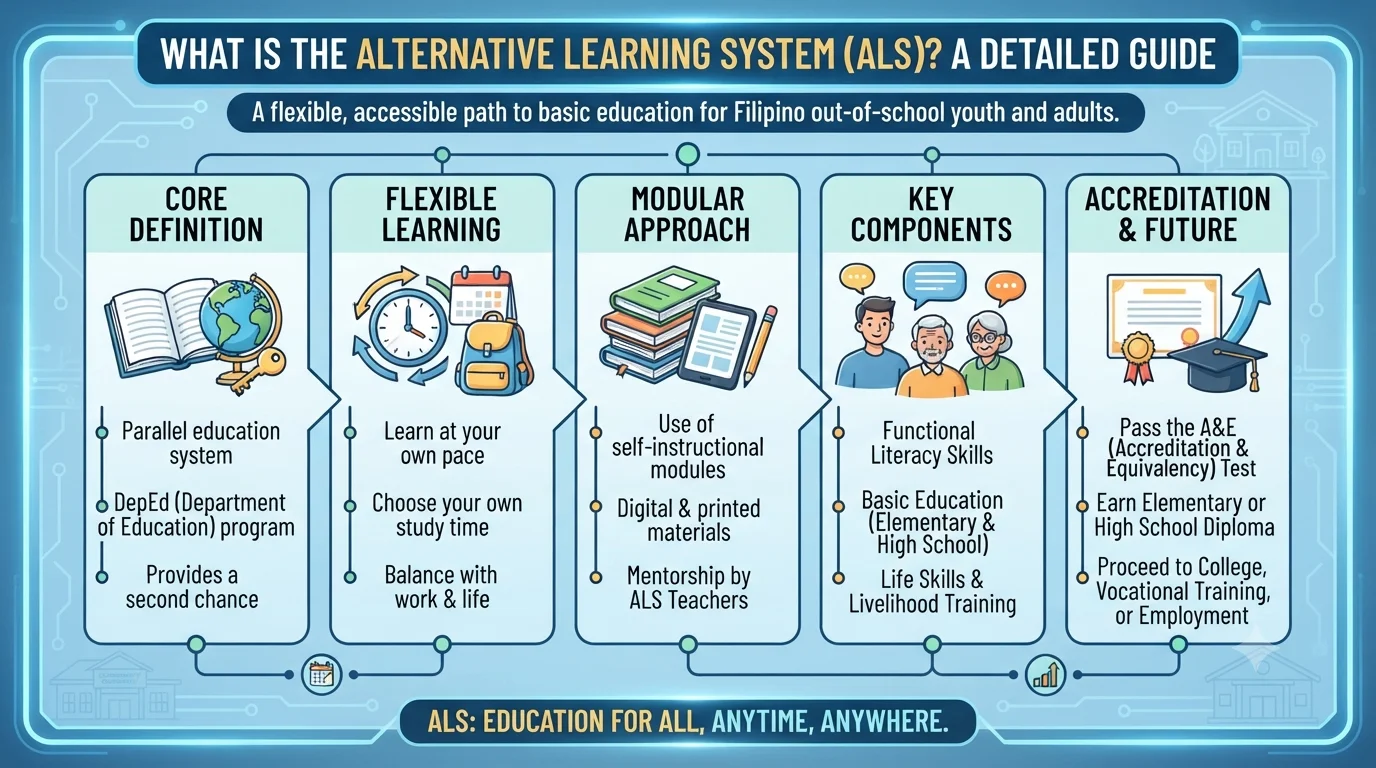
The alternative learning system meaning centers on one idea: education should adapt to the learner, not the other way around. ALS is a parallel, non-formal, and informal learning option that runs alongside the regular classroom-based system in the Philippines.
Instead of daily attendance in a fixed classroom, ALS learners attend flexible sessions at a time and place agreed upon with their facilitator. Sessions happen in barangay halls, community learning centers, libraries, or even private homes. The content still follows DepEd’s K to 12 Basic Education Curriculum, so the education value stays equivalent to formal schooling.
In short, the alternative learning system meaning is simple: a legitimate, government-recognized way to finish basic education when the traditional path is not accessible.
Who Is the Alternative Learning System For?
ALS was built for Filipinos who fell outside the formal school system for reasons beyond their control. The program targets several groups directly.
- Elementary or high school dropouts who left before completing their education
- Out-of-school children, youth, and adults (often labeled OSCYA)
- Working individuals such as drivers, factory workers, domestic helpers, and farmers
- Persons with disabilities who need flexible learning arrangements
- Indigenous peoples and members of cultural minorities
- Senior citizens who never had the chance to attend school
- Solo parents and individuals balancing family responsibilities with study
Learners currently enrolled in the regular classroom system cannot join ALS at the same time. The program exists specifically for those without access to that system.
The Two Major ALS Programs
DepEd runs ALS through two core programs, and understanding both is essential to grasping the full alternative learning system meaning.
| Program | Purpose | Who It Serves |
|---|---|---|
| Basic Literacy Program (BLP) | Builds foundational reading, writing, and numeracy skills | Non-literate out-of-school children, youth, and adults |
| Continuing Education Program – Accreditation and Equivalency (A&E) | Provides equivalent basic education leading to a certificate | Learners who already have some literacy and want to complete elementary or secondary education |
Learners typically start with the Functional Literacy Test (FLT) to measure where they currently stand. This test places each learner into the correct starting point rather than forcing everyone through the same fixed pace.
How ALS Instruction Actually Works
ALS instruction runs on two delivery formats: school-based and community-based. Both formats follow the same curriculum but differ in setting and structure.
- School-based delivery: Sessions take place inside school campuses, often using existing facilities during off-peak hours.
- Community-based delivery: Sessions happen in barangay halls, community centers, or homes, guided by mobile teachers and coordinators.
Learning materials arrive as self-paced modules covering science, mathematics, English, Filipino, and social studies. Advanced learners often study independently, while beginner-level learners receive more direct facilitator support through a Facilitator’s Guide.
Who Delivers ALS: Key People and Entities
Several roles keep the ALS program running smoothly across the country’s 17 regions.
- ALS Mobile Teachers: Specialized DepEd teachers who live in or regularly visit remote barangays to deliver instruction directly to learners.
- District ALS Coordinators (DACs): Oversee and harmonize ALS activities across an entire district.
- Instructional Managers: Support facilitators and help manage day-to-day learning sessions.
- Bureau of Alternative Education (BAE): The DepEd office responsible for national program policy and standards.
Private organizations and non-government organizations may also deliver ALS, but they always operate under DepEd supervision to keep quality consistent nationwide.
The Accreditation and Equivalency (A&E) Test Explained
Passing the A&E test is the finish line for most ALS learners. This paper-and-pencil assessment measures whether a learner has mastered the competencies needed to complete elementary or secondary education.
Learners who pass the Elementary Level A&E test earn a certificate equivalent to a Grade 6 diploma. Learners who pass the Secondary Level A&E test earn a certificate equivalent to a high school diploma. Since 2019, secondary-level passers may need to complete senior high school before proceeding to college, aligning ALS graduates with the K to 12 system used in formal schools.
This certificate carries real weight. It opens doors to college admission, vocational training through TESDA, and formal employment that requires a diploma.
ALS Enrollment: Step-by-Step
Enrolling in ALS is more straightforward than many people expect. Here is the general process most learners follow.
- Visit the nearest DepEd office, community learning center, or barangay hall offering ALS.
- Take the Functional Literacy Test to identify your current learning level.
- Get matched with a mobile teacher, instructional manager, or coordinator.
- Attend scheduled sessions based on the agreed time and venue.
- Complete required modules for your chosen program (BLP or A&E).
- Register for and take the A&E test once you and your facilitator agree you’re ready.
- Receive your certificate upon passing, then pursue college, vocational training, or employment.
Enrollment is free, since ALS falls under the constitutional guarantee of free basic education for all Filipinos.
ALS Enrollment Numbers and Impact
Understanding scale helps clarify why ALS matters so much to the Philippine education system. DepEd reported more than 800,000 ALS enrollees in 2020 alone, and roughly 600,000 learners enroll annually in recent years, with most choosing the Secondary A&E track.
| Metric | Figure |
|---|---|
| Estimated out-of-school youth (ages 17–24) | Around 5 million |
| Annual ALS enrollees | Approximately 600,000 |
| 2023–2024 school year completers | 302,807 out of 655,517 enrollees |
| Current ALS reach of out-of-school youth population | About 9 percent |
These numbers show real progress, but also reveal a persistent gap between the number of Filipinos who need ALS and the number the program currently reaches. Lawmakers, including Senator Sherwin Gatchalian, author of the Alternative Learning System Act, have pointed to this gap as a reason to strengthen implementation further.
ALS Act (Republic Act 11510): Why It Matters
The Alternative Learning System Act, signed into law, gave ALS a permanent legal foundation rather than leaving it as an administrative program. This law mandates funding, staffing, and infrastructure support so ALS can operate as a genuine, institutionalized education pathway rather than a temporary stopgap.
The law also pushed DepEd to align ALS more closely with the K to 12 curriculum, ensuring graduates carry credentials that formal schools, colleges, and employers recognize without hesitation.
Recent Updates to the ALS Program
DepEd continues to expand and refine ALS to reach more learners effectively. In January 2026, DepEd issued updated guidelines strengthening ALS delivery standards nationwide. Education Secretary Sonny Angara has highlighted the program’s growing reach, citing learner stories such as an 81-year-old Aeta learner from Pampanga who enrolled in the Basic Literacy Program decades after leaving formal schooling.
Beginning school year 2026–2027, all school division offices must fully implement a revised ALS curriculum for both the Basic Literacy and Accreditation and Equivalency programs, with additional guidelines coming for a strengthened ALS senior high school track.
ALS vs Formal Education: Key Differences
Comparing ALS to formal schooling makes the alternative learning system meaning even clearer.
| Feature | Formal Education | Alternative Learning System |
|---|---|---|
| Setting | Classroom, fixed schedule | Community, home, or school-based, flexible schedule |
| Instructor | Trained classroom teacher | Mobile teacher, coordinator, instructional manager |
| Pace | Fixed academic calendar | Self-paced, modular |
| Assessment | Quarterly exams, report cards | Functional Literacy Test, A&E test |
| Credential | Diploma per grade level | A&E certificate equivalent to diploma |
| Cost | Free (public schools) | Free |
Common Challenges Facing ALS Learners
No education program is without obstacles, and ALS learners face a few recurring ones worth knowing about.
- Balancing paid work with study time, since many learners are also breadwinners
- Limited access to modules or facilitators in remote areas
- Lower completion rates compared to enrollment rates, especially at the secondary level
- Gaps in digital access for learners using ICT-based delivery like eSkwela centers
DepEd and partner organizations such as UNICEF continue to address these gaps through research, funding proposals, and updated ICT strategic plans aimed at closing completion gaps by region.
Frequently Asked Questions
1. What is the alternative learning system meaning in simple terms? It means a flexible, government-supported way to finish elementary or high school outside a regular classroom, designed for people who cannot attend formal school for personal, financial, or logistical reasons.
2. Who can enroll in the Alternative Learning System? Out-of-school children, youth, and adults, including dropouts, working individuals, persons with disabilities, indigenous groups, and senior citizens, can enroll, provided they are not currently enrolled in formal classroom education.
3. Is the ALS certificate equal to a high school diploma? Yes. Passing the Secondary Level A&E test earns a certificate that DepEd recognizes as equivalent to a high school diploma, accepted by colleges and employers nationwide.
4. How much does it cost to join ALS? ALS is free. It falls under the constitutional right to free basic education, so learners pay nothing to enroll, attend sessions, or take the A&E test.
5. How long does it take to complete ALS? Completion time varies by learner, since the program is self-paced. Some learners finish within a year, while others take longer depending on their starting literacy level and available study time.
6. What is the difference between ALS and eSkwela? eSkwela is not a separate program. It is simply an ICT-based delivery mode of ALS, using computers, electronic modules, and internet access instead of traditional printed materials, while following the same curriculum and A&E pathway.
Final Thoughts
The alternative learning system meaning goes far beyond a technical definition. It represents a real, working second chance for millions of Filipinos who deserve the same educational opportunities as anyone else. Whether you’re exploring ALS for yourself, a family member, or research purposes, the program stands as proof that a diploma should never depend on circumstance alone. If you’re ready to take the next step, visit your nearest DepEd office or community learning center to start the enrollment process today.
Sources: Department of Education (DepEd) official ALS page, Philippine Information Agency, Philippine News Agency, UNICEF Philippines, and Wikipedia (Alternative Learning System, Philippines) were referenced to verify definitions, statistics, and program updates cited in this guide.