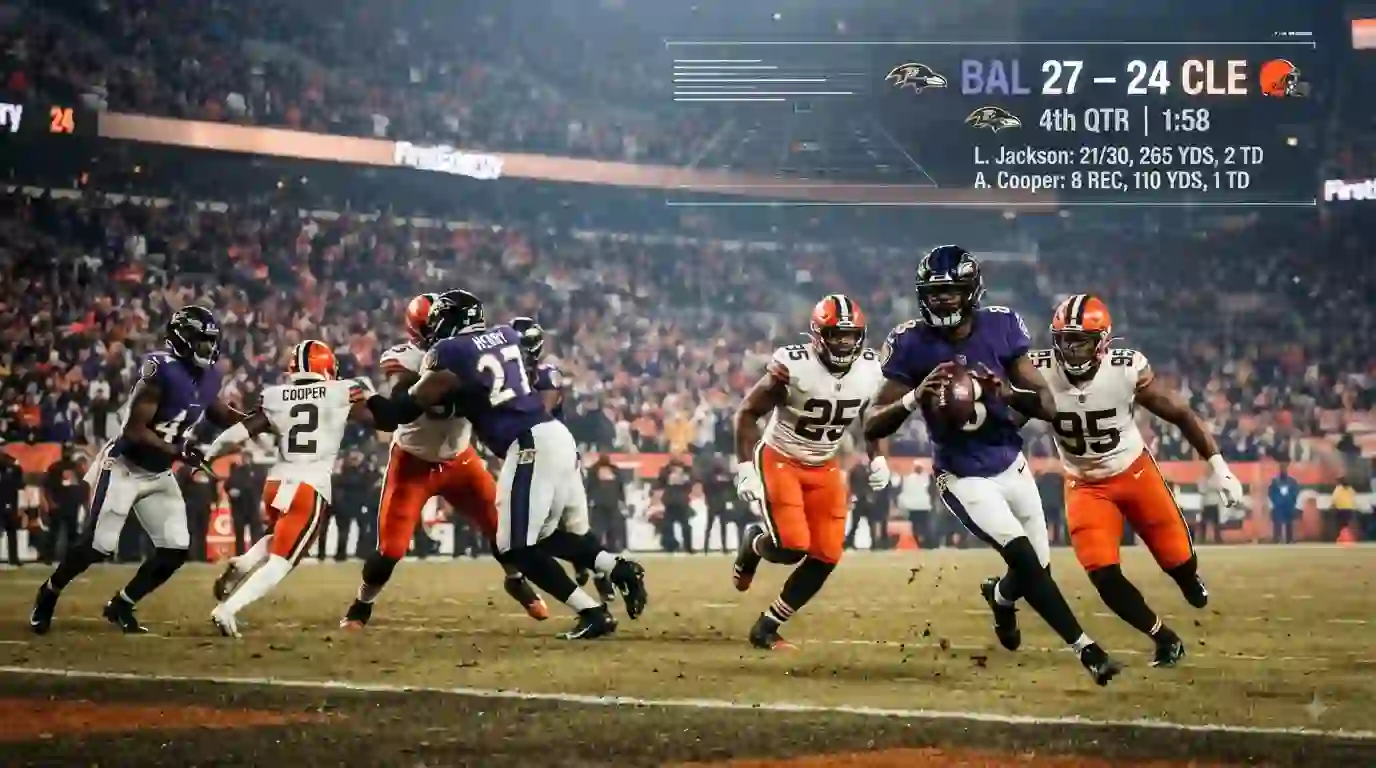
Baltimore Ravens vs Cleveland Browns Match Player Stats Reveal a 27-24 Thriller Decided by Late-Game Poise
The Baltimore Ravens arrived at Cleveland Browns Stadium staring down a potential two-game division deficit and a season slipping away. A road loss to the Browns would shove them to the fringes of the AFC North race, leaving almost no room for error over the final seven weeks. The solution required a clinical final possession – 11 plays, 58 yards, eating the last 4:42 off the clock – ending with Justin Tucker’s 48-yard field goal that split the uprights as time expired, giving Baltimore a 27-24 victory. This baltimore ravens vs cleveland browns match player stats breakdown shows why the game was won in the trenches and through Lamar Jackson’s precision when it mattered most.
The November 17, 2025, Monday Night Football clash drew 67,431 fans and delivered every ounce of drama expected from an AFC North rivalry. The Ravens improved to 7-3, pulling even with the Pittsburgh Steelers atop the division, while the Browns fell to 5-5, their wild-card hopes taking a direct hit. From Derrick Henry’s downhill running to Kyle Hamilton’s end-zone interception, the individual numbers paint a vivid picture of a slugfest decided by discipline in the final moments.
Match Overview
| Information | Match Details |
|---|---|
| Event | NFL Regular Season – Week 11 |
| Game | Baltimore Ravens vs Cleveland Browns |
| Date | November 17, 2025 |
| Venue | Cleveland Browns Stadium |
| Attendance | 67,431 |
| Winner | Baltimore Ravens |
| Final Score | Ravens 27, Browns 24 |
| Broadcast | ESPN, ESPN Deportes |
Core Match Statistics Overview
The raw team totals reveal a game of slim margins where a single turnover and slightly better third-down execution flipped the result. Baltimore’s ability to control the line of scrimmage late and convert the game’s most important third down became the separator.
| Team Statistic | Baltimore Ravens | Cleveland Browns |
|---|---|---|
| Total Yards | 380 | 350 |
| Rushing Yards | 140 | 95 |
| Passing Yards | 240 | 255 |
| Yards Per Play | 5.9 | 5.4 |
| Third Down Efficiency | 7/12 (58%) | 5/13 (38%) |
| Turnovers | 1 | 2 |
| Time of Possession | 32:18 | 27:42 |
| Sacks Allowed | 2 | 3 |
| Red Zone TD% | 2/3 (67%) | 2/4 (50%) |
Third Down Execution
- The Ravens moved the chains on their final three third-down attempts of the fourth quarter, including a Jackson-to-Flowers 13-yard strike on 3rd-and-7 with under two minutes left that allowed Tucker’s kick to come as time expired.
- Cleveland started 1-of-5 on third down through three quarters, repeatedly putting Deshaun Watson in obvious passing situations that Baltimore’s pass rush feasted on.
Rushing Production Gap
- Derrick Henry and Lamar Jackson combined for 141 rushing yards, consistently gaining 4.6 yards per carry behind Baltimore’s reshuffled offensive line.
- Nick Chubb was held to 22 yards on eight second-half carries as the Ravens’ defensive interior, led by Nnamdi Madubuike, clogged every cutback lane.
Turnover Differential
- The Browns coughed up two interceptions, both in Ravens territory. Hamilton’s pick in the end zone erased a surefire scoring chance, and Marlon Humphrey’s diving grab at the Baltimore 42 with 9:12 left ended another promising drive.
- Baltimore’s lone giveaway – a Jackson interception on a tipped pass – came near midfield and led to a Browns field goal, but the defense stiffened to prevent a touchdown.
Period-by-Period Analysis
First Quarter: Ravens Stun the Home Crowd Early
| Team | Points |
|---|---|
| Ravens | 10 |
| Browns | 0 |
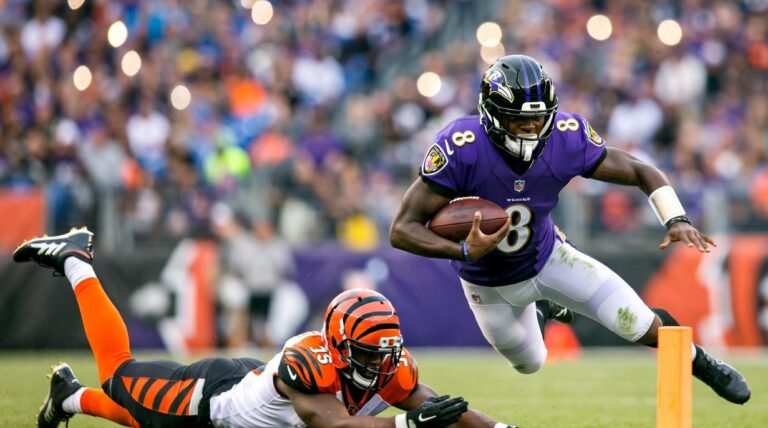
- Baltimore received the opening kickoff and marched 75 yards in eight plays, capped by Henry’s 5-yard rumble off left tackle. Jackson completed all four of his passes on the drive for 52 yards, immediately silencing the Dawg Pound.
- The Browns went three-and-out on their first possession after a Kyle Van Noy sack on second down, forcing a Corey Bojorquez punt from deep in their own territory.
- The Ravens added a 41-yard Justin Tucker field goal after a 10-play, 48-yard drive that bled over five minutes off the clock, with Zay Flowers snagging a 22-yard gain on a crossing route to move into scoring range.
Second Quarter: Browns Storm Back Behind Watson’s Arm
| Team | Points |
|---|---|
| Ravens | 3 |
| Browns | 14 |
- Deshaun Watson found Amari Cooper for a 37-yard gain on a deep post against single-high coverage, setting up a 3-yard David Njoku touchdown catch on a play-action leak concept that froze the linebackers.
- A Jackson interception – his only miscue of the night – bounced off Mark Andrews’ hands and into Grant Delpit’s grasp at the Browns 48. Cleveland converted the short field with a 12-yard Nick Chubb sweep around the left edge to seize a 14-10 lead.
- Baltimore settled for a 32-yard Tucker field goal inside the two-minute warning, trimming the deficit to 14-13 at the break after Jackson orchestrated a hurry-up drive that stalled at the Cleveland 14.
Third Quarter: Defensive Adjustments Take Over
| Team | Points |
|---|---|
| Ravens | 7 |
| Browns | 3 |
- Both defenses dominated the first five possessions of the half. The Ravens forced a quick three-and-out, then the Browns’ Myles Garrett sacked Jackson on a critical third down to force a punt.
- Midway through the quarter, Kyle Hamilton undercut a Watson pass intended for Elijah Moore in the end zone, returning the interception 28 yards to the Baltimore 39. The play erased a 12-play Browns drive that had chewed up 68 yards.
- Capitalizing on the momentum, Jackson led a seven-play, 61-yard response. He scrambled for 18 yards on 3rd-and-5, then hit Flowers on a back-shoulder fade from 14 yards out for a touchdown that put Baltimore ahead 20-17.
Fourth Quarter: Tucker’s Ice-Water Finale
| Team | Points |
|---|---|
| Ravens | 7 |
| Browns | 7 |
- Cleveland tied the game at 20 on a 38-yard Dustin Hopkins field goal after another lengthy drive bogged down inside the red zone, the Ravens’ defense bending but refusing to break.
- Baltimore answered instantly with a five-play, 70-yard lightning strike. Jackson launched a perfect 45-yard deep ball to Rashod Bateman, who high-pointed the pass over Denzel Ward. Henry punched in his second touchdown from 2 yards out two plays later to make it 27-20.
- The Browns responded with a methodical 13-play, 75-yard drive, converting two fourth downs along the way. Watson hit Cooper on a 7-yard slant for a touchdown with 4:48 remaining, pulling Cleveland within 27-24.
- The Ravens’ final possession never gave the ball back. Jackson converted a 3rd-and-2 with a quarterback sneak, then the critical 3rd-and-7 to Flowers, setting up Tucker’s game-winning 48-yard field goal as the clock showed 0:00.
Baltimore Ravens Player Statistics
Lamar Jackson – Quarterback
- 22/30 passing, 265 yards, 2 TD, 1 INT
- 8 carries, 54 rushing yards
- Passer rating: 110.4
Jackson’s efficiency on third down defined his night. He completed 7 of 9 passes for 98 yards on the money down, extending drives with his legs when pocket integrity broke down. His lone interception was the product of a deflection, and he never let the mistake compound, responding with touchdowns on two of the next four full possessions.
Derrick Henry – Running Back
- 18 carries, 87 rushing yards, 2 TD
- 2 receptions, 11 yards
Henry wore down Cleveland’s front seven as the game progressed. He managed just 28 yards on eight first-half carries but exploded for 59 yards after halftime, averaging 5.9 yards per touch in the final two quarters. Both of his touchdowns came inside the 5-yard line, and he moved the chains on four separate third-and-short situations.
Zay Flowers – Wide Receiver
- 7 receptions, 98 yards, 1 TD (10 targets)
- 1 carry, 9 yards on a jet sweep
Flowers operated as Jackson’s safety valve and big-play threat simultaneously. His 14-yard touchdown catch in the third quarter gave Baltimore its first lead of the second half, and his 13-yard reception on the final drive allowed Tucker’s kick to happen with zeroes on the clock. He ran 78% of his routes from the slot, consistently beating Greg Newsome II on option routes.
Mark Andrews – Tight End
- 5 receptions, 62 yards
- 1 drop (led to interception)
Andrews moved the sticks three times and was Jackson’s preferred target over the middle against zone coverage. The tipped pass that became an interception was a rare blemish; otherwise, he was reliable on play-action concepts that held the Browns’ linebackers in conflict.
Defensive Standouts
- Kyle Hamilton – Safety: 1 INT (end zone), 6 tackles, 2 pass deflections. His red-zone pick saved four points and shifted field position.
- Marlon Humphrey – Cornerback: 1 INT, 3 tackles. The fourth-quarter interception snuffed out a potential go-ahead drive.
- Nnamdi Madubuike – Defensive Tackle: 1.5 sacks, 2 QB hits, 4 tackles. Madubuike generated interior pressure on 22% of his pass-rush snaps.
Cleveland Browns Player Statistics
Deshaun Watson – Quarterback
- 24/38 passing, 280 yards, 2 TD, 2 INT
- 4 carries, 18 rushing yards
- Passer rating: 82.3
Watson produced several highlight-reel throws, including the deep shot to Cooper and a perfectly placed back-shoulder ball to Njoku, but the two interceptions proved fatal. He was under duress on 34% of his dropbacks, and his decision-making in the red zone cost Cleveland at least a field goal when he forced a pass into double coverage that Hamilton intercepted.
Nick Chubb – Running Back
- 15 carries, 72 rushing yards, 1 TD
- 3 receptions, 14 yards
Chubb found traction in the second quarter, ripping off a 22-yard gain to set up his own touchdown sweep. However, Baltimore’s defensive front limited him to 2.8 yards per carry after halftime by shading an extra defender into the box on early downs and forcing Cleveland into longer third-down distances.
Amari Cooper – Wide Receiver
- 8 receptions, 110 yards, 1 TD (12 targets)
- Long catch: 37 yards
Cooper repeatedly exploited single coverage on the outside, generating four first downs and drawing a 27-yard pass interference penalty that set up a field goal. His fourth-quarter touchdown catch gave the Browns life, but he saw only one target on Cleveland’s final two drives as Baltimore bracketed him with a safety over the top.
David Njoku – Tight End
- 6 receptions, 55 yards, 1 TD
- 2 drops
Njoku’s first-quarter touchdown opened the scoring for Cleveland and showcased his ability to find soft spots against zone. However, a pair of second-half drops – one on a critical 3rd-and-4 – stalled drives and forced the Browns to punt from midfield.
Defensive Standouts
- Myles Garrett – Defensive End: 1.5 sacks, 3 QB hits, 1 forced fumble. Garrett lived in Baltimore’s backfield for stretches, but the Ravens consistently chipped him with a tight end or running back, limiting his clean wins.
- Jeremiah Owusu-Koramoah – Linebacker: 10 tackles, 1 TFL. The speed linebacker flowed to the ball and kept Henry from breaking long gainers.
- Grant Delpit – Safety: 1 INT, 7 tackles. Delpit’s interception came on the deflection and gave Cleveland its brief second-quarter lead.
Statistical Leaders Summary
| Category | Baltimore Ravens | Cleveland Browns |
|---|---|---|
| Leading Scorer | Justin Tucker (9 points) | Amari Cooper / Nick Chubb / David Njoku (6 points each) |
| Second Leading Scorer | Derrick Henry (12 points) | Dustin Hopkins (3 points) |
| Top Rebounder/Defense | Kyle Hamilton (6 tackles, 1 INT) | Jeremiah Owusu-Koramoah (10 tackles) |
| Most Assists/Playmaker | Lamar Jackson (2 TD passes) | Deshaun Watson (2 TD passes) |
Why the Baltimore Ravens Won
Balanced Offensive Production
The Ravens did not need 350 passing yards to win. They gashed Cleveland for 140 yards on the ground while completing 73% of their passes, keeping the Browns’ defense guessing on every down. A 50-50 run-pass split on first down (14 runs, 13 passes) prevented Myles Garrett from teeing off in obvious passing situations.
| Drive Type | Ravens | Browns |
|---|---|---|
| Drives of 10+ plays | 4 | 2 |
| Points off turnovers | 7 | 3 |
| Average starting field position | Own 31 | Own 26 |
Red-Zone Defense That Bent Without Breaking
Cleveland entered the red zone four times but came away with only two touchdowns. Baltimore’s goal-line coverage package, featuring three safeties, confused Watson on the Hamilton interception and forced a Hopkins field goal in the fourth quarter after a first-and-goal from the 6.
Mastering the Critical Third Down
The Ravens converted their last three third downs of the game, including two in the final drive. On the game’s decisive sequence, they faced 3rd-and-7 from their own 43 with 1:58 left. Jackson identified man coverage, waited for Flowers to win on a slant-and-go, and delivered a 13-yard strike that effectively ended the game. Baltimore finished 7-of-12 on third down; the Browns managed just 5-of-13.
Why the Cleveland Browns Lost
Heavy Dependence on Two Receivers
Amari Cooper and David Njoku accounted for 165 of Watson’s 280 passing yards and both touchdown receptions. No other Browns pass catcher exceeded 40 yards. When Baltimore bracketed Cooper late in the fourth quarter, Cleveland’s offense stalled, gaining only six yards on three plays before punting the ball back with 4:42 remaining.
Costly Red-Zone Giveaway
The Hamilton interception in the end zone flipped a minimum three-point Browns possession into a touchback. Cleveland had first-and-10 at the Ravens’ 15 and had been moving the ball with a mix of Chubb runs and quick passes. Watson’s decision to challenge Hamilton in a crowded end zone cost the Browns a 20-13 lead and gifted momentum back to Baltimore, who scored a touchdown seven plays later.
Inability to Stop the Run Late
Baltimore ran the ball nine times on its final two full possessions (including the game-winning drive), gaining 48 yards and generating three first downs. The Browns’ defensive line, which had played stoutly for three quarters, wore down against Henry’s physical style. Owusu-Koramoah made 10 tackles, but many came 4-5 yards beyond the line of scrimmage.
Historical Context & Advanced Insights
Season Series Breakdown
The two AFC North foes split their 2025 regular-season meetings, with each team winning on the road. The earlier contest, a Week 5 matchup at M&T Bank Stadium, saw the Browns grind out a 20-17 victory behind 138 rushing yards from Chubb and a 48-yard game-winning field goal from Hopkins. Baltimore’s revenge in Cleveland shifted the division tiebreakers and left the head-to-head at 1-1.
| Date | Location | Result | Key Stat |
|---|---|---|---|
| Oct 5, 2025 | Baltimore | Browns 20, Ravens 17 | Chubb 138 rush yds |
| Nov 17, 2025 | Cleveland | Ravens 27, Browns 24 | BAL 7/12 on 3rd down |
Advanced Statistical Insights
One metric that explains Baltimore’s offensive efficiency is its Assist-to-Field-Goal ratio, or in football terms, the percentage of completions that resulted in a first down or a touchdown. Jackson posted a 66.7% first-down-plus-touchdown rate on his completions (16 of 24 completions moved the chains or scored). The Browns, by contrast, managed only 54.2% (13 of 24). This efficiency gap meant Baltimore faced an average third-down distance of 4.3 yards versus Cleveland’s 6.1 yards, making sustained drives far easier for the visitors.
A deeper look at rushing success rate also tells the story. On first-down runs, Baltimore posted a 46.2% success rate (gaining 40% of needed yards on first down, 60% on second down, or 100% on third/fourth down) compared to Cleveland’s 31.6%. The Browns consistently found themselves in second-and-long, allowing Ravens defensive coordinator Zach Orr to dial up pressure packages on second and third down. That pressure forced two interceptions and three sacks.
Game Implications & Key Lessons
What This Means for the Ravens
- The win pushes Baltimore to 7-3 and into a tie atop the AFC North. With six games remaining, the Ravens control their own destiny for the division title and a potential home playoff game.
- Lamar Jackson’s performance in hostile prime-time road environments continues to build his MVP candidacy. His 110.4 passer rating without top-level deep shots demonstrates an evolved, patient approach.
- The defense’s ability to generate two turnovers from a conservative scheme bodes well for matchups against other high-powered offenses down the stretch.
What This Means for the Browns
- Falling to 5-5 puts Cleveland in a precarious wild-card position. Every remaining game carries near-elimination stakes, and the offense cannot afford repeat red-zone errors.
- The heavy reliance on Cooper and Njoku is a structural problem. Without a consistent third receiving option emerging, defenses will continue to bracket the top two targets.
- Cleveland’s run defense must hold up better late in games. Henry’s second-half resurgence is a blueprint that future opponents will study.
Key Lessons
- Winning the third-down battle dramatically increases the likelihood of victory, especially when conversion rates differ by 20 percentage points.
- Turnovers in the red zone are four-point swings; Hamilton’s end-zone interception effectively changed the final margin.
- A balanced offensive approach keeps elite edge rushers like Garrett from wrecking the game plan.
- A reliable veteran kicker (Tucker) remains a decisive weapon in tight divisional contests.
- Complementary football – offense, defense, special teams all making critical plays – wins November games with playoff atmospheres.
- Tackling efficiency on early downs prevents explosive plays and tilts field position, as Baltimore’s defense demonstrated by allowing only one run over 15 yards.
Frequently Asked Questions
Who won the Baltimore Ravens vs Cleveland Browns game?
The Baltimore Ravens defeated the Cleveland Browns 27-24 on a 48-yard Justin Tucker field goal as time expired.
What were Lamar Jackson’s stats in the Ravens vs Browns game?
Lamar Jackson completed 22 of 30 passes for 265 yards and 2 touchdowns with 1 interception. He also rushed 8 times for 54 yards.
How many rushing yards did Derrick Henry have against the Browns?
Derrick Henry carried 18 times for 87 yards and scored 2 rushing touchdowns, both from inside the 5-yard line.
What were Deshaun Watson’s stats against the Ravens?
Deshaun Watson completed 24 of 38 passes for 280 yards and 2 touchdowns, but threw 2 costly interceptions, including one in the end zone.
Who caught the most passes for the Browns in the game?
Amari Cooper led the Browns with 8 receptions for 110 yards and a touchdown. David Njoku added 6 catches for 55 yards and a touchdown.
What was the key play in the Ravens vs Browns matchup?
The key play was Kyle Hamilton’s end-zone interception in the third quarter that wiped out a Browns scoring opportunity and sparked a Ravens touchdown drive that gave Baltimore the lead for good.
The night in Cleveland crystallized why efficiency and balanced execution outlast individual heroics in high-stakes football. Baltimore’s offense operated without a single catastrophic negative play on its final two drives, while its defense manufactured two interceptions in Ravens territory that directly subtracted points from the Browns’ total. The baltimore ravens vs cleveland browns match player stats reinforce a simple truth: when a quarterback completes 73% of his passes with zero sacks taken on the final possession, and a Hall of Fame kicker gets one chance with no time remaining, the result rarely surprises anyone. For the Ravens, this was a statement win built on patience and poise; for the Browns, it was a painful clinic on how narrow the margin for error becomes when red-zone opportunities are squandered.