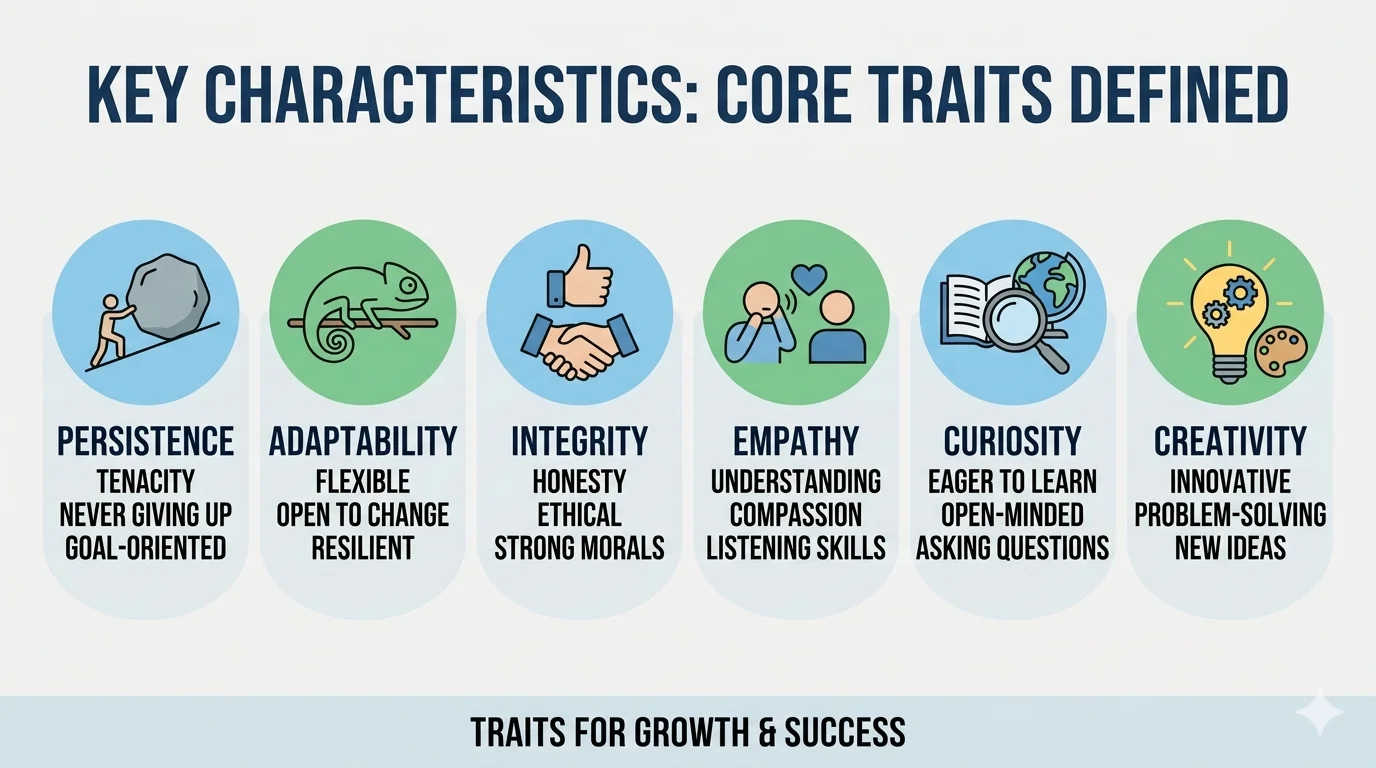
Characteristics: Complete Guide to Traits, Attributes & Qualities
Introduction
Every person, animal, and object has a set of features that make it unique. Think of the last time you described a friend to someone who had never met them. You probably mentioned their height, their laugh, or how they always show up early. Those are characteristics.
The word comes from the ancient Greek kharackter, meaning a “symbol or imprint on the soul”. Today, we use it to describe anything from the color of a butterfly’s wings to the honesty of a leader. Characteristics are the building blocks of identity.
This guide breaks down every type of characteristic you’ll encounter—physical, psychological, behavioral, chemical, and inherited. You’ll learn how to identify them, understand them, and use this knowledge in everyday life, whether you’re analyzing a job candidate, studying biology, or just trying to understand yourself better.
What Are Characteristics? A Clear Definition
A characteristic is a feature, quality, or trait that distinguishes one person or thing from another. It’s what makes a chameleon able to change color, a poodle have pom-pom-like tails, or a particular friend always arrive late to dinner.
Characteristics can be:
- Inherent – something you’re born with, like eye color or blood type
- Acquired – something you develop over time, like a skill or a habit
- Observable – something you can see or measure, like height or weight
- Abstract – something you infer from behavior, like honesty or intelligence
The key is that characteristics are distinguishing. They help us separate one thing from another and understand what makes each unique.
Types of Characteristics: A Complete Breakdown
Physical Characteristics
Physical characteristics are the observable, tangible features of a person, animal, or object. These are things you can see, touch, or measure.
In Humans:
- Height and weight
- Hair color, texture, and style
- Eye color and shape
- Skin tone
- Facial features (nose shape, cheekbones, lip fullness)
- Body type and build
- Distinguishing marks (freckles, birthmarks, scars)
Human physical appearance is the outward phenotype—the result of genetics, environment, age, and lifestyle. Some differences are inherited, while others develop over time.
In Animals:
- Color and pattern (like a tiger’s stripes or a monarch butterfly’s orange and black wings)
- Size and shape
- Fur, feathers, or scales
- Whether they are warm or cold-blooded
- How they breathe (gills or lungs)
- Whether they hatch from eggs
In Objects and Materials:
- Color, shape, and size
- Texture (rough, smooth, sticky)
- Weight and density
- Temperature
- Chemical composition and reactivity
Physical characteristics are often the first things we notice. They’re also the most commonly inherited traits, passed down through genes from parents to children.
Psychological Characteristics
Psychological characteristics relate to the mental and emotional aspects of a person—their personality, intelligence, and emotional responses.
Personality Traits:
Psychologists often describe personality using the Big Five model, also known as OCEAN:
| Trait | Description | High Score | Low Score |
|---|---|---|---|
| Openness | Willingness to try new things | Curious, creative, imaginative | Conventional, prefers routine |
| Conscientiousness | Organization and dependability | Organized, reliable, disciplined | Disorganized, careless |
| Extraversion | Social engagement | Outgoing, energetic, talkative | Reserved, solitary |
| Agreeableness | Cooperation and compassion | Trusting, empathetic, cooperative | Competitive, skeptical |
| Neuroticism | Emotional stability | Calm, secure, resilient | Anxious, moody, sensitive |
Central vs. Secondary Traits:
Early trait theorist Gordon Allport identified thousands of personality-describing words and organized them into three categories:
- Cardinal traits dominate your entire personality (rare—think Mother Teresa’s altruism or Scrooge’s greed)
- Central traits form the foundation of who you are (loyal, kind, friendly, grouchy)
- Secondary traits appear only in specific circumstances (getting nervous before public speaking, always ordering salad dressing on the side)
Raymond Cattell later narrowed the list to 16 personality factors, including warmth, emotional stability, and perfectionism.
Behavioral Characteristics
Behavioral characteristics describe how a person, animal, or organism acts. These are the patterns of movement, interaction, and response you observe over time.
In Animals:
- How they move (walking, flying, swimming)
- What they eat (herbivore, carnivore, omnivore)
- How they reproduce
- How they communicate (sounds, body language, chemical signals)
In Humans:
- Communication style (direct, passive, assertive)
- Decision-making patterns
- Reactions to stress or conflict
- Habits and routines
- Social interaction preferences
Behavioral characteristics are often the most visible indicators of personality. They’re also the most changeable—with effort, you can modify many of your behavioral patterns.
Inherited vs. Acquired Characteristics
Inherited characteristics are passed down through genes from parents to children. These include:
Acquired characteristics develop during your lifetime through experience, environment, or learning. These include:
- Language and accent
- Skills and knowledge
- Preferences and habits
- Scars and other physical changes
It’s important to note that not everything you see is inherited. Height, for example, is influenced by many genes affecting growth, appetite, muscle mass, and activity level. Environment plays a role too.
Characteristics in Different Contexts
Leadership Characteristics
Effective leaders share certain defining characteristics that set them apart. Research from Harvard Business School and Forbes identifies several key traits:
Strong leadership goes beyond management. A strong leader sets clear goals, makes tough decisions, and facilitates clear communication. Ineffective leadership, by contrast, can cost companies significantly—research shows 24% of employees are actively disengaged due to poor management.
Characteristics of a Good Person
What makes someone a good person? While definitions vary, certain characteristics consistently appear:
- Honesty and truthfulness
- Caring for others and putting their needs ahead of your own
- Dependability and loyalty
- Courage to act on your beliefs
- Selflessness and generosity
- Fairness, respect, and responsibility
Good character encompasses a combination of qualities that enable others to trust us and depend on us when help is needed. It’s not just about having these traits—it’s about acting on them.
Characteristics vs. Traits vs. Qualities: What’s the Difference?
These terms are often used interchangeably, but they have subtle distinctions:
In practice, “characteristics” is the broadest term. Traits are specific types of characteristics, usually behavioral or psychological. Qualities are often used to describe positive attributes.
Synonyms for Characteristics
If you’re looking for alternative words, here are the most common synonyms:
| Synonym | When to Use |
|---|---|
| Traits | For specific, consistent behavioral or personality features |
| Attributes | For inherent qualities or properties |
| Features | For notable parts or aspects |
| Qualities | For essential or distinctive characteristics |
| Aspects | For specific facets or elements |
| Properties | For characteristics of objects or materials |
| Peculiarities | For unusual or distinctive characteristics |
Why Understanding Characteristics Matters
Understanding characteristics isn’t just academic—it’s practical.
In science, characteristics help identify different types of organisms and predict how they’ll behave. If you know a bird has wings, you can predict it will be able to fly.
In psychology, understanding personality traits helps predict everything from job performance to relationship satisfaction.
In everyday life, recognizing characteristics helps you:
- Understand yourself and others better
- Make better decisions about relationships and careers
- Communicate more effectively
- Identify what makes people, places, and things unique
Frequently Asked Questions
What are characteristics in simple terms?
Characteristics are the features or qualities that make someone or something different from others. They’re what you notice when you’re trying to describe or identify a person, animal, or object. Eye color, personality, and how something behaves are all examples of characteristics.
What are the main types of characteristics?
The main types are physical (observable features like height and color), psychological (personality traits and emotional patterns), and behavioral (how someone or something acts). There are also chemical characteristics for materials and inherited versus acquired characteristics.
What’s the difference between a characteristic and a trait?
A characteristic is a broad term for any distinguishing feature. A trait is a specific type of characteristic—usually a consistent pattern of behavior or personality. All traits are characteristics, but not all characteristics are traits.
Can characteristics be changed?
Yes, some can. Physical characteristics like eye color are generally fixed, but acquired characteristics like skills, habits, and behavioral patterns can change with effort. Personality traits also evolve over time, though they tend to be relatively stable.
What are the Big Five personality characteristics?
The Big Five are openness to experience, conscientiousness, extraversion, agreeableness, and neuroticism (OCEAN). These five traits are the most widely studied framework for understanding human personality.
What characteristics make a good leader?
Effective leaders are authentic, consistent, empathetic, and have integrity. They can influence others, set clear goals, and adapt to changing circumstances. They lead with humanity and focus on connecting with and motivating their teams.
What’s a cardinal trait?
A cardinal trait is a characteristic that dominates your entire personality and life. It’s rare—most people don’t have a single trait that defines everything about them. Examples include Mother Teresa’s altruism or Ebenezer Scrooge’s greed.
Final Thoughts
Characteristics are everywhere. They’re in the color of your eyes, the way you laugh, the honesty you bring to a conversation, and the leadership you show at work. They’re what make a chameleon change color, a poodle have fluffy tails, and a leader inspire a team.
Understanding characteristics helps you see the world more clearly. You’ll recognize what makes people unique, what drives behavior, and how to categorize the endless variety of living things and objects around you.
The next time you meet someone new, notice their characteristics. The next time you face a challenge, consider which of your traits will help you overcome it. And remember: while some characteristics are fixed, many can be developed. You have more power to shape your own characteristics than you might think.