Decreto Supremo 160: Your Simple Guide to Liquid Fuel Safety Rules
The Complete Guide to Chile’s Fuel Safety Law
Imagine filling up your car with gasoline without ever worrying about safety. That peace of mind does not happen by accident. Behind every fuel station, every storage tank, and every transport truck in Chile stands a powerful set of rules called Decreto Supremo 160. This law, whose full name is the “Reglamento de Seguridad para las Instalaciones y Operaciones de Producción y Refinación, Transporte, Almacenamiento, Distribución y Abastecimiento de Combustibles Líquidos,” was approved back in 2008 by Chile’s Ministry of Economy, Fomento y Reconstrucción . It might sound like a mouthful, but its purpose is simple and vital. It keeps people safe. It protects communities. It ensures that every drop of fuel handled in the country meets strict standards. Before this regulation existed, rules were looser and accidents happened more often.
Today, thanks to Decreto Supremo 160, Chile has one of the most robust fuel safety frameworks in Latin America. Whether you own a gas station, work in the energy industry, or simply drive a car, this law affects your life in ways you might never realize. Let us explore exactly what it means and why it matters so much.
The story of Decreto Supremo 160 begins with a simple truth. Fuel is dangerous. Gasoline and diesel are highly flammable. They can explode. They can poison the ground and water if they leak. They require careful handling at every stage, from the refinery to your vehicle’s tank. Chile’s government recognized this reality and created a comprehensive set of rules to manage these risks. The decree covers everything. Production facilities must meet design standards. Transport trucks must follow specific routes and safety protocols. Storage tanks need regular inspections.
Even the smallest fuel station in the most remote village must comply with the same rules that apply in Santiago . This consistency ensures that safety does not depend on location. Every Chilean, whether in a big city or a small town, deserves the same protection.
The Origins of Decreto Supremo 160
Before 2008, Chile had multiple regulations governing fuel safety, but they were scattered across different laws and agencies. This created confusion. Companies did not always know which rules applied to them. Inspectors struggled to enforce standards consistently. The government saw the need for a single, unified regulation that would bring everything together under one roof. After extensive consultation with industry experts, safety professionals, and environmental groups, Decreto Supremo 160 was born .
The law drew on international best practices while adapting them to Chile’s unique geography and needs. From the Atacama Desert in the north to the icy straits of Patagonia in the south, fuel must travel through every kind of terrain and climate. The regulations had to account for these variations. A storage tank in the desert faces different challenges than one in a rainy coastal town. Decreto Supremo 160 considers these factors and sets requirements that work everywhere. Since its implementation, the law has been modified several times to address new challenges and technologies. Decrees like Nº 138 in 2016 and Nº 125 in 2019 have fine-tuned the original regulation, keeping it current with industry developments .
Who Must Follow Decreto Supremo 160?
The reach of this regulation is incredibly broad. It applies to anyone involved in the fuel industry. Refineries that process crude oil into gasoline and diesel must comply with strict design and operational standards. Companies that transport fuel by truck, train, or pipeline must follow detailed safety protocols for their vehicles and routes. Storage facilities, whether massive tank farms or small depots, have specific requirements for tank construction, leak detection, and fire prevention .
Fuel stations, the places where everyday people fill their cars, are perhaps the most visible part of this system. Every station must meet requirements for tank placement, pump safety, vapor recovery, and emergency equipment. Even businesses that maintain their own fuel tanks for fleet vehicles, like trucking companies or farms, fall under the law’s scope. The regulation leaves no gaps. If you handle fuel in any significant quantity, Decreto Supremo 160 applies to you. This comprehensive approach ensures that safety is built into every link of the fuel supply chain.
Key Safety Requirements for Fuel Storage
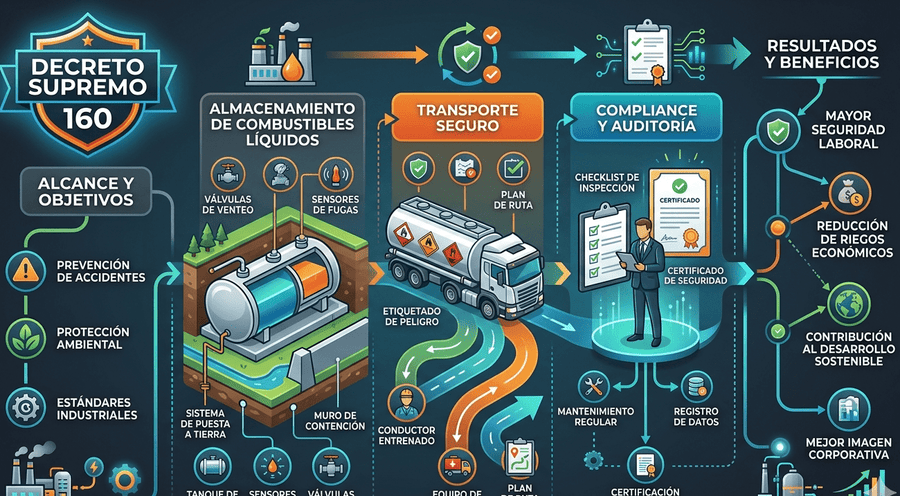
Storage tanks represent one of the biggest potential dangers in the fuel industry. A leaking tank can contaminate soil and groundwater for decades. A tank fire or explosion can threaten entire neighborhoods. Decreto Supremo 160 addresses these risks with detailed requirements for tank design, installation, and maintenance .
Tanks must be built to specific standards that ensure they can withstand the pressure of their contents and the stresses of their environment. They need secondary containment systems, like dikes or double walls, that can catch any leaks before they escape into the environment. Regular inspections are mandatory. Trained professionals must check tanks for corrosion, structural weakness, and signs of leakage. These inspections happen on schedules determined by the tank’s age, construction, and location. Records must be kept and made available to authorities. By mandating these precautions, the law dramatically reduces the chances of catastrophic failures.
Transport Regulations Under the Decree
Moving fuel from refineries to where it is needed involves thousands of trucks traveling Chile’s highways every day. Each of those trucks is a potential hazard if not properly managed. Decreto Supremo 160 sets strict rules for fuel transport .
Vehicles must meet specific design standards. Tanks must be built to withstand crashes. Valves and hoses must be regularly inspected and maintained. Drivers need special training and certification. They must know how to handle emergencies, how to load and unload safely, and what to do in case of an accident. Routes may be restricted in some areas to avoid particularly dangerous roads or densely populated neighborhoods. During transport, drivers must follow speed limits and parking restrictions designed to minimize risks. These rules have made Chile’s fuel transport system one of the safest in the region.
Environmental Protection Measures
Fuel spills can devastate ecosystems. A single gallon of gasoline can contaminate millions of gallons of water. Decreto Supremo 160 recognizes this danger and includes strong environmental protections .
Facilities must have spill prevention and response plans. They need equipment on hand to contain and clean up spills quickly. Storage areas must be designed to prevent leaks from reaching soil or water. Monitoring wells may be required around tank farms to detect any contamination early. When spills do occur, companies must report them immediately and take rapid action to minimize environmental harm. These requirements have significantly reduced the environmental impact of Chile’s fuel industry. They also create accountability. Companies know they will face serious consequences if they neglect their environmental responsibilities.
The Role of the Superintendencia de Electricidad y Combustibles
Enforcing Decreto Supremo 160 falls to Chile’s Superintendencia de Electricidad y Combustibles, known as the SEC . This government agency has the power to inspect facilities, review records, and issue fines for violations. Their inspectors visit fuel stations, storage facilities, and transport companies regularly. They check for compliance with every aspect of the regulation. When they find problems, they can order fixes, impose penalties, or even shut down operations in extreme cases.
The SEC also provides guidance to businesses trying to comply with the law. They publish interpretations of regulations, offer training programs, and answer questions from industry participants. This combination of enforcement and support helps create a culture of safety. Companies know they will be held accountable, but they also have resources to help them meet their obligations. The SEC’s work ensures that Decreto Supremo 160 is not just words on paper but a living system that protects people every day.
Training and Certification Requirements
Safe fuel handling requires skilled people. Decreto Supremo 160 mandates training for anyone whose work involves significant fuel risks . Workers at refineries, transport companies, and fuel stations must complete certified training programs. They learn about the properties of different fuels, the dangers they present, and the proper procedures for handling them safely.
Supervisors and managers need additional training on emergency response and regulatory compliance. Companies must keep records of who has been trained and when. Refresher courses are required periodically to keep knowledge current. This emphasis on training recognizes that technology and equipment are only part of the safety equation. Human beings make decisions every day that affect safety. Well-trained workers make better decisions. They notice problems before they become disasters. They know what to do when emergencies arise. The training requirements in Decreto Supremo 160 have created a workforce that takes safety seriously.
Emergency Preparedness and Response
Even with the best precautions, emergencies can still happen. Decreto Supremo 160 requires facilities to be ready for them . Every regulated facility must have an emergency response plan. The plan must identify potential scenarios, from small leaks to major fires, and specify exactly what workers should do in each case.
Facilities need appropriate emergency equipment. Fire extinguishers, spill kits, communication systems, and personal protective gear must be available and maintained. Workers must practice responding to emergencies through regular drills. These drills build muscle memory so that when real emergencies occur, people react correctly without having to think. Coordination with local fire departments and other emergency services is also required. Firefighters need to know what hazards exist at local facilities so they can respond effectively. This preparation saves lives when things go wrong.
Modifications and Updates to the Law
Decreto Supremo 160 is not frozen in time. It has evolved as technology advances and new challenges emerge . In 2016, Decreto Nº 138 introduced significant modifications to the original regulation. These changes addressed issues that had arisen during years of implementation. They tightened standards in some areas and provided flexibility in others based on real-world experience.
In 2019, Decreto Nº 125 made further adjustments . New technologies for leak detection and tank construction were incorporated. Lessons learned from accidents and near-misses were folded into updated requirements. This ongoing refinement ensures that the regulation stays current with industry best practices. Chile’s commitment to regularly updating its fuel safety law stands in contrast to countries that let their regulations grow stale. By keeping Decreto Supremo 160 dynamic, Chile maintains high safety standards that adapt to changing circumstances.
Penalties for Non-Compliance
Following the rules matters because the consequences of breaking them can be severe. Decreto Supremo 160 gives regulators powerful tools to enforce compliance . Companies that violate the law face fines that can reach significant amounts. In serious cases, the SEC can suspend or revoke operating permits. This effectively shuts down a business until it comes into compliance.
Beyond official penalties, non-compliance creates enormous liability risks. If a company’s violations lead to an accident, they face lawsuits from victims, cleanup costs that can run into millions of dollars, and reputational damage that may take years to repair. Insurance companies also pay close attention to compliance. Facilities with poor safety records struggle to get coverage or face skyrocketing premiums. These powerful incentives push companies to take their obligations seriously. Compliance becomes not just a legal requirement but a business necessity.
Comparison with International Standards
Chile’s approach to fuel safety compares favorably with regulations in developed countries around the world. Decreto Supremo 160 incorporates elements from US standards like those of the National Fire Protection Association and European directives on industrial safety . By building on international best practices, Chile has created a framework that meets global benchmarks.
This alignment benefits international companies operating in Chile. They find regulations that feel familiar and standards that match what they follow at home. It also facilitates trade. When Chilean products and services meet international safety norms, they face fewer barriers in global markets. For Chilean workers and communities, this alignment means protection comparable to what people in wealthier countries enjoy. They do not have to accept lower safety standards just because they live in a developing nation.
Decreto Supremo 160 Key Information Table
Frequently Asked Questions About Decreto Supremo 160
What exactly is Decreto Supremo 160?
It is Chile’s main safety regulation for liquid fuel facilities and operations. It sets standards for how fuel must be handled, stored, and transported to protect people and the environment .
Who needs to comply with this regulation?
Anyone involved in the fuel industry must comply. This includes refineries, transport companies, storage facilities, fuel stations, and businesses with private fuel tanks .
How does Decreto Supremo 160 protect the environment?
It requires leak detection systems, secondary containment for tanks, spill response plans, and groundwater monitoring at many facilities. These measures prevent fuel from contaminating soil and water .
What agency enforces this law in Chile?
The Superintendencia de Electricidad y Combustibles (SEC) is responsible for inspections, enforcement, and providing guidance to regulated businesses .
What training does the regulation require?
Workers who handle fuel must complete certified training programs. Supervisors need additional training on emergency response. All training must be documented and refreshed periodically .
Has Decreto Supremo 160 been updated since 2008?
Yes, it has been modified several times. Major updates include Decreto Nº 138 in 2016 and Decreto Nº 125 in 2019, which incorporated new technologies and lessons learned from implementation .
What happens to companies that violate the rules?
They face fines, possible permit suspension, and legal liability for any accidents caused by their violations. The SEC can also require corrective actions before allowing operations to continue .
Does this regulation apply to small fuel operations?
Yes, it applies to all facilities handling fuel, regardless of size. A small rural fuel station must meet the same basic safety standards as a large urban station, though requirements may be scaled to the level of risk .
How does this compare to US fuel safety regulations?
Chile’s regulation incorporates many elements from US standards, particularly those from the National Fire Protection Association. The overall approach is similar to what you would find in the United States .
Where can I find the complete text of the regulation?
The full text is available through Chile’s official legal databases and the SEC website. Legal information services like vLex also provide access with updates and annotations .
Conclusion: Why Decreto Supremo 160 Matters for Everyone
Decreto Supremo 160 might seem like a technical topic, something only industry insiders need to understand. But its impact touches everyone who lives in or visits Chile. Every time you fill your tank, you benefit from the safety standards this law requires. Every time a fuel truck passes you on the highway, you can feel more secure knowing its driver is trained and its equipment is inspected. Every community near a fuel facility enjoys protection because this regulation exists.
The law represents something important. It shows that regulation, when done right, makes life better. It prevents disasters before they happen. It holds businesses accountable for their impact on the world. It creates a level playing field where responsible companies are not undercut by those who would cut corners. Chile should be proud of Decreto Supremo 160. It stands as a model for how developing nations can protect their people without strangling economic activity.
If you work in the fuel industry, take time to understand your obligations under this law. The requirements are not burdens to be avoided but tools to keep you, your workers, and your community safe. If you are simply a citizen, appreciate the system that operates quietly in the background, protecting you every day. And if you live outside Chile, consider whether your own country has similar protections. The principles behind Decreto Supremo 160 apply everywhere. Safety is not a luxury. It is a right. Chile understands this, and its people are safer because of it.
| Read More Informative Blogs Like This. Tap Here 👉 Unlock Your Potential with zaqrutcadty7 |