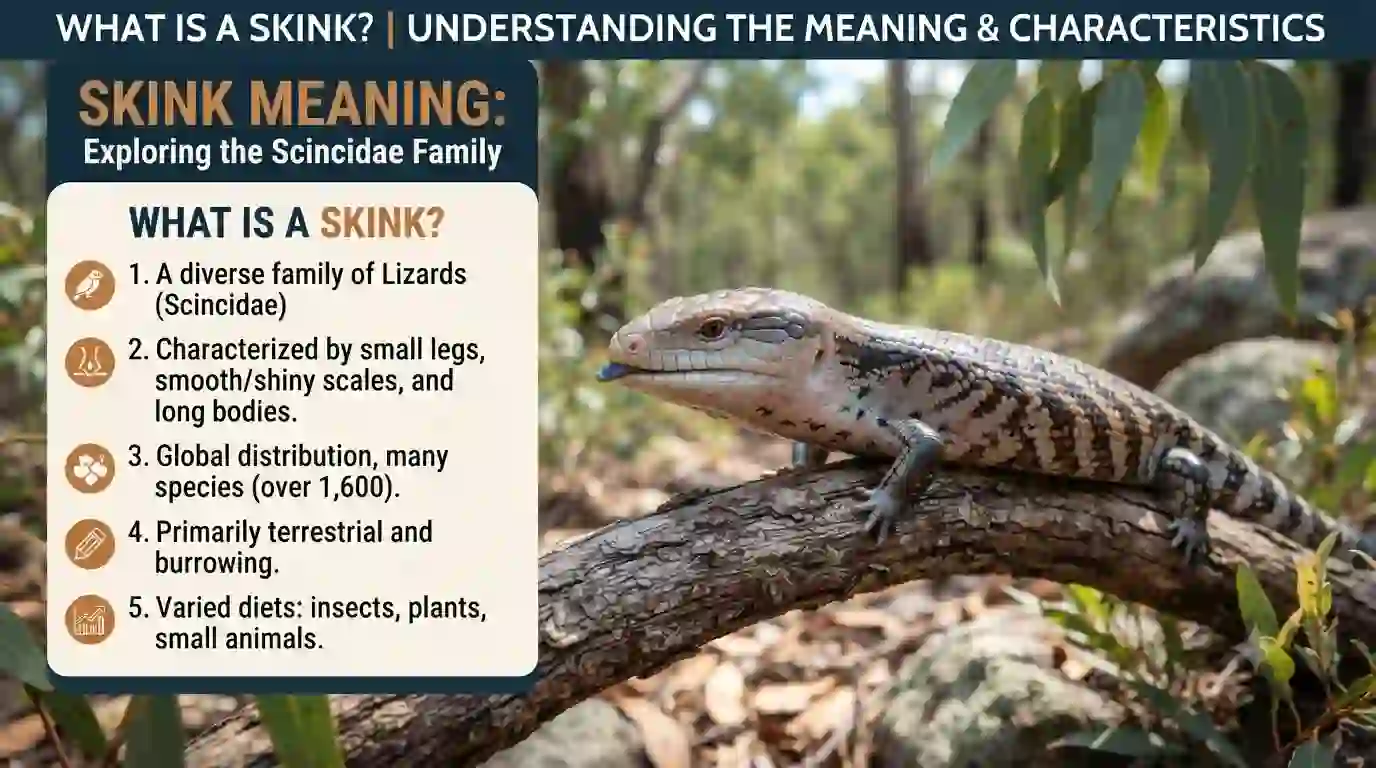
Skink Meaning: The Complete Definition, Symbolism & Species Guide
Fact-checked against primary sources including Merriam-Webster, Encyclopaedia Britannica, and specialist reptile-care research. Last updated August 2026.
You spot a shiny, snake-like lizard darting across your patio, or you stumble on the word “skink” in a book, and you have no clear answer for what it means. That confusion is common. Skink meaning covers a real animal, an old English drinking term, and a layer of modern symbolism, all tangled into one five-letter word. This guide untangles every layer so you leave knowing exactly what it refers to and why it matters.
What Is a Skink? A Quick Definition
A skink is a lizard that belongs to the family Scincidae. The word describes more than 1,500 recognized species of small to medium reptiles found on nearly every continent except Antarctica. Skinks stand out for their smooth, glossy scales, cylindrical bodies, and short legs, which in some species are barely visible at all.
In short, skink meaning points to an entire reptile family rather than one single species. When someone asks “what does skink mean,” they are almost always asking about this lizard, not its rarer historical uses.
- Simple definition: A smooth-scaled lizard from the family Scincidae
- Where they live: Every continent except Antarctica
- Known for: Glossy skin, short limbs, and a fast, wriggling movement style
Skink Meaning: Word Origin and Etymology
The word skink actually carries two separate histories, and knowing both gives you the full picture rather than half the story.
The animal name entered English between 1580 and 1590. It traces back through Latin scincus to the ancient Greek word skinkos, which already described a type of lizard in that era. This is the origin almost everyone means today when they use the word.
A second, unrelated meaning exists in older English and Scottish dialects. As a verb, “to skink” meant to pour or serve a drink, first recorded around 1866 and rooted in Middle Dutch schenken. This sense survives mainly in the Scottish dish name Cullen skink, a smoked fish soup that has nothing to do with reptiles. Because the two words share a spelling by coincidence rather than shared origin, dictionaries such as Merriam-Webster list them as separate entries.
Understanding both roots matters because searches for skink meaning sometimes turn up recipe results alongside reptile facts. The lizard sense is the dominant, modern usage.
Skink Definition & Meaning in the Animal Kingdom
Biologically, the skink definition is anchored in a precise scientific classification. Skinks sit within the order Squamata, the same order that contains snakes and other lizards, but they form their own distinct family.
| Rank | Classification |
|---|---|
| Kingdom | Animalia |
| Phylum | Chordata |
| Class | Reptilia |
| Order | Squamata |
| Infraorder | Scincomorpha |
| Family | Scincidae |
| Genera | Over 100 |
| Species | Roughly 1,275–1,500+ (estimates vary by source and new discoveries) |
Encyclopaedia Britannica places the count near 1,275 recognized species, while other taxonomic databases push the number above 1,500 as researchers continue to document new populations. Either figure confirms the same point: Scincidae is one of the largest and most diverse lizard families on Earth.
Physical Characteristics: How to Identify a Skink
Identifying a skink becomes easier once you know what sets these lizards apart visually. A few features repeat across almost every species in the family.
- Smooth, overlapping scales that give the skin a polished, shiny look
- A cylindrical body with a cone-shaped head and no obvious neck
- Short legs, sometimes reduced to tiny stubs or missing entirely in burrowing species
- A long, tapering tail that can detach and regrow if a predator grabs it
- A transparent lower-eyelid scale in many ground-dwelling species, acting like a built-in window
Color and pattern vary enormously between species, so skin tone alone is not a reliable way to identify a skink. A bright blue tail, for example, appears in juveniles of several unrelated species and fades with age.
Types of Skinks: Common Species Explained
The picture shifts slightly depending on which species someone has encountered, since the family spans desert dwellers, tree climbers, and backyard visitors alike.
| Species | Region | Notable Trait |
|---|---|---|
| Blue-tongued skink (Tiliqua scincoides) | Australia, Indonesia | Bright blue tongue, calm temperament, popular pet |
| Five-lined skink (Plestiodon fasciatus) | Eastern United States | Juveniles have an electric-blue tail |
| Sandfish skink (Scincus scincus) | Sahara Desert, Arabian Peninsula | “Swims” through loose sand |
| Prehensile-tailed skink (Corucia zebrata) | Solomon Islands | Largest skink species; tree-dwelling and herbivorous |
| Shingleback skink (Tiliqua rugosa) | Australia | Short, stubby tail that mimics its head |
Each species adds its own detail to the family’s story, but every one of them shares the same core traits described above: smooth scales, a tapering tail, and membership in the Scincidae family.
Skink vs. Lizard: What Is the Real Difference?
Every skink is a lizard, but not every lizard is a skink. This distinction trips people up constantly and directly affects how they interpret skink meaning.
| Feature | Typical Lizard (e.g., gecko, iguana) | Skink |
|---|---|---|
| Scales | Often rough, ridged, or keeled | Smooth and glossy |
| Neck | Usually distinct | Often absent or barely visible |
| Legs | Well developed | Reduced, tiny, or missing |
| Movement | Walking or running | Fast, wriggling, snake-like |
| Eyelids | Movable, opaque | Often fused with a clear “window” scale |
The word “lizard” refers to a much broader group covering thousands of species. “Skink” narrows that group down to one specific, highly recognizable family within it.
Where Do Skinks Live? Habitat and Range
Skinks occupy nearly every warm and temperate habitat on the planet, which explains why sightings happen across so many different regions. They are especially diverse in Southeast Asia, the deserts of Australia, and the temperate zones of North America.
Common habitats include:
- Forest floors and leaf litter
- Grasslands and suburban gardens
- Sandy deserts, where some species burrow or “swim” through loose sand
- Tree canopies, home to arboreal species like the prehensile-tailed skink
- Rocky outcrops and coastal scrub
Only the harshest polar regions, including Antarctica and the Arctic, remain outside their range.
What Do Skinks Eat? Diet and Feeding Habits
Most skinks are insectivores, feeding on ants, beetles, crickets, spiders, and other small invertebrates they find while foraging through soil and leaf litter. This diet makes them genuinely useful in gardens, since they help keep insect populations in check.
A smaller share of species, roughly 15 percent by some estimates, are omnivorous or herbivorous. Larger skinks such as the blue-tongued skink and the prehensile-tailed skink round out their diet with fruit, leafy greens, flowers, and occasionally carrion or small vertebrates.
Skink Behavior: Tail-Dropping, Reproduction, and Lifespan
Behavior adds another practical layer to the story, especially for anyone who has watched one escape a predator.
Tail autotomy is the family’s signature defense. When grabbed, a skink can detach its own tail, which keeps wriggling on the ground to distract the attacker while the skink escapes. The tail regrows over time, though the replacement is usually shorter and made of cartilage rather than bone.
Reproduction varies by species. Most skinks lay eggs, and some, including the five-lined skink, guard their nests until the eggs hatch. Other species, such as the blue-tongued skink, give birth to live young, typically producing six to twelve babies per litter after a gestation period of roughly 100 days.
Lifespan also depends heavily on species and environment. Small wild skinks often live only a few years due to predation, while larger species kept as pets, particularly blue-tongued skinks, commonly reach 15 to 20 years and have been documented living past 30 with attentive care.
Are Skinks Dangerous or Poisonous? Fact vs. Myth
A persistent folk belief claims that skinks, especially blue-tailed juveniles, carry a venomous sting similar to a scorpion. This idea has circulated in parts of the southeastern United States for generations, but it does not hold up to scrutiny.
Skinks are not venomous. They have no venom glands and no specialized fangs for injecting toxin. A bite feels like a firm pinch and rarely breaks the skin. As with most reptiles, basic hygiene still matters, since skinks can carry salmonella bacteria, so washing your hands after handling one is a smart habit.
One genuine area of ongoing debate involves pets. Some anecdotal reports link blue-tailed skinks to illness in cats that eat them, though researchers have not confirmed a specific toxin responsible. Until that research is settled, keeping curious pets away from wild skinks is a reasonable precaution.
Symbolic Skink Meaning: Spiritual and Cultural Interpretations
Beyond biology, skink meaning also shows up in modern spiritual and totem-animal discussions online. In these interpretations, a skink sighting is often linked to adaptability, quick thinking, and renewal, inspired directly by its ability to drop and regrow its tail.
This symbolism is a contemporary interpretation rather than a documented tradition tied to a specific culture or historical text. Readers exploring this spiritual angle should treat it as personal reflection or modern folklore, not established mythology. If a skink crossing your path resonates with a message of resilience or moving past a setback, that meaning is valid to you personally, even without ancient sourcing behind it.
Skinks as Pets: What You Need to Know
The blue-tongued skink has become one of the most popular pet lizards worldwide, largely because it tolerates handling well and rewards consistent care with real personality. Anyone considering skink ownership should plan for a serious, long-term commitment.
Key care basics include:
- Enclosure size: At least 4 feet by 2 feet for an adult, since these skinks are active and benefit from room to explore
- Temperature gradient: A basking spot around 90–95°F with a cooler zone in the mid-70s
- UVB lighting: Full-spectrum UVB for roughly 10–12 hours daily, replaced every 6–12 months as output degrades
- Diet: A varied mix of insects, lean protein, vegetables, and occasional fruit
- Lifespan commitment: 15–20 years on average, with some individuals living past 30
Their calm temperament and manageable size make them a rewarding pet for owners ready to meet these requirements consistently.
Quick Reference: Skink Facts at a Glance
| Category | Detail |
|---|---|
| Scientific family | Scincidae |
| Number of species | Roughly 1,275–1,500+ |
| Distribution | All continents except Antarctica |
| Typical size | 3–8 inches for most species; up to 30 inches in the largest |
| Diet | Mostly insectivorous; some species omnivorous or herbivorous |
| Reproduction | Egg-laying in most species; live birth in others |
| Lifespan (wild) | Typically a few years |
| Lifespan (captive, blue-tongued) | 15–20 years, occasionally 30+ |
| Venomous | No |
| Popular pet species | Blue-tongued skink, sandfish skink |
Frequently Asked Questions About Skink Meaning
What does the phrase “skink” mean in plain English? Skink meaning refers to a lizard from the family Scincidae, recognized by its smooth, shiny scales and short legs. It describes an entire family of more than 1,000 species rather than one animal, and it is the dominant modern use of the word in English.
Does the word skink refer to a single species or to many? It refers to many species. Scincidae contains well over 1,000 recognized lizards, ranging from tiny burrowing skinks a few centimeters long to the 30-inch prehensile-tailed skink of the Solomon Islands. Shared traits across the family, not one specific animal, define the term.
What does it mean when a skink appears in your yard? Biologically, it usually signals healthy soil and steady insect activity, since skinks feed on the pests that live there. Some people also read a personal, symbolic layer of meaning into the sighting, associating it with adaptability, though that interpretation is modern folklore rather than documented tradition.
Are skinks dangerous or poisonous to humans? No. Skinks are non-venomous, and their bites are harmless pinches that rarely break skin. The “poisonous skink” idea is a long-running myth, most often attached to blue-tailed juveniles, with no scientific support behind it.
What is the myth behind the blue-tailed skink? Rural folklore in parts of the southeastern United States long claimed that blue-tailed skinks sting like scorpions. Wildlife researchers have consistently found this untrue: the bright tail is a predator distraction, not a warning of venom, and the skink itself carries no toxin.
How does skink meaning apply to pet ownership? For pet owners, skink meaning usually points to the blue-tongued skink, a docile, long-lived species that adapts well to captivity. Understanding its full biological meaning, including its diet, size, and 15-to-20-year lifespan, helps new owners prepare properly before bringing one home.
Final Thoughts on Skink Meaning
Skink meaning covers far more ground than a single dictionary line. It spans a 400-year-old word history, a scientific family of more than a thousand species, real behavioral quirks like tail-dropping, and a newer layer of personal symbolism that has grown around the animal. Whichever angle brought you here, you now have a complete, accurate picture rather than a partial guess.
Spotted a skink recently, or thinking about keeping one as a pet? Share your experience in the comments, or explore our species-specific care guides to go even deeper.