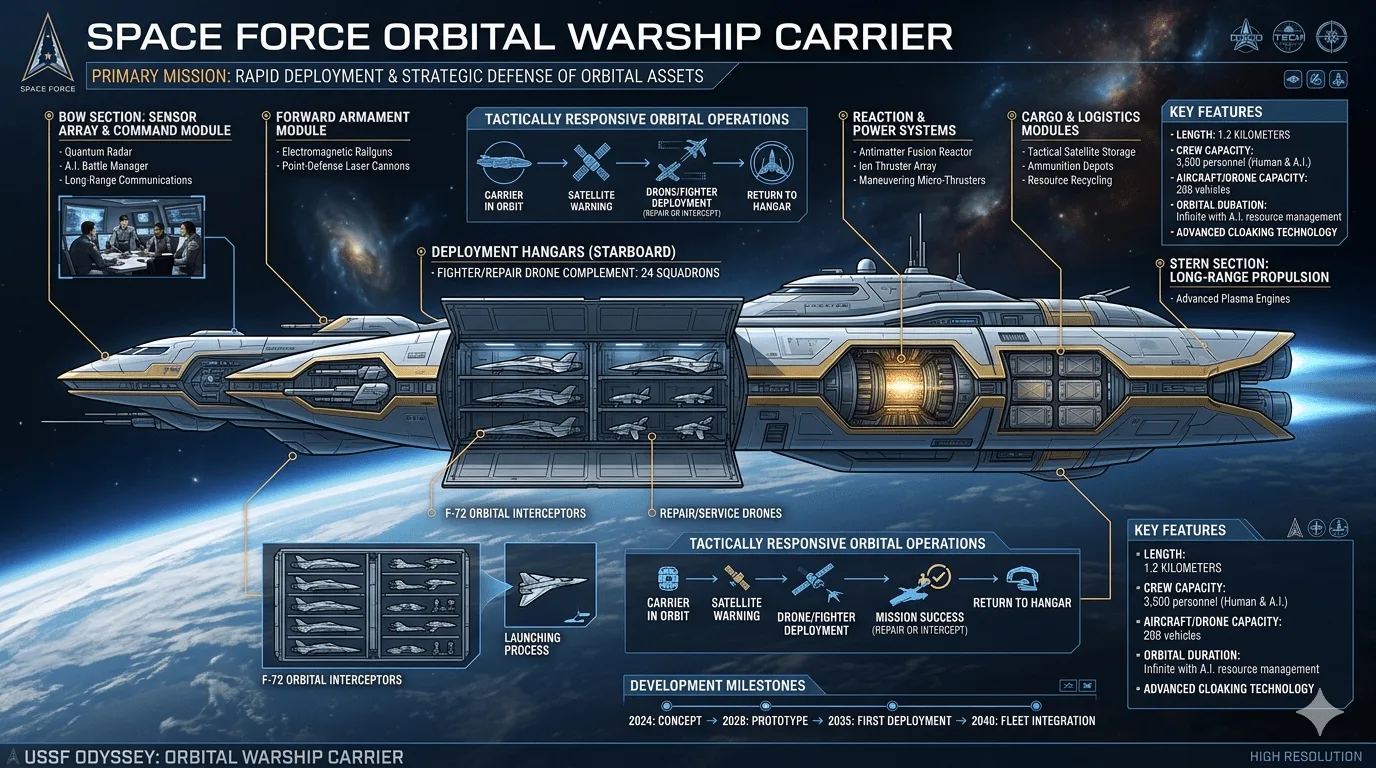
The Amazing Guide to the space force orbital warship carrier
A Bold New Era in Space Defense
Imagine a massive vessel silently gliding through the blackness of space. It carries fighters, weapons, and a highly trained crew ready to protect vital satellites and defend American interests beyond Earth. This is not science fiction. It is the vision behind the space force orbital warship carrier. As space becomes more crowded with satellites and new players, the need for security grows. The United States Space Force is tasked with protecting assets in orbit, and the concept of an orbital carrier offers a way to project power, respond to threats, and ensure that space remains a safe domain for all.
In this article, we will explore what this carrier is, how it might work, and why it matters for everyday people. Whether you are a space enthusiast or just curious about the future, you will walk away with a clear understanding of this groundbreaking idea. Let us dive into the world of orbital defense and see how innovation is shaping the next frontier.
What Is a Space Force Orbital Warship Carrier?
A space force orbital warship carrier is a proposed class of spacecraft designed to serve as a mobile base for defensive and offensive operations in orbit. Think of it like an aircraft carrier, but instead of sailing on the ocean, it orbits Earth. It would carry smaller spacecraft, often called “space drones” or “orbital fighters,” that can be deployed to protect satellites, intercept hostile objects, or conduct surveillance.
The carrier itself would be equipped with advanced sensors, communication arrays, and possibly defensive weapons. Its main job is to provide a persistent, mobile presence in space. Unlike ground-based systems that can only see part of the sky, an orbital carrier can move to where it is needed most. This flexibility makes it a game-changer for space security. The concept is still in early development, but it represents a major shift in how nations think about defending their space assets.
Why the Space Force Needs an Orbital Warship Carrier
The space domain is no longer peaceful and empty. Hundreds of new satellites launch every year, and some nations are developing anti-satellite weapons. Critical infrastructure like GPS, communications, and banking all rely on space. A single attack could disrupt daily life for millions. That is why the Space Force is exploring the space force orbital warship carrier. It provides a way to patrol high-value orbits, deter aggression, and respond quickly if a threat appears. Currently, the U.S. relies mostly on ground-based sensors and stationary satellites.
These are vulnerable because their paths are predictable. A mobile carrier changes the equation. It can hide its movements, reposition to counter threats, and serve as a command post for other space assets. In short, it gives the Space Force something it currently lacks: maneuverability in orbit. For anyone who depends on satellite services—which is nearly everyone—this means greater reliability and security.
Key Capabilities of an Orbital Warship Carrier
Let us break down what this carrier might be able to do. While details remain classified, experts and military documents give us a clear picture of its intended capabilities:
- Mobility and station-keeping: It can change orbit to avoid threats or reposition closer to critical satellites.
- Deployment of small spacecraft: It carries a squadron of smaller vehicles that can inspect, defend, or even repair friendly satellites.
- Situational awareness: Advanced radar and sensors track objects in space, from debris to hostile spacecraft.
- Defensive systems: It may include non-kinetic weapons like jammers or lasers to disable threats without creating dangerous debris.
- Command and control: It acts as a mobile headquarters, coordinating other space assets and relaying data to ground stations.
- Resilience: Built to withstand attacks, with redundant systems and the ability to operate autonomously if communication is lost.
Each of these capabilities contributes to a single goal: ensuring the United States can protect its interests in space without escalating conflicts unnecessarily. The space force orbital warship carrier is designed to be a stabilizer, not a provocateur.
The Technology Behind the Orbital Warship Carrier
Building a space force orbital warship carrier requires technology that pushes the boundaries of engineering. First, propulsion is a major challenge. Traditional chemical rockets are inefficient for frequent orbital changes. Instead, designers are looking at electric propulsion systems that use ion thrusters. These engines are slow but very fuel-efficient, allowing the carrier to shift orbits over days or weeks. Second, power generation is critical. The carrier would need massive solar arrays or possibly a small nuclear reactor to run its sensors, weapons, and life support.
Third, autonomous systems will play a huge role. With communication delays between Earth and space, the carrier must make many decisions on its own. Artificial intelligence will help it navigate, avoid collisions, and prioritize threats. Finally, modular design is key. The carrier should be able to swap out different payloads—like sensors, weapons, or even cargo—depending on the mission. All these pieces are being researched today, and early prototypes may fly within the next decade.
A Detailed Profile and Specifications Table
Comprehensive breakdown of the Space Force Orbital Warship Carrier concept.
| Category | Details |
|---|---|
| Name | Orbital Warship Carrier (Concept Class) |
| Operator | United States Space Force |
| Primary Role | Mobile space defense, threat response, satellite protection |
| Crew Capacity | 8–12 personnel (plus autonomous systems) |
| Length | Approximately 150–200 meters |
| Mass | 20,000–30,000 metric tons |
| Propulsion | Hybrid: chemical boosters + ion thrusters |
| Power Source | Advanced solar arrays with nuclear backup |
| Armament | Directed energy (lasers), electronic warfare suites |
| Carried Craft | 6–12 orbital drones / small space vehicles |
| Sensors | Phased array radar, optical, infrared tracking |
| Orbit | Variable; able to operate in LEO, MEO, and GEO |
| Operational Lifespan | 15–20 years (refuelable and modular) |
| Launch System | Heavy-lift rockets (e.g., Starship, SLS) |
| Development Timeline | 2030s–2040s |
How an Orbital Carrier Compares to Traditional Naval Carriers
Many people ask: is a space force orbital warship carrier just like an aircraft carrier but in space? In some ways yes, but the differences are huge. A naval carrier floats on water, while an orbital carrier must deal with microgravity, radiation, and extreme temperatures. Naval carriers rely on aircraft that use wings and jet engines; orbital carriers would deploy spacecraft that use thrusters and operate in a vacuum.
Another major difference is speed. A naval carrier moves at 30 knots; an orbital carrier travels at 17,500 miles per hour just to stay in orbit. Yet the strategic role is similar: both serve as a mobile base that can project power far from home. Both also act as a deterrent. When an adversary sees a carrier group, they think twice before acting. The same principle applies in space. By having a visible, capable orbital carrier, the Space Force can deter hostile actions before they even begin.
The Role of Autonomous Drones and Support Craft
A space force orbital warship carrier would be nothing without its “air wing” of support craft. These smaller vehicles are sometimes called orbital drones, space interceptors, or service pods. Their jobs vary widely. Some are designed for inspection: they fly close to other satellites to check for damage or suspicious activity. Others are armed with electronic warfare tools that can jam enemy signals or even blind sensors. A few may carry mechanical arms to repair friendly satellites or gently move debris.
The carrier serves as their mothership, providing power, fuel, and data uplinks. When not deployed, these drones are stored in bays inside the carrier. They can be launched quickly when a threat appears. This combination of carrier and drones gives the Space Force a flexible, scalable response capability. Instead of sending a massive ship everywhere, they can deploy just one or two drones to handle a small problem. This saves resources and reduces the risk of escalation.
What Threat Does the Orbital Warship Carrier Address?
The primary threats in space today come from two directions: anti-satellite weapons and irresponsible behavior by other nations. Several countries have tested missiles that can destroy low‑Earth‑orbit satellites. Such tests create thousands of pieces of debris that endanger all spacecraft. Other threats include satellites that maneuver aggressively to shadow or interfere with American assets. A space force orbital warship carrier is designed to counter both.
It can position itself between a hostile satellite and a critical U.S. satellite, acting as a shield. It can also use its sensors to track dangerous debris and warn other spacecraft to move. In the event of an attack, the carrier could use non‑destructive means to disable the aggressor without creating more debris. This approach aligns with the U.S. goal of maintaining a safe and sustainable space environment for everyone. It is about protection, not provocation.
International Reaction and Space Law Considerations
Whenever a new military capability is introduced, the world pays attention. The idea of a space force orbital warship carrier has already sparked discussions among allies and adversaries alike. Some nations worry about an arms race in space. Others see it as a natural evolution of defense. The U.S. emphasizes that its space programs are defensive in nature. International space law, particularly the Outer Space Treaty of 1967, allows for military use of space as long as weapons of mass destruction are not placed in orbit.
The carrier, as envisioned, would comply with that treaty. It would carry only defensive systems and would be used to protect assets, not to initiate conflict. The Space Force is also working with allied nations like the United Kingdom, Australia, and Japan to ensure that space remains a stable domain. Transparency and cooperation will be key to preventing misunderstandings.
The Human Element: Who Will Serve Aboard an Orbital Carrier?
It is easy to focus on technology, but the people inside the space force orbital warship carrier are just as important. These guardians will be among the most highly trained individuals in the world. They will need expertise in space operations, engineering, cybersecurity, and even diplomacy. Life aboard an orbital carrier will be challenging. Crew members will live in close quarters for months at a time, surrounded by the vacuum of space. They will face radiation exposure, psychological stress, and the constant need for vigilance.
Yet many will see this as the ultimate calling. Just as naval aviators dream of carrier landings, space operators dream of serving on the frontier. The Space Force is already developing training programs for orbital warfare. In the coming decades, these guardians will become the pioneers of a new branch of military service, writing the rules for how humanity operates in the high frontier.
Economic Impact and Job Creation
Developing a space force orbital warship carrier is not just a military endeavor; it is an economic engine. Building such a complex system requires thousands of engineers, technicians, and manufacturers. Companies across the United States would contribute components—from propulsion systems to advanced sensors. The program would create high‑paying jobs in aerospace hubs like California, Florida, Colorado, and Alabama. It would also spur innovation in areas like nuclear power, artificial intelligence, and materials science.
These innovations often find their way into civilian life. For example, the miniaturized electronics developed for space eventually end up in smartphones and medical devices. So while the primary goal is defense, the ripple effects benefit the broader economy. For communities near Space Force bases and contractor facilities, the orbital carrier program represents long‑term stability and growth.
The Path Forward: From Concept to Reality
Turning the space force orbital warship carrier from a concept into a real spacecraft will take years of research, testing, and funding. The Space Force is already conducting experiments with small maneuverable satellites. Programs like the X‑37B space plane test autonomous flight and orbital operations. These are stepping stones. Next, we will likely see prototypes of orbital drones that can be refueled and reused. Then, a larger “tender” spacecraft that can service multiple drones.
Finally, a full‑scale carrier. This incremental approach reduces risk and allows engineers to learn from each step. Budgets will need to increase, and Congress must approve long‑term funding. But the strategic importance of space is widely recognized, so support is likely. Within the next 15 to 20 years, we could see the first orbital carrier enter service, forever changing how we think about space defense.
Frequently Asked Questions (FAQs)
1. Does the Space Force already have an orbital warship carrier?
No, it is still a concept. The Space Force is exploring the idea and conducting early experiments, but a fully functional carrier is likely years away.
2. Will the orbital carrier carry nuclear weapons?
No. The Outer Space Treaty prohibits placing weapons of mass destruction in orbit. The carrier would use conventional defensive systems like lasers or electronic warfare.
3. How does this carrier protect everyday people?
It protects the satellites that provide GPS, communications, weather forecasts, and banking services. By ensuring these assets remain safe, it helps maintain the modern way of life.
4. Can other countries build their own orbital carriers?
Several nations are investing in space defense capabilities. The U.S. is not alone in this field, but it is currently the leader in space technology and military space operations.
5. Is space becoming a battlefield?
Space is a shared domain, and tensions are rising. The goal of the orbital carrier is to deter conflict and protect assets, not to start a war. Most nations agree that a peaceful space environment benefits everyone.
6. How can I learn more about the Space Force?
You can visit the official Space Force website, follow their public outreach programs, or read reports from the Department of Defense. Many museums and science centers also feature exhibits on space defense.
Final Thoughts: A Vision for a Secure Space Frontier
The space force orbital warship carrier represents more than just a new piece of hardware. It symbolizes a shift in how humanity approaches the cosmos. Space is no longer a distant frontier; it is a vital part of our daily lives. Protecting it is not optional. The carrier gives us a way to do that with agility, restraint, and strength. It is a tool for stability, not aggression. As we look to the future, we will see more nations operating in space. The choice is between chaos and order. By investing in smart, defensive capabilities, the United States is choosing order.
Whether you are a space enthusiast, a student, or just someone who relies on satellite services, this matters to you. The decisions made today will shape the next century of human exploration. Stay curious, stay informed, and remember that the guardians of the future are already training to keep space safe for all of us.
| Read More Informative Blogs Like This. Tap Here 👉 Misha Ezratti: Personal Life, Career, and Net Worth |